
Wow. Just wow.
I am a bit embarrassed that I have only now just got round to reading what must be one of the most powerful novels written this century. I can completely see why Ishiguro was awarded the Nobel Prize for Literature in 2017. In terms of subtlety, control and lightness of touch this novel ranks with Nabokov at his best.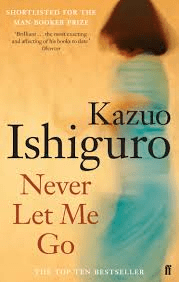
It’s also an extraordinarily difficult book to review without spoilers, and while my approach to spoilers in the past has been robust if not cavalier, here’s where I draw the line – because I can’t tell you (assuming you don’t know already of course) the central idea of this novel without undermining the long slow reveal which is a key part of the narrative structure.
I would hate you to think this all means that this is a ‘difficult’ novel. Part of Ishiguro’s genius is that it is deceptively simple. It is written in the form of the first person memoir by Kathy H, a ‘carer’. She describes a childhood spent at Hailsham, a boarding school somewhere in England. At first Kathy’s memories of school are unremarkable – this could easily be a traditional school story, all hockey sticks and midnight feasts, crushes on teachers and silly games. But the text is carefully sprinkled with suggestions that Hailsham is not your typical boarding school. Although the text opens with a stark sentence “England, 1990s” this is deceptive – and at the same time not, in that apart from the one key difference, this is a remarkably familiar, almost mundane world of bus shelters, offices, cassette tapes and cafes.
This is an incredibly thoughtful meditation on childhood and the mysteries of life. If that sounds pompous then I apologise because it is anything but. If you don’t want spoilers then stop here, because I find I can’t continue without commenting on the treatment of the novel’s major themes. The children at Hailsham and elsewhere are, we eventually discover, clones, bred for their organs, which are slowly harvested from them once they reach maturity. The moment when we find this out is a shocking moment of realisation – all of a sudden the references to caring, donating and ‘completing’ come into focus.
I doubt I am alone in wondering why the clones don’t reject the role in life set out for them as ‘donors’ and rebel, or just run away. The children’s pilgrimage to see a boat washes up on the Norfolk shoreline perhaps hints at their desire to escape their preordained fate. But I came to realise this would be missing the point. When the children are growing up at Hailsham they are gradually introduced to the concept that they will have their organs harvested and then eventually, after two, three or four operations, die. Dying is referred to as “completing”. They grow up understanding this is their fate and are taught not to question it. But don’t we all? We are all told about death, but we are also lied to about it. I don’t often quote the Daily Telegraph, but their reviewer put it really well – ”
‘Gradually, it dawns on the reader that Never Let Me Go is a parable about mortality. The horribly indoctrinated voices of the Hailsham students who tell each other pathetic little stories to ward off the grisly truth about the future – they belong to us; we’ve been told that we’re all going to die, but we’ve not really understood.”
Or as the narrator Kathy puts it
“What I’m not sure about, is if our lives have been so different from the lives of the people we save. We all complete. Maybe none of us really understand what we’ve lived through, or feel we’ve had enough time.”
We do indeed all ‘complete’, and few of us feel we have had enough time.
There’s obviously another perfectly valid reading of this novel which accepts this point – we all die – but goes on to make the point that we don’t all die by having our organs harvested and that society treats some people differently from others. The clones in the novel are treated by their non-clone guardians as little more than soulless meat. Hailsham, we are told, is a progressive school (farm) where the children (clones) are treated humanely, but we are also told that the movement to improve conditions for clones has declined and that they are now treated badly. One can only imagine what that means. This is surely a parable for the way people who we perceive as different, whether by race, gender, disability or religion are treated in some societies, dehumanised, ostracised, and even butchered. Or as Kathy puts it:
Maybe from as early as when you’re five or six, there’s been a whisper going at the back of your head, saying: “One day, maybe not so long from now, you’ll get to know how it feels.” So you’re waiting, even if you don’t quite know it, waiting for the moment when you realise that you really are different to them; that there are people out there, like Madame, who don’t hate you or wish you any harm, but who nevertheless shudder at the very thought of you – of how you were brought into this world and why – and who dread the idea of your hand brushing against theirs. The first time you glimpse yourself through the eyes of a person like that, it’s a cold moment. It’s like walking past a mirror you’ve walked past every day of your life, and suddenly it shows you something else, something troubling and strange.”
I feel I have only scratched the surface of this wonderful, powerful, heartbreaking novel, which I am sure I will return to one day. Like all great books it can only be read for the first time once – after you know Hailsham’s dark secret you can never un-know it – but this is so much more than a mystery novel. As a masterpiece of controlled writing and construction I can’t recall having read anything like it for a very long time.

