Book review

Bartleby the Scrivener, by Herman Melville, 1853

Herman Melville’s ‘Bartleby the Scrivener, A Story of Wall Street‘ tells the curious story of a scrivener – a copyist – who gives up on work and life, responding to all requests for him to do anything with the simple “I would prefer not to“. The narrator, his employer, knows almost nothing about Bartleby – he remains an enigma throughout the story. His reasons for declining specific tasks and then for stopping work altogether are let to the reader to decide.

The story opens with an introduction by the narrator, an elderly New York lawyer. He employs two clerks, Nippers and Turkey, to copy legal documents by hand. Nippers and Turkey are, as their names suggest, comic figures, both with substance abuse issues. The narrator, looking to expand his business, hires Bartleby, partly in the hope that he will moderate the extremes of temperaments of the other two. Initially Bartleby is an exemplary worker, but one day, when asked to help proofread a document, he answers with what soon becomes his catchphrase:

“I would prefer not to”.

Bartleby slowly shuts down, completing less and less work and spending long periods of time staring out one of the window at a brick wall. All attempts to persuade him to do some work or to leave fail, so eventually the narrator himself moves out. The new tenants come to him to ask for help in removing Bartleby, who now sits on the stairs all day and sleeps in the building’s doorway. Finally Bartleby is forcibly removed and imprisoned where he dies of starvation. The story closes with the narrator’s refrain, “Ah Bartleby! Ah humanity!”. (This phrase reminded me of the words of the newscaster at the explosion of the Hindenburg).

This is an enigmatic story, not what I was expecting at all from the author of Moby Dick. It’s an intense psychological piece reflecting on the pointlessness of the human condition that could easily have come from a French existentialist author. It is also a very personal piece – for an author to imagine a character who thinks writing – scrivening – is a pointless, empty activity is in some ways quite shocking. Melville is very much ahead of his time in other ways – Bartleby can be read as a warning of the industrialisation of office work in which people are hemmed into ever smaller cubicles without any personal life outside the office, eating meagre meals at their desk, performing menial repetitive tasks for little reward (Bartleby moves into the lawyers office and never seems to leave).

“Ah, Bartleby, Ah humanity”.

Bartleby is a short story but an immensely impactful and surprising piece that I am very glad to have read – it gives another dimension to one of America’s most significant authors who I had previously only known through Moby Dick.

Standard
Book review

An Occurrence at Owl Creek Bridge, by Ambrose Bierce, 1890

Recently I came across this gem of a post on the ever-wonderful LitHub about the best short stories ever written and it prompted me to guiltily read more of this neglected (by me) genre (although this is a great list, there are some obvious omissions; Ray Bradbury’s A Sound of Thunder is missing for a start. A Sound of Thunder is the “butterfly effect” story in which time-travellers to the age of the dinosaurs inadvertently affect the future.) Most of the stories on this list can easily read in less than an hour and they are usually available for free on the internet.

An Occurrence At Owl Creek Bridge eBook: Ambrose Bierce: Amazon.co.uk:  Kindle Store

I started with An Occurrence at Owl Creek Bridge for reasons of nostalgia. I have a vivid memory of being shown the film adaptation of this story in school one day – I have no idea in what lesson – and to this day it seems a very dark film to show schoolchildren.

An Occurrence is a/the near perfect short story. The title is carefully understated, but we soon learn the nature of the occurrence due to happen on the bridge – a man is to be hung. You probably are familiar with the story and its wonderfully executed (forgive me) twist, but just in case you aren’t I am going to avoid summarising the plot – with the whole story running to only a handful of pages any summary would be largely redundant anyway.

Kurt Vonnegut famously described An Occurrence as “that greatest American short story….a flawless example of American genius“. Without wanting to pick an argument with Mr Vonnegut there’s nothing uniquely American about the story nor its conception. Being just an American story would diminish it. Its universality lies in the use of point of view narration. The reader trusts the story we are being told by the captured (and clearly guilty) plantation owner about to be hung from the bridge because we have been taught to trust narrators. Why would someone about to die mislead us about what happens. His apparent escape from his fate is plausible simply because of the conventional understanding that he must have survived in order to tell his tale.

The narrative emphasises the mundane and everyday nature of what is happening. This is an occurrence, nothing more. A man is about to die, but this is something that in war happens all the time. The setting is just Owl Creek Bridge, an insignificant bridge over an insignificant stream. Everyone involved in the execution is calm and business-like, even the condemned man himself. Everything is ordered and well-prepared.

A man stood upon a railroad bridge in northern Alabama, looking down into the swift water twenty feet below. The man’s hands were behind his back, the wrists bound with a cord. A rope closely encircled his neck. It was attached to a stout cross-timber above his head and the slack fell to the level of his knees. Some loose boards laid upon the ties supporting the rails of the railway supplied a footing for him and his executioners—two private soldiers of the Federal army, directed by a sergeant who in civil life may have been a deputy sheriff. At a short remove upon the same temporary platform was an officer in the uniform of his rank, armed. He was a captain. A sentinel at each end of the bridge stood with his rifle in the position known as “support,” that is to say, vertical in front of the left shoulder, the hammer resting on the forearm thrown straight across the chest—a formal and unnatural position, enforcing an erect carriage of the body. It did not appear to be the duty of these two men to know what was occurring at the center of the bridge; they merely blockaded the two ends of the foot planking that traversed it.

The execution is being carried out with military precision, so it is a shock when, remarkably, an opportunity to escape appears:

All at once, with terrible suddenness, the light about him shot upward with the noise of a loud splash; a frightful roaring was in his ears, and all was cold and dark. The power of thought was restored; he knew that the rope had broken and he had fallen into the stream. There was no additional strangulation; the noose about his neck was already suffocating him and kept the water from his lungs. To die of hanging at the bottom of a river!—the idea seemed to him ludicrous. He opened his eyes in the darkness and saw above him a gleam of light, but how distant, how inaccessible! He was still sinking, for the light became fainter and fainter until it was a mere glimmer. Then it began to grow and brighten, and he knew that he was rising toward the surface—knew it with reluctance, for he was now very comfortable.

An Occurrence is much more than a commentary on war and what men will do for their country. It reminds us that life is short and sweet, and that our perception of time can be strangely distorted in the moment. It also teaches us that narrators and authors can be misleading, and that wishful thinking is a powerful thing. It is also an object lesson in the importance of close and careful reading. If you just engage with this text as an adventure story you will almost certainly miss the clear indications that there is more to this story than the narrator tells us. Bierce wrote about “bad readers—readers who, lacking the habit of analysis, lack also the faculty of discrimination, and take whatever is put before them”. I don’t think there is such a thing as a bad reader, but we can all read more carefully and analytically, not taking at face value what we are told, whether it be a short story, a novel, or the news on our screens, and An Occurrence is an object lesson in why this an important skill.

An Occurrence at Owl Creek Bridge, by Ambrose Bierce, 1890

Aside
Book review

The Fall of the House of Usher, by Edgar Allan Poe, 1837

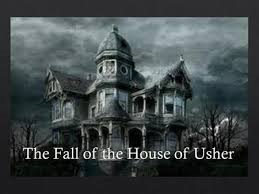
When I finish reading a text I will often consult the internet for some perspective – reviews, commentary, background, etc. My reading about ‘The Fall of the House of Usher‘ was largely un-illuminating – lots of people writing about how wonderful the story is – gothic, macabre, atmospheric are the terms most often used – but no-one able to clearly articulate why. It seems either you ‘get’ Poe or you don’t, and so far I don’t.usher
Here, for example, is some commentary in the journal of the Edgar Allan Poe Society of Baltimore (and let’s not pass too quickly over the fact that there is an Edgar Allan Poe Society of Baltimore) written by someone from the Tennessee Technological University (which sounds a really august centre of learning):

“Many readers consider Edgar Allan Poe’s ‘The Fall of the House of Usher’ to be one of the greatest short stories in all of world literature”.

Do they, really? I can’t find any evidence for that, and none is cited, which for an academic publication is disappointing. The writer continues:

“Few would disagree, at least, that it is one of Poe’s most popular and justifiably famous works.”

If this hyperbole were a one-off then I would be unjustified in quoting it, but that is far from the case – the reviewers on Goodreads, Amazon/com and Amazon.uk are near unanimous that Poe is a genius (which I am sure explains the whole marrying your 13 year old cousin thing) and that his story-telling and prose is outstanding. The editor of the Penguin Classics edition, David Galloway, describes ‘The Fall‘ as “one of Poe’s finest tales ….whose richness and totality of effect entitles it to unquestioned place among the short-fiction masterpieces of all time. Perhaps no other single short story has exerted such profound influences on other artists as Poe’s ‘Germanic’ tale“. Unquestioned place? Not ‘an unquestioned place’ – has the author’s gothic way of expressing himself transferred itself to the editor?

So what is it I am missing? I decided to give ‘The Fall‘ a further look following this research – surely the story has more to offer than I originally thought?

“During the whole of a dull, dark and soundless day in the autumn of the year, when the clouds hung oppressively low in the heavens, I had been passing alone, on horseback, through a singularly dreary tract of country, and at length found myself, as the shades of the evening drew on, within view of the melancholy House of Usher”. 

Poe establishes his themes and techniques as soon as possible – he piles up the adjectives, alliteratively where possible, keeps on adding subordinate clauses one after the other, and is slow to tell the reader what is going on, even though the tale is told in the past tense (or more strictly the pluperfect – “I had been passing alone”). This is almost a prose poem, and makes it quite easy to copy and/or parody. Indeed, so over the top is Poe’s writing that it can easily be read as self-parody.

Poe also establishes early on that the phrase “The House of Usher” means both the family, and their home. Thus the term “fall” used in the story’s title tells us that both the house and the family are to meet their end in the course of the tale. The description of a “fissure, which, extending from the roof of the building in front, made its way down the wall in a zigzag fashion” together with a long description of the decayed fabric of the house, suggests a likely fate for both the house and the family. The additional suggestion a little later that the house has gained a form of sentience from the family, builds even closer links between the two.

Switching to the present tense, to give a more immediate sense to the narrative, the narrator describes his host, Roderick Usher, clearly suffering from a psychological illness of an undefined nature – he is pale and lethargic, suffering from nerves and ‘fear’. His sister, Madeline, has a mysterious sickness that doctors cannot treat. The narrator tries to cheer Roderick up – he listens to him play the guitar, and reads him stories, but without effect.

“I have just spoken of that morbid condition of the auditory nerve which rendered all music intolerable to the sufferer, with the exception of certain effects of stringed instruments. It was, perhaps, the narrow limits to which he thus confined himself upon the guitar which gave birth, in great measure, to the fantastic character of the performances. But the fervid facility of his impromptus could not be so accounted for. They must have been, and were, in the notes, as well as in the words of his wild fantasias (for he not unfrequently accompanied himself with rhymed verbal improvisations), the result of that intense mental collectedness and concentration to which I have previously alluded as observable only in particular moments of the highest artificial excitement. 

It would be ridiculous to hold Poe to any normal standard of coherence or clarity in what is a tale of the supernatural, but his characters’ behaviour is still puzzling. The Lady Madeline passes away from her mysterious illness, and Roderick announces that he plans to inter her body in one of the vaults within the main family house, rather than the nearby burial grounds. The reasons given are, as always, ambiguous and vaguely sinister. The vault is lined with metal walls and a heavy iron door. Our last look at the corpse sees that she has “a faint blush upon the bosom and face, and that suspiciously lingering smile upon the lip which is so terrible in death.”

Any reader versed in the conventions of the gothic will be able to fill in the rest of the narrative without assistance from the author (or reviewer).

I could continue to delve into the depths of this narrative to try and find some additional value, but there comes a point when you just have to accept that certain styles of writing are just not to your taste. If you enjoy overblown, over the top, over-written gothic horror then this will be your cup of tea. But don’t be disappointed if you don’t find it the masterpiece that some believe it to be.

Standard