Book review

The Chrysalids, by John Wyndham, 1955

KEEP PURE THE STOCK OF THE LORD; WATCH THOU FOR THE MUTANT.

What did novelists do for their plots and settings before the Cold War and the possibility of a post-apocalyptic primitive society? Although writers have always speculated about the end of the world, it was only really once the apocalypse became a practical, foreseeable possibility that science fiction kicked into gear and began imagining how the survivors might live.
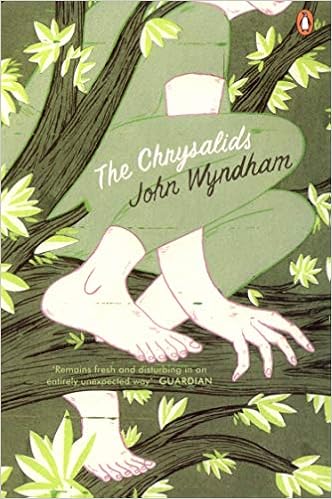
In Wyndham’s post-apocalypse Canada, set many years after “the tribulation” which has destroyed most of humanity and caused serious problems with birth deformities, society is slowly recovering, in part by following a strict system of genetic purity. Their form of fundamentalist Christianity (they wear a cross on the front of all clothing) believes that to avoid another Tribulation they must enforce a rigid definition of normality. This inevitably forces them to practice eugenics in which any minor mutation or difference is considered blasphemous. Aberrant crops are destroyed, babies are euthanized if they display the slightest variation and failed to pass inspection. Other human mutations not apparent at birth are subsequently sterilized and banished.

We learn about this society through the narration of David Strorm, a young man from the rural community of Waknuk. David dreams of cities, planes and horseless carts, but he keeps these dreams secret to avoid suspicion – difference even of the imagination is feared. He befriends Sophie, a girl who hides the fact she has six toes on her feet. Sophie’s mutation is discovered and her family are forced to flee. This is how David and the reader learn how difference is treated in Waknuk. But David has another darker secret – he and other local children are telepaths, able to communicate in thought pictures across distance. They are the Chrysalids of the novel’s title, a new advanced form of humanity, a larval form of something more than homo-sapiens, and therefore taboo in their society.

The group keep their powers hidden with the help of David’s sympathetic uncle, Axel, who goes to the extreme of killing the husband of one of the group’s members who was planning to blackmail them. David’s younger sister Petra develops telepathic powers as she grows, and it becomes clear that these are of a different order from the others – when her horse is attacked by a predator she calls telepathically for help across the entire region, stunning those closest to her. This arouses suspicions. Two members of the group are tortured for information, causing David, his cousin Rosalind and Petra to run for their lives.

The future following a nuclear holocaust was never going to be much fun. Wyndham shows humanity slowly recovering, and exercising genetic purity as a difficult but necessary discipline. Any discussion of eugenics only a decade after the Second World War and the holocaust was always going to be difficult topic, but Wyndham doesn’t blink from the upsetting issues it presents. Good science fiction is about more than just technology, but uses the scenario as a springboard for a discussion of moral and philosophical issues. Here Wyndham uses the tribulation as an allegory for the tensions between change and conservatism in post-war 1950’s Britain and a meditation on difference, both visible and hidden.

Is this a novel for young adults? Definitely. It may not have been written as such, but most teens will enjoy the growing awareness of David’s special abilities, the knowledge that he is not alone, and the exciting pursuit of the young telepaths across a landscape peopled by mutants. The novel’s conclusion however is its weak point. Wyndham wraps things up with a brisk deployment of deus ex machina as a rescue party of scientifically advanced telepathic New Zealanders contacted by Petra arrive in the midst of a battle between the Waknuk settlers and their genetically challenged enemies. It’s not quite a happy-ever-after ending – the New Zealanders are in some ways as brutal eugenicists as the Waknuk fundamentalists. But any doubts about the wisdom of their approach are waved aside as David and friends are whisked away to New Zealand where their technological society is presented as a utopia. This is fundamentally an optimistic novel – nuclear war can be survived, and a better world will emerge despite the forces of reaction.
Standard
1950's post war fiction, 20th century Literature, apocalypse, Book review, cosy catastrophe, John Wyndham, science fiction', The Day of the Triffids

Supplementary: The Day of the Triffids – a closer look at murder/suicide

Yesterday’s post on ‘The Day of the Triffids’ was getting overly long, and I wanted to spend some time looking more closely at the scene below from chapter 5, ‘A Light in the Night’. I think it demonstrates Wyndham’s “less is more” technique. it also provides a further perspective on the question of how to respond to overwhelming tragedy from which there appears no escape.

Bill and Joella have found a flat in which to hide overnight on the first night after the mass-blinding. They have chosen an opulent third floor flat to celebrate what they both think will be their last night of ‘civilised’ living. While Joella is out scavenging for clothes, Bill witnesses the following scene. I have included it in full because I think it merits it:

“As I stepped outside, another door farther down the passage opened. I stopped, and stood still where I was. A young man came out, leading a fair-haired girl by the hand. As she stepped over the threshold he released his grasp.  “Wait just a minute, darling” he said.

He took three or four steps on the silencing carpet. His out-stretched hands found the window which ended the passage. His fingers went straight to the catch and opened it. I had a glimpse of a fire-escape outside. “What are you doing Jimmy?” she asked. “Just making sure” he said, stepping quickly back to her and feeling for her hand again.

“Come along darling”. She hung back. “Jimmy I don’t like leaving here. At least we know where we are in our own flat. “How are we going to feed? How are we going to live? In the flat darling we shan’t feed at all, and therefore not live long. Come along sweetheart don’t be afraid”. “But I am Jimmy, I am”. She clung to him and he put one arm around her.

“We’ll be alright darling, come along”. “But Jimmy that’s the wrong way…” “You’ve got it twisted round dear. It’s the right way”.

“Jimmy, I’m so frightened. Let’s go back”. “It’s too late darling”. By the window he paused. With one hand he felt his position very carefully. Then he put both arms around her., holding her to him. “Too wonderful to last”, he said softly. “I love you my sweet, I love you so very, very much”. She turned her lips up to be kissed. As he lifted her he turned and stepped out of the window…

I found this is a chilling scene. It is mutely observed by the narrator. He makes no attempt to intervene, not a sound. He could have tried to help this loving young couple, but decides to do nothing. Passively he accepts the young man’s judgment that death is the preferable option for the blind. Note by the way that this is clearly a murder/suicide – the young girl is frightened and suspicious (perhaps they have already discussed their options previously).

Bill’s observation is detailed – he watches them carefully. He describes events more in the manner of an omniscient narrator than an observer, without judgment. He glimpses the fire escape outside, hears the fear in the girl’s voice, counts the man’s steps to the window, and notices that he finds the catch easily, rather than fumbling for it. He records their conversation word for word, even the telling repetition of ‘very’ in the final line. The fact that he records this scene in such detail, when he looks away from so many others that must be occurring all around him, suggests he feels it has a particular significance.

Bill has already seen a suicide by jumping earlier in the novel, by a doctor in the hospital; he also has met a man in a pub who goes to join his wife and children in death by gas after getting properly drunk:

“Wha’s good of living blind’s a bat?. . . Thash what my wife said. An’ she was right-only she’s more guts than I have. When she found as the kids was blind too, what did she do? Took ’em into our bed with her an turned on the gas”

Suicide is a rational, sensible, even brave, option in the new world, is the implication.

The scene ends with an ellipsis and a paragraph break. In the next scene no mention is made of what Masen has witnessed – he chooses not to tell the reader (nor Joella) what happens to the couple after this point. A more horrific description would have followed their fall, the screams, the crunch of mangled bodies on pavement, the blood slowly pooling. Wyndham gives us none of this, just those three little dots after the word “window”.

Is this an example of the author protecting the reader from the worst of the apocalypse, making it more cosy? It is interesting that it is Bill only who witnesses this scene – Joella is conveniently out ‘shopping’. Personally I found the scene powerful and effective, and a description of their fall and death would have added little. The reader is left to fill in the gaps with their imagination. But I accept that this narrative approach allows readers to also look away if they choose, to decide not to engage emotionally with the enormity of what is being shown, as Bill effectively does.

Standard
apocalypse, Book review, cosy catastrophe, John Wyndham, science fiction

The Day of the Triffids, by John Wyndham, 1951

The term “cosy catastrophe” was coined by the author Brian Aldiss.

“The essence of cosy catastrophe is that the hero should have a pretty good time (a girl, free suites at the Savoy, automobiles for the taking) while everyone else is dying off.”triffids

Aldiss coined the term to critique John Wyndham’s classic ‘The Day of the Triffids’. I think he was quite wrong, and I am going to use this post to explain why. Continue reading

Standard