Book review

The Ghost Road, by Pat Barker, 1995

I think it would be fair to say that my experience of reading Booker prize winning novels has so far been patchy, to say the least, certainly recently having focussed on some of the earlier winners. Along the way there have been some incredible novels, but also a fair share of stinkers. I am delighted to say that The Ghost Road was very much in the first category. It was outstanding – original, touching, and very well written.

The Ghost Road

The Ghost Road is the third novel in the Regeneration trilogy. I found this out after buying the novel, which put me in a bit of a quandary – do I read the previous two novels or just push ahead with this one on its own? In the end I decided to read this novel first – which I now regret. If it had been a stinker then I could just tick it off the Booker list and move on, but it was such a well-written book that I really think I ought to read the first two in the trilogy. But of course that’s a daft way to read any series of books! So I just have to live with my decision.

Ghost Road follows the continuing adventures of Billie Prior, who in the earlier books had served in the trenches in World War One and been hospitalised suffering from shell-shock. This novel sees his recovery and return to the front. It opens with a scene in which Prior leers at women sun-bathing on the beach (a reference to the Nausicaa chapter in Ulysses?). He is keen to return to France despite being offered the opportunity to serve out the rest of the war in a desk job in the Ministry of Munitions, while at the same time accepting fatalistically that his chances of being killed are high. Prior is a sexually adventurous and ambivalent young man – Barker recounts his numerous encounters graphically without ever being salacious.

The battle scenes in the last days of the Great War are reserved for the final chapters of the book and arrive with huge impact. A futile war becomes even more pointless as the armistice is just days away; readers will be aware of that ticking clock and the imminent death of Prior’s fellow officer, Wilfred Owen. These powerful scenes are hard to read but incredibly well written.

The other main thread of the novel interwoven with the story of Prior’s return to France is told by his former doctor, Rivers. While continuing to care for his patients as the Spanish flu begins to take grip, Rivers recalls his time on an anthropological expedition to the Solomon Islands to study the local culture. This section is based on the work of the real-life character of Dr Rivers. Throughout the novel Barker draws on factual accounts and experiences, but integrates them seamlessly into the narrative to the extent that it is impossible to tell which is fiction and which fact, nor that it really matters. This is one of those novels that sends the reader down a series of internet rabbit-holes as passing references to the executor of Oscar Wilde’s estate for example, or the gay sub-culture of the Edwardian era appear in the narrative. The Solomon islanders culture, dying out due to the imposition of European ‘law and order’, is focused on the capturing of prisoners from local tribes and beheading them. This death cult is implicitly contrasted with the industrialisation of death on the Somme and Passchendaele, and seems almost civilised by comparison.

The First World War is very familiar ground for novelists, but Barker has used this setting with a highly original approach to create a powerful novel. I caught some echoes of Catch 22 in the descriptions of the struggles to capture an insignificant piece of land days before the Armistice. I could have done with more Prior and less Rivers in the overall balance of the novel – I found Billie the more interesting character – a working class officer recovering from shell-shock with an out of control libido and friends with some of the greatest poets of the twentieth century, what’s not to like?

This is a brave and interesting novel and a worthy winner of the 1995 Booker, a self-conscious and stunningly successful attempt to break away from the northern, working class, feminist stereotypes Barker previously found herself constrained by. The novel addresses the profound contradiction of the heart of the Great War – that it was at once terrible and, for some, exciting and worthwhile or rewarding. Barker explained in an interview:

I think the whole British psyche is suffering from the contradiction you see in Sassoon and Wilfred Owen, where the war is both terrible and never to be repeated and at the same time experiences derived from it are given enormous value”.

Prior thinks he is mad to have come back to France, but would equally have been mad not to. The novel’s ending is hard to read after all that has come before, as the attempt to cross the canal is beaten back:

“Prior was about to start across the water with ammunition when he was himself hit, though it didn’t feel like a bullet, more like a blow from something big and hard, a truncheon or a cricket bat, only it knocked him off his feet and he fell, one arm trailing over the canal.

He tried to turn to crawl back beyond the drainage ditches, knowing it was only a matter of time before he was hit again, but the gas was thick here and he couldn’t reach his mask. Banal, simple, repetitive thoughts ran round and round his mind. Balls up. Bloody mad. Oh Christ. There was no pain, more a spreading numbness that left his brain clear. He saw Kirk die. He saw Owen die, his body lifted off the ground by bullets, describing a slow arc in the air as it fell. It seemed to take forever to fall, and Prior’s consciousness fluttered down with it. He gazed at his reflection in the water, which broke and reformed and broke again as bullets hit the surface, and then, gradually, as the numbness spread, he ceased to see it.”

Is this not wonderful, under-stated writing?
Standard
Book review

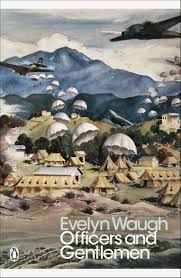
Officers and Gentlemen, by Evelyn Waugh, 1955

Volume 2 in the Sword of Honour trilogy, and sequel to Men At Arms, Officers and Gentlemen sees our hero and Waugh avatar Guy Crouchback returning to London following the debacle at the end of the first novel. Despite the capital suffering from the worst weeks of the Blitz, aristocratic young men try their best to ignore the bombings and continue their social lives – dinner at the club, cocktails, etc – as normally as possible. Guy however is just passing through, on the search for a continuing role in which he can contribute to the war effort. He is also burdened by the responsibility of having to return the possessions of Apthorpe to a fellow officer, Trimmer McTavish.

Officers and Gentlemen (Penguin Modern Classics): Amazon.co.uk: Waugh,  Evelyn: 9780141184678: Books

Guy reports back to his battalion, but nobody expects him nor knows what to do with him. Eventually he is posted to an island in the north of Scotland to join a newly formed commando unit – more to get him out of the way it seems than find him something useful to do. On the Isle of Mugg he finally tracks down McTavish and with relief hands over Apthorpe’s burdensome possessions. Waugh peoples his narrative with absurd but believable caricatures such as the explosives obsessed Laird of Mugg and his Nazi-supporting niece. Trimmer is another example – we find out that he was once a hairdresser using the name ‘Gustave’ working on the Aquitainia where one of his regular customers was Virginia (formerly Guy’s wife).

More shambolic ‘training’ and preparation for combat follows, of a sort very similar to that endured in the first novel. Waugh captures the absurdity of this stage of the war – orders issued and then immediately countermanded, an obsession with who salutes who, petty deference to authority and where administration is more important than military fitness for duty – the unit is profoundly unprepared for combat:

They had no transport, they had no cooks, they had far too many officers and sergeants, they wore a variety of uniforms and followed a multitude of conflicting regimental customs, they bore strange arms, daggers and toggle-ropes and tommy-guns.

Eventually the unit, now dubbed Operation Hookforce, after many false starts sets off Egypt, Back in the UK a morale-boosting commando raid to the occupied Channel Islands surfaces in German-occupied France. The army can’t afford another fiasco so the operation is presented as a success and its senior officer, Trimmer, is feted as a patriotic hero.

This operation presages another more serious military disaster, the evacuation of Crete, Hookforce is sent to help with the campaign, but it is utterly chaotic and the troops are quickly overwhelmed. Guy manages to get out at the very last minute, and awakes in hospital, recovering from sunstroke and a serious case of PTSD. Despite having had a decade or more to reflect on the fact, Waugh is clearly still bemused by the fact that the Allies won the war, given their extraordinary levels of incompetence. It’s no coincidence that in both this novel and Men at Arms people blow themselves up accidentally. Senior officers are obsessive and slightly deranged – Ritchie-Hook decapitates a guard in the earlier novel and in this Major Fido Hound steals his own troops rations, and Ivor Claire deserts his post and is sent to India to avoid the disgrace of a court martial.

Several scenes from Officers and Gentlemen closely follow those of Waugh’s experiences in the Second World War, with a good mixture of creative and comedic licence thrown in: “I have been in a serious battle and have decided I abominate military life,” he wrote to his wife Laura from Egypt in June 1941, after the evacuation of Crete. “It was tedious and futile & fatiguing. I found I was not at all frightened; only very bored and very weary.” This may have been bravado – many men lost their lives in Crete, and many others were taken prisoner, and Waugh was fortunate to escape unscathed. But the novel does reflect the chaotic nature of Waugh’s training and combat experience, even if Guy is a pared-back version of Waugh, more respectful of authority, trying to do the right thing while others around him are panicking or looking after number one.

At times Waugh writes like an old man looking back with bitterness across the years to a long-forgotten, ignominious war. He was only in his early fifties when he published this novel, had experienced huge success with, amongst other works Brideshead Revisited (1945) and had what would generally be described as a ‘good war’. It’s hard to understand quite what made him so embittered. We do know that he was suffering from bromide poisoning when he was writing Officers and Gentlemen, apparently taking it as a cure-all for among other things insomnia. However I don’t think one would be able to diagnose this from the text alone. On reflection I probably should have built more of a break between the first two volumes of the trilogy because close-up they felt very similar in structure and style, and I am not sure I will be able to distinguish between them in a year or two. However I will push on and finish the trilogy with Unconditional Surrender when and if the bookshops finally reopen!

Standard
Book review

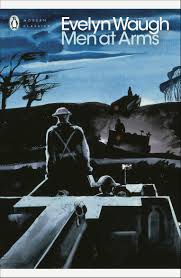
Men at Arms, by Evelyn Waugh, 1952

Men at Arms (not to be confused with the Terry Pratchett Discworld novel of the same name) is the first in Waugh’s Sword of Honour trilogy of novels about his experiences in

Men at Arms (Penguin Modern Classics): Amazon.co.uk: Waugh, Evelyn:  9780141185736: Books

the Second World War. His avatar for the purposes of this semi-autobiographical novel is the urbane Guy Crouchback. Guy is in his mid-thirties, has a failed marriage behind him, and his strict Catholicism means he cannot remarry. Hiding away in the family villa in Italy, Guy is moved to volunteer and join the army on the declaration of war in 1939. Being in his thirties he is considered rather old for active service and his extensive efforts to find a posting come to nothing. Nothing that is until a chance encounter leads to a role as an officer in eccentric and ancient Royal Corps of Halberdiers. In real life Waugh was in the Marines (initially at least) and it is clear that many of the experiences and challenges of army life are drawn from Waugh’s own life. Much of the novel focuses on his desultory training as an officer and the various random postings around the country, while the real events of the war take place off-stage, filtered back to the UK in a slowly descending spiral of bad news. Guy’s fellow officers are a series of fellow eccentrics and outcasts, particularly Apthorpe whose large and burdensome collection of personal possessions follows him around the country and becomes a running joke.

On leave in London during a short break in training Guy bumps into his ex-wife and her second husband Tommy Blackhouse, from whom she is also divorced. This is the kind of novel where characters are constantly bumping into friends and former lovers in unlikely circumstances, always responding in a low-key, fancy meeting you here old chap way. This motif is one of the few stylistic remnants from Waugh’s earlier comic novels where London and life was one big party for the rich and fabulous. As Guy is desperate to produce an heir to the Crouchback name, his brothers having pre-deceased him, he conceives an absurd plan to seduce and impregnate his ex-wife. Despite his efforts to get her drunk and into bed, his clumsy execution of his plan, not to mention the constant interruptions, frustrate him.

Back in training, a new officer, Brigadier Ritchie-Hook, takes command of the halberdiers, and threatens to bring some order to the chaos. While a sense of purpose is introduced the brigade seems no nearer to being combat-ready or to actually going into action, despite the steadily deteriorating position in Europe at the front. At this point in the novel there is an extended comic scene revolving round a chemical toilet, also known as a thunderbox. Quite why they need a chemical toilet when they are billeted in a school building is not explained and probably not relevant. This scene was well done and illustrated the ridiculousness of the modern army, with echoes of earlier, much more light-hearted Waugh. The feud between Apthorpe and Ritchie-Hook over ownership and exclusive access to the toilet culminates in it being sabotaged and destroyed in an explosion. Toilet humour may seem a bit out of place in this stiff-upper-lip novel of army life; the Halberdiers is an ancient brigade governed by a strict and sometimes apparently arbitrary set of rules, rituals, conventions and codes. But it is a welcome comic relief from army routine. These scenes reminded me of some chapters in Spike Milligan’s war memoirs such as Adolf Hitler, my part in his downfall, with which Men at Arms shares some dna – the extended and chaotic time spent preparing for conflict, pointless exercises, long journeys around the country ending up back in the same location, and moments of high farce.

Eventually the brigade sets sail for Dakar in Vichy French Senegal. Waugh was involved in a similar expedition to Senegal, which had a similar outcome. Having travelled all this way it comes as no surprise as the attack is called off. Nevertheless a frustrated Ritchie-Hook organises a clandestine raid on the coast, led by Guy, and returns with the severed head of an African soldier as a grisly trophy. For Ritchie-Hook this is all a gruesome game, another anecdote for when he is eventually decommissioned, but the consequences for Guy (for the unofficial raid, not for the decapitation of the guard) are serious, and he leave Senegal under a cloud. The brigade moves on to Sierra Leone where Apthorpe is hospitalised with an unspecified fever, his end hastened by a well-meaning gift of a bottle of whisky from Guy.

I’ve read quite a lot of Waugh in the past, and I am not sure how I haven’t got round to the Sword of Honour trilogy before. It is markedly different in tone from the dark comedy of his pre-war novels. Men at Arms is much closer to a straightforward memoir, with some exaggeration thrown in for comic effect. It is not a plot driven novel – the narrative meanders along at a relaxed pace. It’s also not really a war novel – the amount of combat involved in very limited and Waugh is in no way a triumphalist (the references to Churchill are pretty unflattering). Guy is something of an anti-hero, even of his own novel – he is determined to do the right thing when his country needs him and fully resigned to the discomforts and danger that military service will involve. But at the same time he tries to seduce his ex-wife, causes the death of a colleague, and the only action he sees is farcically unsuccessful. There is an honesty to this account of the early years of the war, when shambolic defeat follows defeat and only the Channel saves the country from invasion. I am pretty sure I’ll push on and read the other two novels in the trilogy to see how things pan out and try to decide whether I would recommend this to anyone other than Waugh completists or not.

Standard
Book review

Moon Tiger by Penelope Lively, 1987

Penelope Lively won the 1987 Booker Prize for this interesting, eminently readable but ultimately unsatisfying novel. It tells the story of Claudia Hampton, a 76-year-old historian. As Claudia lays dying in hospital she narrates the story of her life in an internal monologue. The narrative is complex, with the point of view changing constantly, and with time and place jumping across the decades and across the continents.

The novel’s title is romantic and mysterious, but the explanation when it comes – a moon tiger is a rather absurd name for an anti-mosquito candle (see picture) which burns slowly through the night – is disappointingly prosaic, involving neither moons nor tigers. The moon tiger is co-opted as a rather heavy handed symbol for the human experience – we all glow brightly and then end up as ashes – but I was still disappointed that something so romantic-sounding could be such an everyday utilitarian object.

Lively creates some vivid characters in this narrative. Claudia’s brother Gordon is for a while her incestuous lover – this is their closely-held for the rest of their lives, but is not portrayed as a damaging or harmful experience.  At the outbreak of the second world war Claudia becomes a war correspondent (as one does) and travels to Cairo, where she meets and begins an intense relationship with Tom Southern, captain of an English armoured tank division. This, we know from the comments of contemporary Claudia looking back on their time together, (although it is narrated in real time) is a doomed war-time affair, and inevitably Tom is killed at El Alamein. 

After the war Claudia meets Jasper, an artistic aristocrat with whom she goes on to have a long-term but sporadic relationship from which she has her only child, Lisa. Lisa is not the free spirit her mother considers herself to be, and their relationship is strained. Later a gay Hungarian student, Lazlo, has a walk-on part in the narrative, although one has the impression that all of life’s events for Claudia after the loss of Tom are an afterthought. This is reinforced by the novel’s finale, when Claudia is sent Tom’s wartime diary which re-emphasises the intensity of his feelings for her. Regret for what might have been her life had he survived is one of her last thoughts before the novel closes.

Despite its innovative structure, this is a very traditional novel. It is a romance, albeit an exceptionally well-written one. There’s nothing wrong with that – Pride and Prejudice is a romance, and it is one of the best novels of all time. But has Moon Tiger got anything interesting to say about human relationships? I’m not sure. Do the characters come alive at all; do they ever go beyond being characters in a novel about whom one never really cares? At one point Claudia reminisces about Lazlo going for a walk in London, and bringing home a nice bunch of flowers, which, it later transpires, he unwittingly picked from a public park. At a dinner party this might be a short, not particularly funny about how foreigners don’t understand English social conventions. But here it is an awkward anecdote, intended to illustrate  Lazlo’s naivety, but never escaping the sense that it is a made-up story intended to play a role in a narrative, rather than something that genuinely happened to someone.

The death-bed format plays a factor here, depriving the narrative of any true surprises. It is probably my failure to engage with the text fully that stopped me caring about Gordon, Lazlo, or Jasper – they felt like background characters in the play of Claudia’s life – and it was only really Claudia and Tom, in the vivid chapters telling the story of their brief moments together, where the story truly felt real. It’s worth reading for that story alone.

Standard
Book review

Put Out More Flags, by Evelyn Waugh, 1942

I re-read Scoop, Black Mischief, and Vile Bodies almost annually, yet somehow I had never got round to reading Waugh’s Put Out More Flags, which features many of the characters established in these earlier novels and could be seen as a sequel. Why that is I have no idea, but I have now rectified the omission.

Image result for Put Out More Flags, by Evelyn Waugh, 1942

Waugh’s sixth novel was written and published in 1942 and as we shall see that date is significant. The plot looks back at the first year of the war and contemplates the strange period in which at first little changed for many people followed quickly by the major upheavals thereafter.

Waugh’s characters are as usual wealthy and upper-class, and the war impacts them in (for them) unexpected ways. Country estates lose their servants. Billeting officers have to find accommodation for evacuees. Basil Seal, the louche ne-er do well of earlier novels struggles to find an army commission or any other constructive role in the war. Ambrose Silk, a gay Jewish intellectual looks elsewhere for a role, ideally in the Ministry of Information. Peter Pastmaster, about to go abroad into combat, decides to marry and father an heir in case he is killed in action.

In my eyes, the novel is less than the sum of its parts. There are admittedly some fascinating character portraits. Ambrose Silk for example is an openly gay character who Waugh treats surprisingly sympathetically. In previous novels he would have been an object of ridicule, but here he is treated as the unhappy victim of his sexual desires:

A pansy. An old queen. A habit of dress, a tone of voice, an elegant, humorous deportment that had been admired and imitated, a swift, epicene felicity of wit, the art of dazzling and confusing those he despised – these had been his; and now they were the current exchange of comedians; there were only a few restaurants, now, which he frequent without fear of ridicule, and there he was surrounded, as though by distorting mirrors, with gross reflections and caricatures of himself.

While Waugh may be tolerant of Silk’s sexuality, society is not. He writes a novel about a former lover, a Brownshirt who is now in a Nazi extermination camp. Basil spitefully engineers a situation where this work is interpreted as pro-German and Silk is forced to flee to Ireland, disguised as a priest. Waugh’s writing directly about a gay character without hiding behind euphemism or suggestion was quite transgressive for its time, showing a progression in his treatment of character.

Put Out More Flags captures a very precise moment in time, starting with the weeks before the war (“days of surmise and apprehension which cannot, without irony, be called the last days of “peace”) followed by the phoney war in which nothing seems to change very much, (“Well, we’re at war now. I expect there’ll be a lot to put up with”) and the final grim realisation that the war is starting in earnest, people are dying, and there’s no going back: “There’s only one serious occupation for a chap now, that’s killing Germans. I have an idea I shall rather enjoy it.”

Waugh’s commentary on these phases of the war is, as you would expect, scathing. His characters speculate that the decadence of the 20’s and 30’s, portrayed in his earlier novels and exemplified by his characters, are what lead Germany to believe we would not put up much resistance:

“You can’t blame Ribbentrop for thinking us decadent when he saw people like Basil about. I don’t suppose they’ll have much use for him in the Army.”

The comic elements of the novel are the outstanding chapters, for example when Basil abuses his sister’s position as local billeting officer, finding homes for evacuee children sent to the country to escape the air raids. He uses three horrible working class children to extort money from country folk who pay him to rehouse them. Incidentally there’s a disturbing hint of incest in these scenes. Doris, precocious oldest sister of the profitable evacuees, notices the incipient attraction between Basil and his sister Barbara:

“He’s your boy, isn’t he?” she said, turning to Barbara.

“He’s my brother, Doris”

“Ah” she said, her pig eyes dark with the wisdom of the slums, “but you fancy him don’t you? I saw”.

Waugh makes no attempt to disguise his class hatred – Doris has ‘pig’ eyes, not ‘pig-like’ eyes. He suggests that her ‘wisdom of the slums’ gives her an insight into the attraction between siblings that has previously always been hinted at but never openly acknowledged. Waugh never returns to this topic, but even to open this door the smallest of cracks must have been shocking to contemporary readers.

Put Out More Flags is in many ways just a series of sketches with the barest of plots. I think it is best seen as a portrait of the period, and as a transition novel between the lightly comic, absurbist novels of the pre-war period and the later, more serious Brideshead Revisited and the Sword of Honour trilogy.

Standard