Book review

Officers and Gentlemen, by Evelyn Waugh, 1955

Volume 2 in the Sword of Honour trilogy, and sequel to Men At Arms, Officers and Gentlemen sees our hero and Waugh avatar Guy Crouchback returning to London following the debacle at the end of the first novel. Despite the capital suffering from the worst weeks of the Blitz, aristocratic young men try their best to ignore the bombings and continue their social lives – dinner at the club, cocktails, etc – as normally as possible. Guy however is just passing through, on the search for a continuing role in which he can contribute to the war effort. He is also burdened by the responsibility of having to return the possessions of Apthorpe to a fellow officer, Trimmer McTavish.
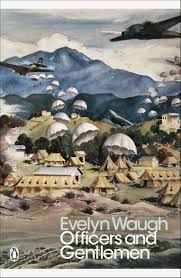
Officers and Gentlemen (Penguin Modern Classics): Amazon.co.uk: Waugh,  Evelyn: 9780141184678: Books

Guy reports back to his battalion, but nobody expects him nor knows what to do with him. Eventually he is posted to an island in the north of Scotland to join a newly formed commando unit – more to get him out of the way it seems than find him something useful to do. On the Isle of Mugg he finally tracks down McTavish and with relief hands over Apthorpe’s burdensome possessions. Waugh peoples his narrative with absurd but believable caricatures such as the explosives obsessed Laird of Mugg and his Nazi-supporting niece. Trimmer is another example – we find out that he was once a hairdresser using the name ‘Gustave’ working on the Aquitainia where one of his regular customers was Virginia (formerly Guy’s wife).

More shambolic ‘training’ and preparation for combat follows, of a sort very similar to that endured in the first novel. Waugh captures the absurdity of this stage of the war – orders issued and then immediately countermanded, an obsession with who salutes who, petty deference to authority and where administration is more important than military fitness for duty – the unit is profoundly unprepared for combat:

They had no transport, they had no cooks, they had far too many officers and sergeants, they wore a variety of uniforms and followed a multitude of conflicting regimental customs, they bore strange arms, daggers and toggle-ropes and tommy-guns.

Eventually the unit, now dubbed Operation Hookforce, after many false starts sets off Egypt, Back in the UK a morale-boosting commando raid to the occupied Channel Islands surfaces in German-occupied France. The army can’t afford another fiasco so the operation is presented as a success and its senior officer, Trimmer, is feted as a patriotic hero.

This operation presages another more serious military disaster, the evacuation of Crete, Hookforce is sent to help with the campaign, but it is utterly chaotic and the troops are quickly overwhelmed. Guy manages to get out at the very last minute, and awakes in hospital, recovering from sunstroke and a serious case of PTSD. Despite having had a decade or more to reflect on the fact, Waugh is clearly still bemused by the fact that the Allies won the war, given their extraordinary levels of incompetence. It’s no coincidence that in both this novel and Men at Arms people blow themselves up accidentally. Senior officers are obsessive and slightly deranged – Ritchie-Hook decapitates a guard in the earlier novel and in this Major Fido Hound steals his own troops rations, and Ivor Claire deserts his post and is sent to India to avoid the disgrace of a court martial.

Several scenes from Officers and Gentlemen closely follow those of Waugh’s experiences in the Second World War, with a good mixture of creative and comedic licence thrown in: “I have been in a serious battle and have decided I abominate military life,” he wrote to his wife Laura from Egypt in June 1941, after the evacuation of Crete. “It was tedious and futile & fatiguing. I found I was not at all frightened; only very bored and very weary.” This may have been bravado – many men lost their lives in Crete, and many others were taken prisoner, and Waugh was fortunate to escape unscathed. But the novel does reflect the chaotic nature of Waugh’s training and combat experience, even if Guy is a pared-back version of Waugh, more respectful of authority, trying to do the right thing while others around him are panicking or looking after number one.

At times Waugh writes like an old man looking back with bitterness across the years to a long-forgotten, ignominious war. He was only in his early fifties when he published this novel, had experienced huge success with, amongst other works Brideshead Revisited (1945) and had what would generally be described as a ‘good war’. It’s hard to understand quite what made him so embittered. We do know that he was suffering from bromide poisoning when he was writing Officers and Gentlemen, apparently taking it as a cure-all for among other things insomnia. However I don’t think one would be able to diagnose this from the text alone. On reflection I probably should have built more of a break between the first two volumes of the trilogy because close-up they felt very similar in structure and style, and I am not sure I will be able to distinguish between them in a year or two. However I will push on and finish the trilogy with Unconditional Surrender when and if the bookshops finally reopen!
Standard
Book review

Men at Arms, by Evelyn Waugh, 1952

Men at Arms (not to be confused with the Terry Pratchett Discworld novel of the same name) is the first in Waugh’s Sword of Honour trilogy of novels about his experiences in

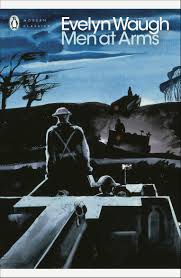
Men at Arms (Penguin Modern Classics): Amazon.co.uk: Waugh, Evelyn:  9780141185736: Books

the Second World War. His avatar for the purposes of this semi-autobiographical novel is the urbane Guy Crouchback. Guy is in his mid-thirties, has a failed marriage behind him, and his strict Catholicism means he cannot remarry. Hiding away in the family villa in Italy, Guy is moved to volunteer and join the army on the declaration of war in 1939. Being in his thirties he is considered rather old for active service and his extensive efforts to find a posting come to nothing. Nothing that is until a chance encounter leads to a role as an officer in eccentric and ancient Royal Corps of Halberdiers. In real life Waugh was in the Marines (initially at least) and it is clear that many of the experiences and challenges of army life are drawn from Waugh’s own life. Much of the novel focuses on his desultory training as an officer and the various random postings around the country, while the real events of the war take place off-stage, filtered back to the UK in a slowly descending spiral of bad news. Guy’s fellow officers are a series of fellow eccentrics and outcasts, particularly Apthorpe whose large and burdensome collection of personal possessions follows him around the country and becomes a running joke.

On leave in London during a short break in training Guy bumps into his ex-wife and her second husband Tommy Blackhouse, from whom she is also divorced. This is the kind of novel where characters are constantly bumping into friends and former lovers in unlikely circumstances, always responding in a low-key, fancy meeting you here old chap way. This motif is one of the few stylistic remnants from Waugh’s earlier comic novels where London and life was one big party for the rich and fabulous. As Guy is desperate to produce an heir to the Crouchback name, his brothers having pre-deceased him, he conceives an absurd plan to seduce and impregnate his ex-wife. Despite his efforts to get her drunk and into bed, his clumsy execution of his plan, not to mention the constant interruptions, frustrate him.

Back in training, a new officer, Brigadier Ritchie-Hook, takes command of the halberdiers, and threatens to bring some order to the chaos. While a sense of purpose is introduced the brigade seems no nearer to being combat-ready or to actually going into action, despite the steadily deteriorating position in Europe at the front. At this point in the novel there is an extended comic scene revolving round a chemical toilet, also known as a thunderbox. Quite why they need a chemical toilet when they are billeted in a school building is not explained and probably not relevant. This scene was well done and illustrated the ridiculousness of the modern army, with echoes of earlier, much more light-hearted Waugh. The feud between Apthorpe and Ritchie-Hook over ownership and exclusive access to the toilet culminates in it being sabotaged and destroyed in an explosion. Toilet humour may seem a bit out of place in this stiff-upper-lip novel of army life; the Halberdiers is an ancient brigade governed by a strict and sometimes apparently arbitrary set of rules, rituals, conventions and codes. But it is a welcome comic relief from army routine. These scenes reminded me of some chapters in Spike Milligan’s war memoirs such as Adolf Hitler, my part in his downfall, with which Men at Arms shares some dna – the extended and chaotic time spent preparing for conflict, pointless exercises, long journeys around the country ending up back in the same location, and moments of high farce.

Eventually the brigade sets sail for Dakar in Vichy French Senegal. Waugh was involved in a similar expedition to Senegal, which had a similar outcome. Having travelled all this way it comes as no surprise as the attack is called off. Nevertheless a frustrated Ritchie-Hook organises a clandestine raid on the coast, led by Guy, and returns with the severed head of an African soldier as a grisly trophy. For Ritchie-Hook this is all a gruesome game, another anecdote for when he is eventually decommissioned, but the consequences for Guy (for the unofficial raid, not for the decapitation of the guard) are serious, and he leave Senegal under a cloud. The brigade moves on to Sierra Leone where Apthorpe is hospitalised with an unspecified fever, his end hastened by a well-meaning gift of a bottle of whisky from Guy.

I’ve read quite a lot of Waugh in the past, and I am not sure how I haven’t got round to the Sword of Honour trilogy before. It is markedly different in tone from the dark comedy of his pre-war novels. Men at Arms is much closer to a straightforward memoir, with some exaggeration thrown in for comic effect. It is not a plot driven novel – the narrative meanders along at a relaxed pace. It’s also not really a war novel – the amount of combat involved in very limited and Waugh is in no way a triumphalist (the references to Churchill are pretty unflattering). Guy is something of an anti-hero, even of his own novel – he is determined to do the right thing when his country needs him and fully resigned to the discomforts and danger that military service will involve. But at the same time he tries to seduce his ex-wife, causes the death of a colleague, and the only action he sees is farcically unsuccessful. There is an honesty to this account of the early years of the war, when shambolic defeat follows defeat and only the Channel saves the country from invasion. I am pretty sure I’ll push on and read the other two novels in the trilogy to see how things pan out and try to decide whether I would recommend this to anyone other than Waugh completists or not.

Standard