
Volume 2 in the Sword of Honour trilogy, and sequel to Men At Arms, Officers and Gentlemen sees our hero and Waugh avatar Guy Crouchback returning to London following the debacle at the end of the first novel. Despite the capital suffering from the worst weeks of the Blitz, aristocratic young men try their best to ignore the bombings and continue their social lives – dinner at the club, cocktails, etc – as normally as possible. Guy however is just passing through, on the search for a continuing role in which he can contribute to the war effort. He is also burdened by the responsibility of having to return the possessions of Apthorpe to a fellow officer, Trimmer McTavish.
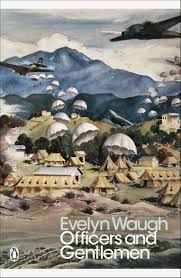
Guy reports back to his battalion, but nobody expects him nor knows what to do with him. Eventually he is posted to an island in the north of Scotland to join a newly formed commando unit – more to get him out of the way it seems than find him something useful to do. On the Isle of Mugg he finally tracks down McTavish and with relief hands over Apthorpe’s burdensome possessions. Waugh peoples his narrative with absurd but believable caricatures such as the explosives obsessed Laird of Mugg and his Nazi-supporting niece. Trimmer is another example – we find out that he was once a hairdresser using the name ‘Gustave’ working on the Aquitainia where one of his regular customers was Virginia (formerly Guy’s wife).
More shambolic ‘training’ and preparation for combat follows, of a sort very similar to that endured in the first novel. Waugh captures the absurdity of this stage of the war – orders issued and then immediately countermanded, an obsession with who salutes who, petty deference to authority and where administration is more important than military fitness for duty – the unit is profoundly unprepared for combat:
They had no transport, they had no cooks, they had far too many officers and sergeants, they wore a variety of uniforms and followed a multitude of conflicting regimental customs, they bore strange arms, daggers and toggle-ropes and tommy-guns.
Eventually the unit, now dubbed Operation Hookforce, after many false starts sets off Egypt, Back in the UK a morale-boosting commando raid to the occupied Channel Islands surfaces in German-occupied France. The army can’t afford another fiasco so the operation is presented as a success and its senior officer, Trimmer, is feted as a patriotic hero.
This operation presages another more serious military disaster, the evacuation of Crete, Hookforce is sent to help with the campaign, but it is utterly chaotic and the troops are quickly overwhelmed. Guy manages to get out at the very last minute, and awakes in hospital, recovering from sunstroke and a serious case of PTSD. Despite having had a decade or more to reflect on the fact, Waugh is clearly still bemused by the fact that the Allies won the war, given their extraordinary levels of incompetence. It’s no coincidence that in both this novel and Men at Arms people blow themselves up accidentally. Senior officers are obsessive and slightly deranged – Ritchie-Hook decapitates a guard in the earlier novel and in this Major Fido Hound steals his own troops rations, and Ivor Claire deserts his post and is sent to India to avoid the disgrace of a court martial.
Several scenes from Officers and Gentlemen closely follow those of Waugh’s experiences in the Second World War, with a good mixture of creative and comedic licence thrown in: “I have been in a serious battle and have decided I abominate military life,” he wrote to his wife Laura from Egypt in June 1941, after the evacuation of Crete. “It was tedious and futile & fatiguing. I found I was not at all frightened; only very bored and very weary.” This may have been bravado – many men lost their lives in Crete, and many others were taken prisoner, and Waugh was fortunate to escape unscathed. But the novel does reflect the chaotic nature of Waugh’s training and combat experience, even if Guy is a pared-back version of Waugh, more respectful of authority, trying to do the right thing while others around him are panicking or looking after number one.
At times Waugh writes like an old man looking back with bitterness across the years to a long-forgotten, ignominious war. He was only in his early fifties when he published this novel, had experienced huge success with, amongst other works Brideshead Revisited (1945) and had what would generally be described as a ‘good war’. It’s hard to understand quite what made him so embittered. We do know that he was suffering from bromide poisoning when he was writing Officers and Gentlemen, apparently taking it as a cure-all for among other things insomnia. However I don’t think one would be able to diagnose this from the text alone. On reflection I probably should have built more of a break between the first two volumes of the trilogy because close-up they felt very similar in structure and style, and I am not sure I will be able to distinguish between them in a year or two. However I will push on and finish the trilogy with Unconditional Surrender when and if the bookshops finally reopen!

