
I am sure there are exceptions, but most great novels have great opening lines. “It was the best of times”, “All happy families”, “It was a bright cold morning” and so on. Anita Brookner by contrast chose to open Hotel du Lac with the following:
“From the window all that could be seen was a receding area of grey.”
Which won’t be going into any collections of great opening lines any time soon. This self-consciously down-beat opening sets the tone of the novel – this is going to be a mono-chromatic sketch where the reader is going to have to do a lot of the work.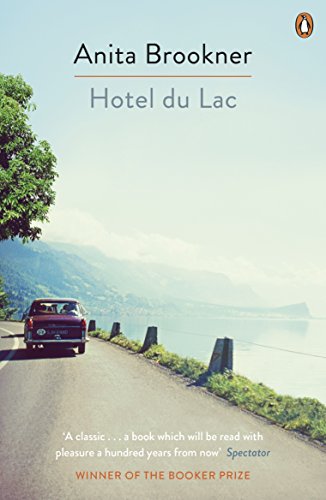
Edith Hope, author of romantic novels such as Beneath the Visiting Moon and The Stone and the Star, has fled from London to the Hotel du Lac in disgrace. Initially we are not told the reasons for this flight – some sort of scandal is hinted at. It emerges she has been having an affair with a married man, to whom she pens forlorn love-letters. We are initially led to believe that this is the cause of her exile, although it later emerges that it is her decision to leave her groom (another man entirely, naturally) at the altar that has outraged her friends and led to her banishment. Why deciding not to go through with an ill-advised wedding is considered such a cause of outrage is never made clear.
The hotel is a suitable location for Edith’s contemplation of her future:“
“The Hotel du Lac was a dignified building, a house of repute, a traditional establishment, used to welcoming the prudent, the well-to-do, the retired, the self-effacing, the respected patrons of an earlier era.”
“As far as guests were concerned, it (the hotel) took a perverse pride in its very absence of attractions, so that any visitor mildly looking for a room would be puzzled and deflected by the sparseness of the terrace, the muted hush of the lobby … There was no sauna, no hairdresser and certainly no glass cases displaying items of jewellery; the bar was small and dark and its austerity did not encourage people to linger.”
The portraits of the other guests at the hotel provide Edith with illustrations of the choices before her (and, we might reasonably extrapolate, many women in her position) as she considers her next steps. They are all lonely in their different ways. There is the overbearing widow Mrs Pusey, who has made a vocation out of shopping, so empty is her life; her devoted daughter Jennifer, secretly far less docile than her mother believes her to be (the novel hints at sexual liaisons between Jennifer and Alain, the hotel’s waiter, and later Mr Neville); Mme de Bonneuil, who lives in isolation at the hotel, expelled from her chateau, now inhabited by her son and his wife, and Monica, living alone the hotel on the instructions of her husband to fix her “eating disorder” and become fertile enough to bear him an heir.
“She (Monica) hates and fears her husband, but only because he has not protected her, and she sees herself condemned to loneliness and exile. In this she is prescient. I see her, some years hence, a remittance woman, paid to live abroad, in such an hotel, in various Hotels du Lac, her beautiful face grown gaunt and scornful, her dog permanently under her arm. ”
Edith also has a friend back in London, Penelope – “a handsome woman of forty-five and would remain so for many years” (one of the novel’s better lines).
“To Penelope, men were conquests, attributes, but they were also enemies; they belonged to the species that must never be granted more than the amount of time and attention she considered they deserved.”
The boorish Mr Neville presents Edith with a final choice: a marriage without love or respect, No matter that he has only known her for a matter of days. Neville is looking for a “safe” wife who will maintain his home and offers to turn a blind eye to any lovers she might take. Possibly the absurdity of this proposal is intentional, although Edith seems close to accepting despite her disastrous engagement itself only weeks earlier.
There is something quite circular about romantic novels about romantic novelists. At several points it is not clear whether Brookner is writing about her character, or about the novel itself. When Mr Neville, in an extraordinarily clumsy attempt at seduction, insults her, Edith
“to contain her anger…tried various distancing procedures..the most productive of which was to convert the incident into a scene from one of her novels”.
In her sad letters to her silent lover Edith adopts the role of narrator of the novel, recounting various scenes of minimal activity by the other guests (indeed this is a novel where so very little happens other than walks being taken and coffee drunk that we might almost be in a Virginia Woolf novel, whom we are constantly told Edith looks like). Later Edith consoles herself with the thought that
“Fiction, the time-honoured resource of the ill-at-ease, would have to come to her aid.”
Is this what we are reading – simply an act of consolation, a distraction for the ill-at-ease? Intended or not I can’t think of a way in which Brookner could have more clearly reminded the reader that this is just a novel, her characters are not real, and all this never really happened, something that other novelists are at pains to conceal. This is not some Brechtian ultra-realistic narrative however, but a story about a woman thinking about her life.
The tone and pace of the novel are consistently grey and slow, but there was one scene towards the end of the novel which jarred acutely. Mr Neville is proposing marriage to Edith. He is essentially a well-groomed thug, and manages to insult her throughout the proposal. (If this is intended to remind readers of the clumsy first proposal in Pride and Prejudice, it doesn’t). Upset, Edith starts to weep, and his response is startling:
“Edith, said Mr Neville. Please don’t cry. I cannot bear to see a woman cry; it makes me want to hit her. “
If that wasn’t bad enough, and it is, a few moments later, while she sobs on his shoulder, he muses:
“You are very thin…I am afraid that I might break you in half”.
It is possible Brookner did not intend the threat of sexual violence explicit in this line, but it is hard to imagine otherwise. Most women would I suspect want to get as far away as possible from this man, but Edith meekly accepts his proposal.
Brookner is not a bad novelist. Her use of language is controlled and precise. The Penguin edition of the novel mentions that Brookner “is the author of 24 novels, many of which are available in Penguin” – that “many” is quite poignant. It is however a puzzle why this novel was considered the best written or published in 1984. It’s not the first unusual decision by the Booker panel, but it is one of the strangest.

