
It has been a long time since I have read any science fiction, but while browsing in my local library, The Futurological Congress, a black humour science fiction novel by Polish author Stanisław Lem, caught my eye. I’ve long been interested in dystopian novels – 1984, Brave New World, etc – and I wondered what the future looked like in the early 1970’s, when 2026 seemed an impossibly long way away. It wasn’t a surprise that like most novels of its kind, some aspects of the future are captured with eerie precision and others are wildly wrong. Which always makes me wonder which of the technological innovations we think are inevitable – the rise of AI, self-driving cars, etc – will actually happen, and instead what undreamt of changes will occur in our future?
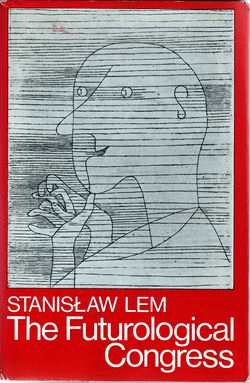
In The Futurological Congress, Lem’s protagonist, Ijon Tichy, attends the Eighth World Futurological Congress in Costa Rica. The novel is set in an indeterminate future (but not too far ahead, because a later time jump takes Tichy to 2039). The conference is being held to consider the world’s population crisis. Futurologists predict the future from existing trends – and at this point in humanity’s story all predictions for the future of the world are bleak.
Lem’s description of this future is at first dominated by absurdity. Tichy’s hotel room is ‘guaranteed bomb-free’ and includes a palm grove and an orchestra. Conference papers are distributed in hard copy (paper always seems very resilient when people thought about the future of business or education) but speakers call out paragraph numbers to save time. The hotel’s water supply is drugged with a chemical that makes the user profoundly good-natured.
Shortly after the start of the congress, the hotel it is being held at comes under attack by protestors. After an attempt to ignore the bombs Tichy and some other attendees and hotel staff take cover in a sewer beneath the hotel. From here he is evacuated only to realise he is still hallucinating. The next rescue attempt ends with the helicopter taking him away crashing. He wakes up in a hospital to find his brain has been transplanted into the body of a young black woman. This then happens all over again – waking up from a hallucination, attack by mysterious forces, rescue and body transplant – which would I suspect make most people wonder about the nature of reality they are experiencing, but Tichy seems accustomed to a world in which bizarre things happen as a matter of course. Finally, in yet another hospital, he is cryogenically frozen (cryonics was just becoming a ‘thing’ in the US in the late 60’s) and wakes up (in scenes familiar from Austin Powers, Futurama and Sleeper – take your pick) in the year 2039.
When the novel jumps forward to 2039, the tone switches dramatically from being a freewheeling comedy to a rather bleak dystopia. From this point the novel is written in the format of a journal. Initially, 2039 (presumably 2039 Costa Rica?) seems utopian. Everyone is happy, all society’s ills have been cured, war is no more, and everything is abundant. Drugs are used to control everyone’s perception of reality and can do just about anything:
“The most recent of the iamides, heavily advertised – authentium. Creates synthetic recollections of things that never happened. A few grams of dantine, for instance, and a man goes around with a deep conviction that he has written The Divine Comedy. Why anyone would want that is another matter and quite beyond me.”
But slowly Tichy becomes disillusioned with this chemically enhanced ‘paradise’. He stops taking any drugs but doesn’t realise that the air itself is suffused with perception-altering chemicals. Finally his friend, Professor Trottelreiner, tells him a terrible secret:
“By introducing properly prepared mascons (reality-masking chemicals) to the brain, one can mask any object in the outside world behind a fictitious image—superimposed—and with such dexterity, that the psychemasconated subject cannot tell which of his perceptions have been altered, and which have not. If but for a single instant you could see this world of ours the way it really is — undoctored, unadulterated, uncensored — you would drop in your tracks!”
A small dose of an unmasking drug allows Tichy to see the world as it really is: instead of being in a five-star restaurant he is in a dank concrete bunker eating “the most unappetizing gray-brown gruel, which stuck in globs to my tin“. No-one drives a car – they run in the road believing they are doing so, and instead of travelling up and down in lifts they climb the empty elevator shafts. Everyone lives in abject squalor eating horrible muck, all the time believing they are living in luxury. The world is being destroyed by over-population – the very problem that the original Futurological Congress was intending to address. Only a small number of soothseers know the real state of the world. This is Tichy’s red pill moment – the terrifying realisation that the world is actually squalid and disgusting. When finally he is returned to his original time, hiding in the sewers from the bombers attacking the conference, we are left in doubt as to whether this is a return to reality or yet another chemically induced nightmare.
As well as its bleak portrait of the future, the other predominant feature of The Futurological Congress is its experimental use of language. I can imagine that translating the text from Polish to English must have been challenging to say the least, and many of the words must surely be approximations, given that Lem made many of them up in the first place. Take a paragraph like this for example:
In just the last issue of Science Today there had been an article on some new psychotropic agents of the group of so-called benignimizers (the N,N-dimethylpeptocryptomides), which induced states of undirected joy and beatitude. Yes, yes! I could practically see that article now. Hedonidil, Euphoril, Inebrium, Felicitine, Empathan, Ecstasine, Halcyonal and a whole spate of derivatives. Though by replacing an amino group with a hydroxyl, you obtained instead Furiol, Antagonil, Rabiditine, Sadistizine, Dementium, Flagellan, Juggernol and many other polyparanoidal stimulants of the group of so-called phrensobarbs (for these prompted the most vicious behavior, the lashing out at objects animate as well as inanimate—and especially powerful here were the cannibal-cannabinols and manicomimetics).
In the 1970s Poland was still part of the Soviet bloc. The Futurological Congress is (at least in part) a commentary on the communist state that told its citizens they were living in a socialist utopia, but where their actual experience of life was of hardship and want. In 1984 George Orwell makes a similar point – in that novel, instead of chemicals, the state uses terror to force its citizens to believed that rations are being increased even as they are cut. Perhaps Lem was telling us to wake up and take over-population seriously, and not put our faith in political ideologies?
 The Reading Bug