
The 4.50 from Paddington by Agatha Christie, 1957
I’ve always felt very slightly guilty at never having read anything by Agatha Christie. TheTuesday Murder Club stories assuaged this a little, although I would never had read them were it not for the association with Richard Osman. The 4.50 from Paddington was a very late attempt to address this shortcoming. It features one of the author’s recurring detective characters, Miss Marple. Overall I think it is quite seriously flawed. The murder mystery element of the story depends on some utterly bizarre behaviour by the protagonist. There are a series of other serious structural flaws, but these could be forgiven if the murderer had not seemed desperately to do everything he possibly could to be caught. Obviously there is no way I can make this point without extensively spoiling the book for you, so if you ever intend to read this please turn away now.
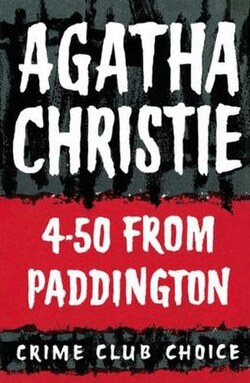
The novel opens as a traditional ‘murder on a train’ puzzle. Mrs McGillicuddy, a friend of Miss Marple, is travelling by train when her carriage passes another train going in the same direction. When the trains are stopped next to each other she sees a woman being strangled. This was obviously a very strange time to choose to strangle someone. She is convinced this is a case of murder. She reports the attack, but the police are unable to find a body or any other evidence.
Miss Marple decides to investigate, of course. By some analysis of train timetables that was quite dull she works out that the body was probably thrown from the train into the grounds of Rutherford Hall, a stately home just outside Brackhampton. She asks her friend Lucy Eyelesbarrow, to help her investigate by taking a job at the hall as a housekeeper. Lucy is a promising character, but I could not move past the fact that Christie asks us to accept that despite her having a First in Mathematics from Oxford she decides to become a housekeeper. A well paid housekeeper, but a domestic servant nonetheless. I can see Lucy serves a useful role in the novel – she is bright and observant, and acts as Miss Marple’s eyes and ears on the ground within the Hall (a more conventional approach would have been for Miss Marple to have somehow get herself invited to stay with the family) but this is still a deeply implausible career choice for a first class mathematician, and is profoundly old-fashioned. Is this really the optimum career choice for a bright young woman in the 1950s? One character observes of Lucy “She scares the life out of me, she’s so devastatingly efficient. No man would ever dare marry that girl”. Sadly, Christie abandoned the character after this novel, and she never reappears.
We are then introduced to the inhabitants of Rutherford Hall: the cranky patriarch Luther Crackenthorpe, his unmarried daughter, Emma. and his sons Cedric, a painter; Harold, a businessman, and Alfred, occupation undetermined. His older daughter Edith died four years before the novel begins, and her husband Bryan and son Alex are part of the extended family. Another son died in the second world war. Local doctor, Dr Quimper frequently comes to the hall to see to Luther and is ‘close friends’ with Emma. These characters are paraded before the reader several times, and it is quite obvious that this is a list of suspects from whom we are being invited to select the killer.
Lucy uses her free time to search the hall’s grounds, and quickly finds the body hidden in a stone sarcophagus in a barn. Having a stone Greco-Roman sarcophagus lying around in one’s barn is typical eccentric aristocratic behaviour, nor worthy of further comment. The police are of course contacted, and resume their investigation into the original murder, led by Inspector Craddock of the Yard (When did local police forces start investigating murders in their area instead of calling in Scotland Yard?) The police conclude that the body is either that of a dancer, Anna Stravinska, who had gone missing from a ballet troupe, or a French woman called Martine. Martine may have married the eldest brother who died in the war – Emma reveals that she received a letter a few weeks before the woman’s body was found, claiming that she had married Edmund just before he died. The police speculate that Martine may have been murdered by one of the Crackenthorpe family to prevent her making a claim on Luther’s estate. However the ‘Martine’ theory doesn’t last long – a neighbour, Lady Stoddart-West reveals that she is Martine, Edmund’s former fiancee. She explains that Edmund died before they could be married, and since she married another man soon after the war, she had resolved not to bring up the painful past by telling the Crackenthorpes about their connection. Even the author has to accept that this is profoundly improbable – a woman forms a relationship with a British soldier who is killed in action, only to subsequently years later marry another soldier who just happens to be a near neighbour of the first. But this revelation leaves the identity of the body in the sarcophagus/the woman on the train a mystery.
Things then take a turn for the worse when the entire household is poisoned and Alfred dies. Dr Quimper diagnoses arsenic poisoning. Harold then receives a delivery of poisoned tablets from Dr Quimper and he dies. One would have thought that the focus of suspicion would fall on the doctor at this point – not only has he provided Harold with poisoned tablets, but in his role as a GP he would have ready access to arsenic and other poisons. But no, the focus is mysteriously elsewhere. In the novel’s denouement Miss Marple arranges for Mrs McGillicuddy to see Dr Quimper in a pose similar to that she saw the murder, by pretending to choke. Dr Quimper helps here, and as he does so Mrs McGillicuddy enters the room, sees the doctor against the window with his hands at Miss Marple’s throat, and cries out, “But that’s him – that’s the man on the train!” Miss Marple then wraps the case up in a few paragraphs. Her explanation is that the dead woman was Quimper’s wife, who would not divorce him due to being Catholic. He killed her to be free to marry Emma, and then murdered Harold and Alfred to increase Emma’s share of any inheritance.
I don’t know if many readers would finish this novel and conclude that the explanation given makes sense. Certainly we are asked to accept many leaps of faith: that the Doctor would murder his wife on a moving train while visible from a passing train just five minutes out from the destination; that he would (somehow) throw her body out of the train onto an embankment, arrive later that day to collect it from where it landed, carry it (again, somehow) through the estate to the barn, and leave it there, all the time unseen and uninterrupted; that while a police investigation is underway, he decides to murder some of the other family members in order to increase the proportion of the family inheritance he will receive, when Luther dies, and if he can successfully woo Emma. And so on. The absurdities pile up. The doctor takes fantastical risks for little reward, when far more straightforward options are before him.
The whole novel had an anachronistic feel – although written in the 50’s and seemingly set then, it really is an old-fashioned Edwardian country house murder story, uncomfortably superimposed onto a murder on a train story. That explains why the Doctor kills Harold and Alfred when he does, despite the heavy police presence in the immediate vicinity – the tradition of the country house murder story demands more murders. Miss Marple is here a peripheral character, wheeled out to resolve the mystery in the final pages simply by deciding what has happened rather than by any process of deduction or the use of evidence. Without Mrs McGillicuddy’s identification of the Doctor on the basis of what he looks like from behind – a defence barrister would have fun with that – there is no other evidence of him having committed any crime. Miss Marple makes a strange comment right at the end of the novel, having delivered her speech to the assembled family on how she ‘solved’ the murder:
“I am really very, very sorry that they have abolished capital punishment, because I do feel that if there is anyone who ought to hang it is Dr Quimper”.
Capital punishment in the UK had not been abolished in 1957 and people were still being killed by the state well into the 1960’s. Perhaps this was just Christie’s comment on the campaign for the abolition of capital punishment which was obviously gaining momentum at this point. But I think she was getting ahead of herself – she would have to get a conviction first.
On a more positive note, one has to give the Doctor credit for his cunning plan to misdirect the investigation by suggesting that the victim was Martine, laying a paper trail away from his ex-wife, only for that plan to be foiled by the stunning coincidence of the real Martine being alive and well and living in the neighbourhood. Also, Lucy is a promising character who ably fills the absence of Miss Marple, even if she is the world’s most unlikely housekeeper. But overall this felt like an author well past her prime using some of her ‘greatest hits’ material to keep her publishers happy. Which means I have missed the mark in looking for Christie at her best, and need to keep looking.


A lot of her novels don’t stand up to scrutiny in terms of plausibility.
LikeLiked by 1 person