Book review

“People change,’ she said
‘Oh, no they don’t. Look at me. I’ve never changed. It’s like those sticks of rock: bite it all the way down, you’ll still read Brighton. That’s human nature.”

Greene’s 1938 novel of gang warfare in Brighton pulls off a rare achievement – it is at

Brighton Rock By Graham Greene

once both an adventure story and a serious mediation on good and evil. I was blown away by it; not necessarily by the plot (the ending is largely predictable) but by the quality of the prose. Greene’s control of language is masterful throughout, and virtually every sentence is a gem.

Charles Hale comes to Brighton to distribute cards for a newspaper competition. Hale has somehow underestimated the antipathy felt for him by a local gang, a mistake he quickly comes to regret. The novel tells the reader as much with the ominous opening line:

“Hale knew, before he had been in Brighton three hours, that they meant to murder him”.

To avoid being isolated by the gang who begin tracking him through the crowds of day-trippers, Fred picks up Ida Arnold, visiting Brighton for the races. This helps keep the gang at arms length, but he is then briefly separated from her, long enough for them lead him away to his fate.

Pinkie Brown, (also known as The Boy), is the leader of the gang that murders Hale. Pinkie struggles through the remainder of the novel to avoid the consequences of this killing. Although he has carefully planned the timing of his alibi, things quickly unravel. One gang member, Spicer, is tasked with distributing Hale’s leftover cards around Brighton in order to confuse any investigation into the timing of his death. But a witness, Rose, the waitress at a café, sees him leaving one of Hale’s cards, and is able to identify him. Pinkie knows that the waitress’s evidence could reveal his complicity in Hale’s murder. Rose is an innocent and vulnerable 16 year old, a fellow Roman Catholic, and she falls into a destructive and abusive relationship with Pinkie.

Pinkie is the novel’s central character, and much of the story is told from his perspective. He is a highly damaged individual – only 17 years old and already a killer. We are told repeatedly that he doesn’t drink, doesn’t smoke, and is a virgin. He inherited control of the gang following the death of the original leader Kite in a fight on St Pancras station, and rules the gang through fear of his instability and propensity for sudden violence. As well as his weapon of choice, a razor blade, he carries around a bottle of acid (“vitriol”) with which he threatens Rose. He aims to silence her with fear, before later deciding to marry her, as wives were unable to testify against their husbands law at the time.

The police are peripheral figures in Brighton Rock – a gang fight at the races doesn’t merit an investigation; neither does Spicer’s obviously suspicious death. Pinkie is floundering with the challenges of his new role – his immaturity is emphasised by his diminutive nickname. The local police persuade a witness to an attack by the gang to withdraw his evidence, make a mess of the investigation into Hale’s death, if any, and encourage Pinkie to join forces with the mobster planning to take over his territory.

Hale’s death does not go completely uninvestigated however. Ida Arnold, who was with him moments before his murder, doesn’t believe the inquest verdict, and decides to try to discover how he came to die. The novel’s narrative voice consistently if gently mocks Ida, but she sets about the investigation in a very systematic manner, following up leads and persuading the local police to let her see the report into Hale’s death. She takes all the steps that one would expect a traditional investigator to follow, including starting at the scene of the crime and attempting to trace Hale’s contacts on the day. But we are encouraged throughout despite all the evidence to the contrary to see Ida as a clumsy, rather foolhardy figure.

Ida is a fascinating character. The narrator tells the reader that

“You thought of sucking babies when you looked at her”

says she has

“A touch of nursery and the mother”

and describes

“Her Guinness kindness”.

In other words she is the last person one would expect to bravely confront murderous gangsters and bring them to justice. But she does just that. I can’t think of any other character in fiction to can compare to Ida. Women in detective and thriller stories usually are given a subordinate role, and those that do feature are usually young and sexually attractive. The exceptions – Miss Marple for example – are usually shown as eccentric and devoid of sexuality. Ida’s actions consistently undercuts the narrator’s depiction of her as an ineffective slightly comic figure.

The novel also contains a serious discussion on the Christian concepts of good and evil, damnation and salvation, without being in any way didactic. Rose is terrified that she might be damned, but is prepared to lose her mortal soul for the sake of Pinkie; Pinkie is certain about the existence of hell, but less convinced about its counterpart:

“But you do believe, don’t you,” Rose implored him, “you think it’s true?”
“Of course it’s true,” the Boy said. “What else could there be?” he went scornfully on. “Why,” he said, “it’s the only thing that fits. These atheists, they don’t know nothing. Of course there’s Hell. Flames and damnation,” he said with his eyes on the dark shifting water and the lightning and the lamps going out above the black struts of the Palace Pier, “torments.”
“And Heaven too,” Rose said with anxiety, while the rain fell interminably on.
“Oh, maybe,” the Boy said, “maybe.”

Pinkie is a Roman Catholic and knows that his crimes are sins for which a price will be paid at some point. Ida is the counterpoint to Pinkie in the novel. Her ideas about sin are in stark contrast to Pinkie’s – she says:

“It doesn’t do anyone any harm that I know of. It’s human nature…It’s only fun after all…fun to be human.

Reflecting on an afternoon of sex with her gentleman friend Corkery:

“She knew what was right and what was wrong. God didn’t mind a bit of human nature – what he minded – and her brain switched away from Phil in pants to her mission, to doing good, to seeing that evil suffered”.

All these elements come together in the climax of the novel with extraordinary pace and flair. The thriller element of the story is highly effective, and perfectly balanced with the ideas about morality – the two elements complement one another rather than providing a distraction. Without the discussion of good versus evil this would just be a quite limited detective story, albeit one that introduces a new kind of amateur detective to fiction. Without the detective element this would be a tedious debate about what makes people commit crimes. Together they form a compelling story.

There’s much else of interest in this novel. The prose is luxurious and complex without being in any way obscure. For his gangster characters Greene adopts a limited version of Polari – a slang dialect initially derived from travellers which in the 1950’s became popular within the gay community to allow ideas to be openly discussed without being overheard or understood by others.

The novel is crowded with vividly realised portraits of characters, especially Pinkie’s gang and their base at Frank’s. For example, Pinkie’s rival, Colleoni, is an aging Italian mobster

“in glace shoes, with a white slip to his waistcoat and a jewelled pin”

who stays at the Cosmopolitan, a world away from Frank’s, the seedy boarding house which acts as the base for Pinkie’s gang. Frank’s telephone number is 666, either Greene’s or Pinkie’s joking reference to Revelations and the number of the beast. There is also a strong sense of place about the novel – the streets of Brighton and the local landmarks are vividly captured.

At the close, Greene provides us with an understanding of the cruel events of the novel, in a line quoted in Jed Bartlett’s extraordinary Two Cathedrals speech from the West Wing:

“You can’t conceive, my child, nor can I or anyone the…appalling…strangeness of the mercy of God.”

But there is still time for one last shock, as Greene allows Rose to discover Pinkie’s true feelings toward her, described as “the worst horror of all”.
Brighton Rock is a magnificent, rewarding, complex book that demands to be read and reread for a long time. It has its flaws, but in my view is one of the masterpieces of the twentieth century.

Brighton Rock by Graham Greene, 1938

Aside
Book review

The Hound of the Baskervilles, by Sir Arthur Conan Doyle, 1902

Sir Charles Baskerville is found dead of a heart attack, his corpse disfigured by an expression of horror. Next to the corpse the footprints of a gigantic hound are found. There is a sinister curse on the Baskerville family dating back to the brutal abduction of a local girl by one of Sir Charles’ ancestors. The girl died escaping from Baskerville Hall and her abductor was killed by a demon hound which has haunted the family ever since. The curse has now returned to the Baskervilles once more. Can Sherlock Holmes work out what’s going on and save Sir Charles’s heir from the curse?

The Hound of the Baskervilles - Wikipedia

Thus begins the atmospheric classic The Hound of the Baskervilles, the third of Conan Doyle’s four full-length Holmes novels. The formula that Conan Doyle used to construct his detective short stories was well honed by this point, but did not lend itself comfortably to being adapted to novel length. This in part explains why structurally the novel is a mess. But I really don’t want to write a review explaining why The Hound of the Baskervilles is a flawed mystery story, not least because that kind of deconstruction of the novel has been done before. Instead I wanted to focus on at least one of the reasons why the novel works in spite of its plotting weaknesses. Much of its undeniable impact is down to the strong evocation of place created by Watson’s descriptions of Baskerville Hall and the moor.

Watson and Sir Henry, Sir Charles’s successor, newly arrived in the country, travel down to his estate on Dartmoor. They have good reason to feel apprehensive about what they will find. This is Sir Henry’s first visit to Baskerville Hall. He is aware of the family curse, and has been troubled by mysterious events while staying in London which add to the sense of foreboding.

We first see the moor from Watson’s train carriage window:

“Over the green squares of the fields and the low curve of a wood there rose in the distance a grey, melancholy hill, with a strange jagged summit, dim and vague in the distance, like some fantastic landscape in a dream. “

The formal squares of the rural landscape break down into jagged, vague shapes as the train progresses from the farmed countryside to the dream-like moors. The other-worldly quality of the landscape is something Watson returns to time and again.

Our first sight of Baskerville Hall, ancestral home of the Baskerville family, is soon upon us. The point of view narration as Watson provides an almost minute-by-minute account of his journey gives an immediacy to the narrative:

The wagonette swung round into a side road, and we curved upward through deep lanes worn by centuries of wheels, high banks on either side, heavy with dripping moss and fleshy hart’s-tongue ferns. Bronzing bracken and mottled bramble gleamed in the light of the sinking sun. Still steadily rising, we passed over a narrow granite bridge and skirted a noisy stream which gushed swiftly down, foaming and roaring amid the grey boulders. Both road and stream wound up through a valley dense with scrub oak and fir…. a tinge of melancholy lay upon the countryside, which bore so clearly the mark of the waning year. Yellow leaves carpeted the lanes and fluttered down upon us as we passed. The rattle of our wheels died away as we drove through drifts of rotting vegetation—sad gifts, as it seemed to me, for Nature to throw before the carriage of the returning heir of the Baskervilles.

This is fine descriptive writing of a quality not often found in the short stories, where there is rarely the room for Watson to be expansive about landscape or place (although to be fair some of the descriptions of foggy London streets are very evocative). Again the emphasis is on the melancholy atmosphere of the countryside, in which the dying vegetation provides a suitable setting for the scenes that are to follow.

The road in front of us grew bleaker and wilder over huge russet and olive slopes, sprinkled with giant boulders. Now and then we passed a moorland cottage, walled and roofed with stone, with no creeper to break its harsh outline. Suddenly we looked down into a cuplike depression, patched with stunted oaks and firs which had been twisted and bent by the fury of years of storm. Two high, narrow towers rose over the trees. The driver pointed with his whip.

“Baskerville Hall”

(One might reasonably expect a crash of thunder at this point, but sadly, no.) Patched, twisted, stunted, bent – this landscape is described using the language of sickness or illness, and stands in stark contrast to the ordered, productive fields which had come before.

Inside, Baskerville Hall is equally striking, a fine setting for a murder-mystery:

It was a fine apartment in which we found ourselves, large, lofty, and heavily raftered with huge baulks of age-blackened oak. In the great old-fashioned fireplace behind the high iron dogs a log-fire crackled and snapped. Sir Henry and I held out our hands to it, for we were numb from our long drive. Then we gazed round us at the high, thin window of old stained glass, the oak panelling, the stags’ heads, the coats of arms upon the walls, all dim and sombre in the subdued light of the central lamp...the dining-room which opened out of the hall was a place of shadow and gloom. It was a long chamber with a step separating the dais where the family sat from the lower portion reserved for their dependents. At one end a minstrel’s gallery overlooked it. Black beams shot across above our heads, with a smoke-darkened ceiling beyond them. .. A dim line of ancestors, in every variety of dress, from the Elizabethan knight to the buck of the Regency, stared down upon us and daunted us by their silent company.

Again this is impressive descriptive writing. Unusually Watson is not now writing for the magazine readers who follow his accounts of Holmes’s achievements but for Holmes himself, stranded back in London dealing with a tricky blackmail case (or so we are told). So attention to detail, even if it is not immediately clear whether it is relevant to the case or not, is key, and Watson completes his commission diligently. The detailed layout of the Hall is to prove an important aspect of the mystery.

The setting of The Hound of the Baskervilles is a key element of its enduring success as a novel. Holmes fades into the background for much of the narrative, allowing Watson more time to expand his observations and at least start to unpick the mystery.

P.S. On re-reading this post in draft I am conscious that it is mainly extracts from the novel, with little by way of commentary or analysis. That’s not necessarily a bad thing, but I don’t think I can call it a review. I will however let it stand, because the extracts are fine writing, and if they prompt anyone to go on and read the novel itself (free online, or otherwise) then that can’t be a bad thing.

Standard
Book review

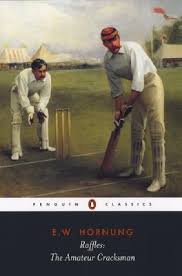
Raffles, the Amateur Cracksman, by E W Hornung, 1899

Raffles: The Amateur Cracksman has not aged well. While his contemporary Sherlock Holmes has prospered in the twenty-first century, with films, television adaptation and yet more ‘inspired by’ novels, Raffles languishes largely forgotten. In this post I am going to explore the reasons for this neglect and suggest a possible way back into the stories.Raffles

Raffles, conceived by Hornung as a counterpoint to his brother-in-law Conan-Doyle’s master detective, is the archetypal gentleman thief. By day, he is a member of London society, and a noted cricketer. By night he is a burglar – a ‘cracksman’. His accomplice and biographer is Bunny Manders, who narrates these stories and looks up to Raffles, one might even say adores him. But more of the homo-erotic undertones of the stories in a moment.

In his wonderful essay Raffles and Miss Blandish, George Orwell compared the Hornung stories with a more contemporary detective tale which offended his sensibilities. He described Raffles as

still one of the best-known characters in English fiction. Very few people would need telling that he played cricket for England, had bachelor chambers in the Albany and burgled the Mayfair houses which he also entered as a guest.

That was in 1944, but the same could certainly not be said now. Orwell’s anatomy of Raffles centres on the acute observation that the

“truly dramatic thing, about Raffles, the thing that makes him a sort of byword even to this day… is the fact that he is a gentleman. Raffles is presented to us and this is rubbed home in countless scraps of dialogue and casual remarks — not as an honest man who has gone astray, but as a public-school man who has gone astray. His remorse, when he feels any, is almost purely social; he has disgraced ‘the old school’, he has lost his right to enter ‘decent society’, he has forfeited his amateur status and become a cad…In making Raffles a cricketer as well as a burglar, Hornung was not merely providing him with a plausible disguise; he was also drawing the sharpest moral contrast that he was able to imagine.

But this is not all, because with his laser-like precision on matters of class, Orwell identifies that while Raffles may be a gentleman, his position in society is less secure than a casual reader might think:

Raffles…is a story of snobbery, and it gains a great deal from the precariousness of Raffles’s social position. A cruder writer would have made the ‘gentleman burglar’ a member of the peerage, or at least a baronet. Raffles, however, is of upper-middle-class origin and is only accepted by the aristocracy because of his personal charm. ‘We were in Society but not of it’, he says to Bunny towards the end of the book; and ‘I was asked about for my cricket’. Both he and Bunny accept the values of ‘Society’ unquestioningly, and would settle down in it for good if only they could get away with a big enough haul. The ruin that constantly threatens them is all the blacker because they only doubtfully ‘belong’. A duke who has served a prison sentence is still a duke, whereas a mere man about town, if once disgraced, ceases to be ‘about town’ for evermore. 

Well, as we will see, there are different forms of disgrace.

Much, perhaps too much, has been made of Raffles’s relationship with Holmes. Hornung didn’t help this reflex reaction by dedicating this book to “ACD” and suggesting the stories were a form of flattery. A criminal version of Holmes would indeed have been fascinating, but Raffles doesn’t fit the bill. He is far too clumsy a thief, relying on crude strategems including violence, and is very nearly caught by the police, something that would never happen to Holmes. In the second story in this collection, ‘A Costume Piece” Raffles tries to steal jewels from the millionaire Reuben Rosenthall. He breaks into his house, only to be captured red-handed by the alert Rosenthall and companions who were waiting for him all along. He escapes by the simple strategem of running away, although he does come back later to rescue the hapless Bunny, disguised as a policeman. In another story, ‘Gentlemen and Players’, Raffles secures an invitation to a country house party. The rich visitors seem easy pickings, but a complicating factor involves a successful burglary by some professional thieves. Raffles takes the opportunity afforded by the theft of walking into the victim’s bedroom and taking her remaining jewels. No bravery, cunning nor skill required, just an invitation to the right kind of house party.

We are constantly told Raffles is a gentleman, but his code of ethics is not as clear cut as you would expect. He is quite prepared to murder his blackmailer for example, and only avoids doing so because someone has beaten him to it. In fact the scene where Raffles first contemplates murder is chilling in its amorality; Raffles seems alive with the thrilling prospect of the crime:

The biggest man alive is the man who’s committed a murder and not yet been fund out… Just think of it! Think of coming in here and talking to the men, very likely about the murder itself, and knowing you’ve done it; and wondering how they’d look if they knew! Oh it would be great, simply great! 

Bunny – and what a childish nickname for a grown man to have – adores him. The Wikipedia entry for Hornung  claims that Raffles and Bunny were “were based partly on his friends Oscar Wilde and his lover, Lord Alfred Douglas”. By 1898, the year the first Raffles story was published, Wilde had already completed his prison sentence for perjury, and was living in Paris. His name became synonymous with homosexuality, and it would have been a brave author who openly used Wilde’s relationship with Douglas as a model for his characters. But the homo-eroticism between Raffles and Bunny, albeit a somewhat one-sided attraction of the younger man for his hero, is undeniable. They first meet at school, where Bunny is Raffles’s “fag”; when the stories begin Bunny has lost all his money gambling, is facing disgrace, and is considering suicide. Raffles offers him a way out of his troubles – an exciting and seductive new life of sin and crime.

Once Raffles and Bunny’s ‘crimes’ are seen as a metaphor for gay love, the stories come alive as an “in plain sight” confession of “the love that dare not speak its name”. In fact it is hard to read many of their exchanges without spotting a gay sub-text.

I’ll do it again…I will…I’ll lend you a hand as often as you like! What does it matter now? I’ve been in it once. I’ll be in it again. I’ve gone to the devil anyhow. I can’t go back, and wouldn’t if I could. Nothing matters another rap! When you want me I’m your man.

Bunny repeatedly tries to break away (break up?) from Raffles – he knows what he represents is wrong, but finds it compellingly attractive, both hating and wanting it at the same time. When in “The Return Match” Raffles seeks him out, lays his hand on his arm and says “Come up to my place”, Bunny can’t resist:

“To me, at all events, there was never anybody in the world so irresistible as Raffles…I made my excuses …but his arm slide through mine…and even while I argued we were on his staircase in the Albany.”

Elsewhere Bunny is openly affectionate towards Raffles, and comes close to accepting his feelings:

It was Raffles I loved. It was not the dark life we led together, still less its base rewards; it was the man himself, his gayety, his humour, his dazzling audacity, his incomparable courage and resource. And a very horror of turning to him again in mere need of greed set the seal on my first angry resolution. But the anger was soon gone out of me, and when at length Raffles bridged the gap by coming to me, I rose to greet him almost with a shout.

This affection burns at its brightest when Bunny is tortured by jealously seeing Raffles flirt with a young Australian women on their ill-fated cruise in The Gift of the Emperor:

What he could see in her—but that begs the question. Of course he saw no more than I did, but to annoy me, or perhaps to punish me for my long defection, he must turn his back on me and devote himself to this chit from Southampton to the Mediterranean. They were always together. It was too absurd. After breakfast they would begin, and go on until eleven or twelve at night; there was no intervening hour at which you might not hear her nasal laugh, or his quiet voice talking soft nonsense into her ear. Of course it was nonsense! Is it conceivable that a man like Raffles, with his knowledge of the world, and his experience of women (a side of his character upon which I have purposely never touched, for it deserves another volume); is it credible, I ask, that such a man could find anything but nonsense to talk by the day together to a giddy young schoolgirl? I would not be unfair for the world.

I think I have admitted that the young person had points. Her eyes, I suppose, were really fine, and certainly the shape of the little brown face was charming, so far as mere contour can charm.

I admit also more audacity than I cared about, with enviable health, mettle, and vitality. I may not have occasion to report any of this young lady’s speeches (they would scarcely bear it), and am therefore the more anxious to describe her without injustice. I confess to some little prejudice against her. I resented her success with Raffles, of whom, in consequence, I saw less and less each day. It is a mean thing to have to confess, but there must have been something not unlike jealousy rankling within me.

References to their physical attraction for one another, the compelling nature of their relationship, the enjoyment of one another’s company, and the recognition that what they are engaged in is wrong by the moral code of society, but thrilling and rewarding nonetheless, crowd the stories’ pages. Raffles toys with Bunny’s affection, keeping him guessing at all times about his motivation. Bunny blindly follows wherever Raffles leads, even when it ends up in a prison cell.

I suspect the simple reason why Raffles is no longer read widely, is that despite this interesting element of modernity, the stories are just not very good. Raffles rarely has a cunning plan of any kind, and Bunny is so dim that the fun of understanding more than him about what is going on palls quickly. Raffles isn’t half as charming or interesting as he thinks he is. Add to that some appalling racism which yes, is of its time, but which Conan Doyle somehow managed to largely avoid, and these stories are not yet ready for a revival. Perhaps when this inevitably happens it will involve a degree of reinvention that they sorely need.

Standard
Book review

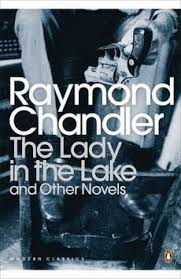
The Lady in the Lake, by Raymond Chandler, 1943

My binge reading of Chandler continues with ‘The Lady in the Lake‘, a title that does two things. It tells us to expect a body to turn up sooner or later in a lake, and hints more obliquely that there may be Arthurian elements to the narrative.

Marlowe takes a case that he would normally avoid – a MisPers (missing person). Crystal Kingsley has run out on her husband, Derace, sending him a telegram saying she was divorcing him and marrying her lover Chris Lavery. But Lavery denied all knowledge of an elopement plan when Derace met him a few days after he received his wife’s letter. Marlowe begins his investigation with a visit to Lavery in Bay City, somewhere Marlowe has had run ins with the local cops before. It’s no surprise therefore that while watching Lavery’s house, Marlowe is threatened local cop Al Degarmo, who accuses him of watching Lavery’s neighbour, Dr. Almore. Almore’s wife had died in suspicious circumstances about a year earlier. Anyone with any experience of detective fiction will jump to the conclusion that Marlowe’s missing persons case and Mrs Almore’s death will, in some way, be connected.

Lavery leads Marlowe nowhere except the run in with the local law enforcement, so he decides to drive up to the Kingsley’s holiday cabin at Little Fawn Lake, where Mrs Kingsley was staying before she went missing. Yes, that’s the lake we were waiting for. Marlowe meets the caretaker, Bill Chess, who in a highly suspicious, red lights flashing coincidence, has just been walked out on by his wife, Muriel. The scene where Marlowe and Chess chat on the boardwalk by the lake, and eventually discover the secret hidden in the water, is a masterpiece of controlled writing:

“The depths cleared again. Something moved in them that was not a board. It rose slowly, with an infinitely careless languor, a long dark twisted something that rolled lazily in the water as it rose. It broke surface casually, lightly, without haste. I saw wool, sodden and black, a leather jerkin blacker than ink, a pair of slacks. I saw shoes and something that bulged nastily between the shoes and the cuffs of the slacks. I saw a wave of dark blond hair straighten out in the water and hold still for a brief instant as if with a calculated effect, and then swirl into a tangle again.” 

Chess is arrested for his wife’s murder, although Marlowe  is sceptical. Marlowe tries not to be distracted by this discovery, although even he begins to wonder why death seems to follow him around: 

It’s only Marlowe, finding another body. He does it rather well by now. Murder-a-day Marlowe, they call him. They have the meat wagon following him around to follow up on the business he finds.

He goes back to interview Lavery again, and it is no surprise to anyone when he finds him shot in his bathroom. Without a solid lead, he picks up the Almore case, and visits Mrs Almore’s parents, who suspect their daughter was murdered. Another run-in with the local police who are trying to prevent Marlowe investigating the Almore case derails this thread of the investigation for now, but there is no time to pause for breath before he receives a call from Derace Kingsley saying that Crystal has telephoned him asking for money to help her leave town. He asks Marlowe to make the pay-off –  by now he just wants rid of his wife, even if she seems the most likely suspect for Lavery’s murder.

Marlowe is never going to give money to help a murder suspect flee the jurisdiction, but when he confronts and accuses her she pulls a gun on him. As they struggle Marlowe is sapped. Some time later he comes round:
“I smelled of gin. Not just casually, as if I had taken four or five drinks of a winter morning to get out of bed on, but as if the Pacific Ocean was pure gin and I had nosedived off the boat deck. The gin was in my hair and eyebrows, on my chin and under my chin. It was on my shirt. I smelled like dead toads.”

Crystal lies strangled to death on the bed, presumably by whoever sapped Marlowe, and with a view to framing him for the murder. Degarmo the Bay City cop, who we have learned was in love with Muriel Chess, arrests Marlowe but quickly accepts he was not responsible for Crystal’s murder. He drives him back to Little Fawn Lake to arrest Kingsley, now chief suspect. There a final confrontation ensues and all the complex threads of the mystery are drawn together in a very satisfying finale. 

I’ve raved enough in recent posts to make it unnecessary to write further about the magnificence of Chandler’s prose. His imagery in particular is to my mind some of the best in modern fiction. Can you find a better simile than this, anywhere?
“She looked playful and eager, but not quite sure of herself, like a new kitten in a house where they don’t care much about kittens.” 

His descriptive passages are vivid and his character portraits have a wonderful economy. Here’s Kingsley’s assistant for example – note how the imagery just can’t be kept out of his writing even if he wanted it to:
“She wore a steel gray business suit and under the jacket a dark blue shirt and a man’s tie of lighter shade. The edges of the folded handkerchief in the breast pocket looked sharp enough to slice bread.”

‘The Lady in the Lake’ is not one of Chandler’s most popular or well-known Marlowe novels. It should be; it is classic Chandler, in full control of his material and at the top of his game. Marlowe is cynical but not bitter, hard-boiled but still open to romance. For me Chandler transcends detective fiction, while at the same time defining it. I guess if my reviews haven’t persuaded you of this now then I probably should quit trying, but in case you are in any doubt, give him a try, you won’t regret it. 

Standard
Book review

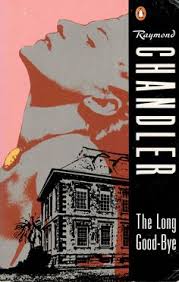
The Long Goodbye, by Raymond Chandler, 1953

I first read ‘The Long Goodbye‘ around 25 years ago, and returning to it was an absolute pleasure. It is another Marlowe novel, and is (as they all are), a gem. Some novels change over time, but Chandler’s work has a timeless quality. It doesn’t matter what is happening in the outside world, Marlowe will always be there with a smart line and a stiff drink, even if he has just discovered a body and been socked over the head.  ‘The Long Goodbye’ is late Marlowe/Chandler, with a reflective quality that shows that both men have been through a lot, and are beginning to feel their age.chandler

The plot is complex, as you would expect. Marlowe meets a drunk, Terry Lennox, outside a club. Lennox is a lush, married to a rich women who is serially unfaithful to him, and has a mysterious past, testified to by the scars down one side of his face. Marlowe and Lennox become unlikely and occasional drinking friends until Lennox shows up late one night needing a ride to the airport, no questions asked. Marlowe knows he must have very good reasons for this request, but doesn’t ask any awkward questions. He is a good enough detective to know there are only one or two reasons why someone in Lennox’s position would want to fly the country in the middle of the night. So it is no surprise when on his return from the airport, the police confirm that Mrs Lennox has been murdered. Marlowe refuses to co-operate with the police, and is slung in jail for his efforts. But his interrogation is cut short when news arrives that Lennox has committed suicide leaving a confession. Marlowe later receives a letter from Lennox containing a Madison, a $5,000 bill, and some cryptic comments that leave Marlowe with some questions about what has happened.

Chandler’s novels are often built around earlier magazine stories. Knowing this I was expecting a new storyline to be introduced at this point, and it comes when Marlowe is asked by a publisher to work out the dark secrets of one of his (the publisher’s) writers, Roger Wade. Wade is being driven to drink by whatever is troubling him, and when drunk he becomes violent, not least towards his wife. Wade has also gone missing.

Marlowe quickly tracks Wade down to a detox facility in an isolated ranch. Case solved. Inevitably that is not the end of Marlowe’s involvement with the Wades. They try to convince him to work for them as what we would now call Roger’s sober companion, but Marlowe is not interested. Meanwhile, the Lennox ‘case’ refuses to go away, even though there appears nothing left to investigate. Marlowe’s work with the Wades leads other people to conclude that he is still looking into the deaths of Mrs Lennox and her husband. This is a close-knit community where everyone knows everyone else, and there is a suggestion that Wade and Mrs Lennox were lovers . Marlowe is menaced by a mobster friend of Lennox’s, Mendy Menendez, and by Lennox’s ultra-rich father-in-law, to drop the case, even though he tells them repeatedly that he is not investigating it. Slowly, details emerge of the lives of these troubled people. Marlowe learns that Terry Lennox had lived in England, fought in the Second World War, and had been previously married.

Wade starts drinking again, and then apparently commits suicide. Marlowe is suspicious, but because he was alone with Wade at the time of his death it is he that becomes a suspect, although never seriously. In a traditional reveal scene Marlowe walks us through who really killed Mrs Lennox and Wade, and finally what really happened to Terry Lennox.

Chandler’s byzantine plots mean that even though I have read this novel before I was constantly kept guessing as to who killed whom. But as I have said before you shouldn’t read Chandler for the plots, but the wonderful prose:

When I got home I mixed a stiff one and stood by the open window in the living room and sipped it and listened to the groundswell of traffic on Laurel Canyon Boulevard and looked at the glare of the big angry city hanging over the shoulder of the hills through which the boulevard had been cut. Far off the banshee wail of police or fire sirens rose and fell, never for very long completely silent. Twenty four hours a day somebody is running, somebody else is trying to catch him. Out there in the night of a thousand crimes, people were dying, being maimed, cut by flying glass, crushed against steering wheels or under heavy tires. People were being beaten, robbed, strangled, raped, and murdered. People were hungry, sick; bored, desperate with loneliness or remorse or fear, angry, cruel, feverish, shaken by sobs. A city no worse than others, a city rich and vigorous and full of pride, a city lost and beaten and full of emptiness. It all depends on where you sit and what your own private score is. I didn’t have one. I didn’t care. I finished the drink and went to bed.” 

This is a melancholy and reflective novel in which the portraits of two serious drinkers, Wade and Lennox, are both considered self-portraits of the author.  Marlowe still takes a punch with the best of them, but it takes him just that little bit longer to come round. He is still a sucker for a pretty face, and when he takes a lover it forms part of the long goodbye of the novel’s title. I can’t rank Chandler’s novels against one another, and they are equally hard to compare to other detective fiction, such is their distinctiveness. All I can say is that if I had a desert island disc decision to make, Chandler would be very near if not at the top of my list. He is one of the language’s great stylists, and if you haven’t read him before, and aren’t offended too easily, I can’t recommend his work highly enough.

Standard
Book review

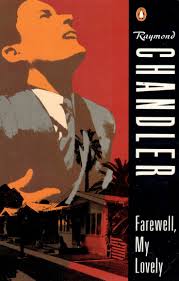
Farewell, My Lovely, by Raymond Chandler, 1940

farewell

I’ve written previously on this blog about my admiration of Chandler’s prose. His flair for dramatic imagery is really unsurpassed in the detective fiction genre. People have tried to copy it, but never achieved the same vividly imaginative description.
Plot is in many ways secondary in these novels, which is surprising given that in most detective fiction whodunnit is the central question. For Chandler the journey is more important than the destination and when we arrive at the novel’s denouement the reveal can be a little anti-climactic.

‘Farewell My Lovely’ has a typically byzantine plot, where it is really easy for the reader to get lost as to what is happening, even after several rereads. (Where I say ‘the reader’ I am thinking of one specific reader in particular, me – other people may not have these issues. See what you think)

Marlowe is investigating a missing person’s case when he crosses the path of the novel’s anti-hero, Moose Malloy. Malloy is a prodigiously large man, and has just got out of prison after serving an eight years sentence. He is looking for his former girlfriend, Velma. Malloy is slow on the up-take, but extremely persistent. In the course of a visit to a club where Velma once worked, Malloy casually kills the owner. Having witnessed the killing, Marlowe decides to track down Velma.

He locates the widow of the nightclub’s former owner but this seems a dead end as she claims Velma is dead. That evening Marlowe picks up another case in which he is asked to act as a bodyguard for a man delivering a ransom for some stolen jewellery. The reader is hardly surprised when this payment goes badly wrong, and while Marlowe escapes with a bump on the head, his client, Lindsay Marriott, is murdered.

Anne Riordan, daughter of a former chief of police, finds the coshed Marlowe, and decides to help him with his investigation. She is not the typical sidekick – Marlowe doesn’t seem to welcome her help – but she races ahead with the case, finding out that the jewellery that was to be ransomed belonged to a Mrs Grayle, the young wife of a wealthy industrialist. Prompted by Anne, Marlowe visits Mrs. Grayle. There is an immediate spark between them, and after making out they agree to go on a date at a club owned by the local kingpin, Laird Brunette. Experienced detective fiction readers will be twitching at this point, knowing that there is more to both Mrs Grayle and Laird than meets the eye, but the speed of the action is such that there is little time to contemplate this development before Marlowe is off pursuing another red herring.

While investigating Marriott’s possessions, Marlowe finds some cannabis cigarettes, and inside these the business cards of a psychotherapist, as we would now call him, called Amthor. Marlowe begins to formulate an idea that Amthor identified his clients as potential victims, and then passed their details to Marriott, who gets to know them, sets up the robbery, and then manages the payment of the ransom. Confronting Amthor turns out to be a big mistake, as Marlowe is beaten up by first his bodyguard and then two local policemen on Amthor’s payroll, then kept drugged in a private hospital run by the sinister Dr. Sonderborg. He escapes, but on the way out he sees Malloy in another room. Marlowe subsequently works out that Malloy may now be hiding out on a gambling boat anchored beyond the city’s three-mile limit, and run by Brunette Laird, who we have met before.

The novel now moves swiftly to a conclusion. In a tense scene Marlowe sneaks on board the gambling boat, before the final confrontation between Malloy, such a strong presence in the novel despite only the briefest of appearances, Marlowe, and the ghosts of the past.

As was often the case with Chandler’s novels, ‘Farewell my Lovely’ is something of a Frankenstein’s monster in which earlier short stories are welded together to create the one narrative. If you look hard for the joints you can find them, but the fact that detectives will often pursue several cases at once gives this a plausibility it might otherwise lack. But as I have said earlier, you shouldn’t read Chandler for the plot. He is above all a superb stylist.

The eighty-five cent dinner tasted like a discarded mail bag and was served to me by a waiter who looked as if he would slug me for a quarter, cut my throat for six bits and bury me at sea in a barrel of concrete for a dollar and a half, plus sales tax.”

“She gave me a smile I could feel in my hip pocket.”

“1644 West 54th Place was a dried-out brown house with a dried-out brown lawn in front of it. There was a large bare patch around a tough-looking palm tree. On the porch stood one lonely wooden rocker, and the afternoon breeze made the unpruned shoots of last year’s poinsettias tap-tap against the cracked stucco wall. A line of stiff yellowish half-washed clothes jittered on a rusty wire in the side yard.”

Just occasionally Chandler goes over the top – “The wet air was as cold as the ashes of love.” – but you feel happy to overlook this given the percentage of hits to misses. But it is as king of the simile that Chandler reigns supreme:

“Even on Central Avenue, not the quietest dressed street in the world, he looked about as inconspicuous as a tarantula on a slice of angel food.”

and

“It was a blonde. A blonde to make a bishop kick a hole in a stained glass window” (a line that can still make me laugh out loud).

Having said all that, I can’t finish this review without mentioning the racism that is scattered throughout this novel. It’s painful to read and hard to separate out the racism of 1940’s America which is I am sure being accurately portrayed from the racist attitudes of the author. I don’t think it fatally damages the novel as a whole, but it does a good job at trying. A politically correct Philip Marlowe would be an abomination, agreed, but there is something about the casual way that racist terms are used that is distasteful.

Standard
Book review, Conan Doyle, Detective, Detective fiction, Holmes, Holmes and Watson

Supplementary: The Mystery of Sherlock Holmes

If you read the comments on my recent post about ‘The Adventures of Sherlock Holmes’ you may have seen I postulated that there is a paradox at the core of how we perceive Sherlock Holmes. On the one hand he is (and so far as I can make out, always has been) enormously popular; on the other his stories are formulaic and (in the words of Bookertalk) “preposterous”.download (3)

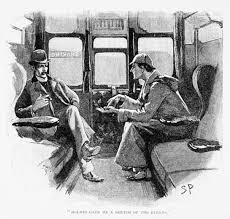
The case for the prosecution  is easily made. The Holmes stories are rigidly structured – Holmes and Watson are chatting, Holmes casually tosses over a letter he has received from his most recent client, telling him they will call at a certain hour which precisely arrives at the moment their initial assessment of the case has concluded.

“DEAR MR. HOLMES:—I am very anxious to consult you as to whether I should or should not accept a situation which has been offered to me as governess. I shall call at half-past ten to-morrow if I do not inconvenience you. Yours faithfully, “VIOLET HUNTER.”
“Do you know the young lady?” I asked.

“Not I.”

“It is half-past ten now.”

“Yes, and I have no doubt that is her ring.” (The Adventure of the Copper Beeches).

Holmes performs his parlour trick of determining the visitor’s background – “Beyond the obvious facts that he has at some time done manual labour, that he takes snuff, that he is a Freemason, that he has been in China, and that he has done a considerable amount of writing lately, I can deduce nothing else.” – (The Red-Headed League)

The game is then afoot, and Holmes quickly resolves the mystery by dint of some off-camera background research, investigations using a disguise or two, and a good dose of luck. I pointed out in my previous post that the resolution of each case is often not what the client hoped for. Of the twelve stories in ‘The Adventures’, one case fails completely (A Scandal in Bohemia), in another the client is murdered and the murderers escape (The Five Orange Pips) and in yet another Holmes solves the mystery but decides not to reveal the solution to his client (A Case of Identity).

Beyond this rigid structure, there are other issues. Apart from Holmes and Watson few other characters are brought to life – certainly not in the way they are in Sherlock for example, where they are given complex and interesting back stories. The writing is nothing out of the ordinary, and the author frequently ‘cheats’ by way of undetectable poison or by withholding information key to the resolution of the case until the last moment. Some if not many of the situations are indeed preposterous – for example in ‘The Adventure of the Speckled Band’ a  bell pull is installed in the victim’s bedroom, but it is not connected to anything (did people have bell-pulls in their bedrooms anyway? Perhaps the senior aristocracy who needed help dressing, but not in a small household as in this story).

The case for the defence would probably point out that the Holmes stories are some of the best loved in literature. Holmes has inspired many other writers, film-makers and artists, and the rich range of secondary characters in the books, from Mrs Hudson to Irene Adler, Lestrade, and of course not forgetting Moriarty may indeed be sketched briefly but are powerfully brought to life. The defence would also mention Conan Doyle’s virtual invention of the detective story, the cleverness of many of his plots, the inventiveness of Holmes’s deductions, and the strength of his enduring relationship with Watson. Descriptive writing may not be Conan Doyle’s strength, but London is brilliantly evoked.

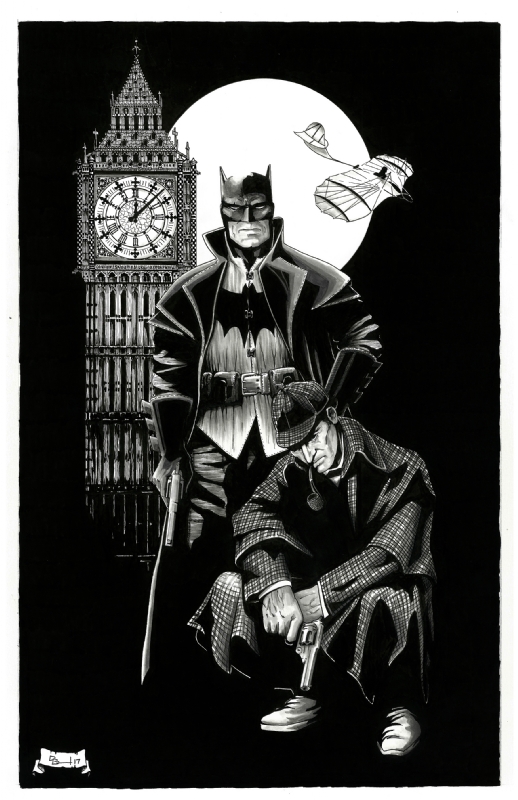
Thus far a fairly balanced case. But I think the enduring power of the Holmes stories lies elsewhere. Holmes was one of the earliest super heroes.  He has enormous strength – he can straighten a bent poker. He is utterly fearless. He has almost super-human powers of observation, deduction and intelligence, and well as a vast array of scientific and other information at his fingertips. He fights for the poor and the oppressed as well as the prosperous. He is a master of disguise, and sometimes wears a cloak. He lives among us, but apart. The country would fall without him. Yes, he’s Victorian Batman.Sherbat.jpg

And we all love a good super hero. The MCU franchise is not the most successful series of films in Hollywood history for nothing. What is more we need heroes. In Victorian England the readers of the Strand magazine would have felt threatened by trade unions, rising crime, the poor, suffragettes, and Germans, not in any particular order. Today we fear rising crime, lawlessness, terrorism, Trump. We still need Holmes out there stopping the bad guys, which is why we still have him.

Being a conscientious blogger I always try and find out if what I think is an original observation is just a cliche, and no surprise – I am not the first person by a long way to draw this parallel. Apologies, but I think the point still stands. Incidentally I don’t think it is important to get hung up on the specific super hero – the point is he plays the same role in society, offering hope to the vulnerable and scared. Which is why Holmes has developed such a rich life outside the Conan Doyle stories, and why he will remain a source of fascination and inspiration for many decades to come. Inevitably the original source material might look a little jaded in this context, but that would be to miss the point. Which I think, in my previous post, I did.

Standard

Conan Doyle’s ‘The Adventures of Sherlock Holmes’ contains 12 short stories, all originally published in the Strand magazine between June 1891 and July 1892. Some are better known than others, but all follow a fairly rigid format – a curious case is brought to Holmes’s attention by a flustered individual, often incognito, Watson’s support is engaged, and the case is then swiftly resolved. Disguises are often deployed, trusty service revolvers are pocketed, and Lestrade is ritually humiliated. In every story Holmes performs the deductions which are his hallmark, usually at the opening of the story, although rarely if ever are these deductions anything to do with the case in point.

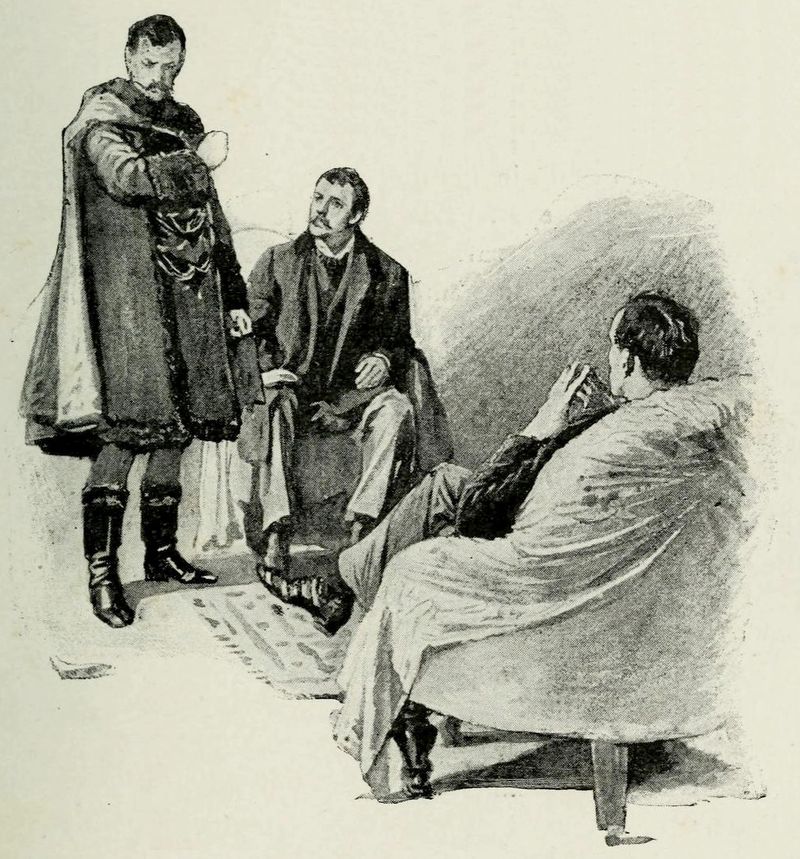
A Scandal in Bohemia is the story in which Irene Adler, ‘the woman’, makes her one and only appearance in Conan Doyle’s stories. It is a simple case of blackmail which is resolved without Holmes’s assistance, because Irene marries and decides not to pursue her victim. Holmes counts it as one of his very few failures, which suggests his definition of success is somewhat flexible, but there is no suggestion of any attraction between the two, more a mutual respect.800px-A_Scandal_in_Bohemia-04

The Red-Headed League is one of Holmes’s more ridiculous cases. A pawn broker is duped into leaving his store all day for several weeks to allow a tunnel to be dug from the premises to a nearby bank. The bank robbers could surely have found easier ways to do this than the invention of the League, which would have drawn a lot of attention to themselves, left clues all over the place, cost a lot of time and effort to establish, and could have fallen apart at any time.

A Case of Identity is one in which someone assumes a flimsy disguise, which Holmes sees through but fails to tell his client he has resolved the case. See ‘The Man with the Twisted Lip’

The Boscombe Valley Mystery. In this story Holmes bizarrely allows a murderer to go free, and a guilty man to spend months in prison, simply because the murderer is dying.

The Five Orange Pips sees Holmes allow his client to be brutally murdered and the murderers to escape the country, if not justice. Another great success!

The Man with the Twisted Lip. Someone assumes a flimsy disguise which Holmes sees through, again.

The Adventure of the Blue Carbuncle. In this story Holmes starts with the missing gem falling into his lap, and then working back to find out who stole it – an easier approach than the other way round I would have thought.

The Adventure of the Speckled Band. Conan Doyle thought this his finest Holmes story, but it is riddled with preposterous plot points.

The Adventure of the Engineer’s Thumb. A good headline, but a story in which Holmes detects absolutely nothing. Perhaps explains why this has not been an adaptor’s favourite.

The Adventure of the Noble Bachelor. A missing person story depending for its resolution of a previous relationship in America – the States is the setting for several of Holmes’s client’s backstories.

The Adventure of the Beryl Coronet. I think the real mystery – why a member of the royal family comes to pawn an incredibly valuable coronet for a fraction of its value – is ignored, instead focusing on whodunit in which footprints in the snow provide all the answers.

The Adventure of the Copper Beeches. A governess is recruited at highly inflated wages to impersonate a kidnapped heiress. Another case where the villains employ ridiculously complex means to pursue their villainy, when many other simpler options are available.

To Victorians, Holmes’s deductions and flashes of brilliance must have been dazzling, and to this day there are readers who hold Holmes in the highest possible regard. He is not the character most often portrayed on film for nothing. In recent years ‘Elementary’ and ‘Sherlock’ have given new life and new depths to the character. For me Holmes probably works best in this short story format where the weaknesses in his deductive method and approach aren’t too visible.

19th Century literature, Book review, Conan Doyle, Detective, Detective fiction, Holmes, Holmes and Watson, Sherlock

The Adventures of Sherlock Holmes, by Arthur Conan Doyle 1892

Gallery