Book review

Tess of the D’Urbervilles by Thomas Hardy, 1891

I am not sure why my feelings towards the novels of Thomas Hardy are so ambivalent. It could be the fairly turgid poetry I was force-fed at school, dating from the period of his life when he gave up writing novels (apparently because of the hostile popular reaction to Tess and 1895’s Jude the Obscure). It could also be because Hardy is so often the “go-to” writer for film and television adaptations, so I have a pretty good understanding of what happens in his novels, meaning that they can feel over-familiar.

Despite these reservations I am slowly coming round to the uncontroversial view that Hardy is a wonderful writer. I have many more of his novels to read, but thus far Tess is to my mind his most successful novel – in fact one of the best Victorian novels ever written, up there with Dickens at his finest.

Set in rural Wessex at the end of the nineteenth century, as technology slowly transforms country life, Tess is the tragic tale of a young country woman who has the misfortune to have an ancient family name, Durbeyfield. Her parents believe this to be a corruption of “d’Urberville”, the surname of a noble Norman family. This seemingly unimportant discovery is the spark for Tess’s tragedy .

We first see her at a village May Dance, a traditional ritual to welcome the spring. The dance is joined by Angel Clare, on a walking tour with his brothers – he notices Tess but doesn’t speak to her and the incident is soon forgotten. Meanwhile, Tess’s parents hatch a plan to recover their family fortunes. They send her to visit Mrs D’Urberville, a rich widow in the nearby town of Trantridge, to “claim kin”. There Tess meets Mrs D’Urberville’s son Alec, who persuades his mother to offer her a job as a poultry keeper. Alec’s interest in Tess is apparent. Her parents are well aware they are exposing the young and vulnerable Tess to risk in sending her to work at Trantridge, but they openly encourage the idea that Alec might marry her.

Late one night, walking home from town Alec offers Tess a ride home. They reach a grove in a forest where he drugs and rapes her. The attack is only implied, but there’s very little ambiguity in terms of what happens. What happens immediately after the attack is less clear. The narrator fast forwards several months to a new section of the text, entitled “Maid no More”. Tess is returning home, pregnant, angry and ashamed. This is a novel of silences and ambiguity, not least here. Was Tess living with Alec as his lover, perhaps with a promise of marriage? The text gives only hints and we are left to fill most of the gaps . Tess’s mother Joan hints she was aware all was not well: “After all the talk about you and him which has reached us here” (81) and Tess is even more ambiguous, telling Alec “I made up my mind (to leave) as soon as I saw – what I ought to have seen sooner” – presumably that Alec had no serious intention of marrying her.

Tess has a complex publication history – it first appeared in serial publication in a magazine, and the publisher required Hardy to make a number of changes to the text to make it more palatable to late-Victorian mores. This gave Hardy the opportunity to test public reaction and make changes when the text appeared in novel form a couple of years later. The chapters in which Tess is “seduced” (as it might have been seen at the time) or more rightly attacked, were fine-tuned by the author to leave sufficient ambiguity as to the precise relationship – and degree of immorality – between Tess and Alec. Hardy wants us to be on Tess’s ‘side’. He portrays her as a victim of male depravity and the judgmental social attitudes of the time. The novel’s defiant sub-title “A Pure Woman Faithfully Presented” emphasises Hardy’s close identification with his heroine.

Once she has left Trantridge, Tess gives birth to a sickly infant son, who only lives a few weeks. Just before he dies she baptises him herself with the name Sorrow, and then buries him in a “shabby corner” of the churchyard reserved for unbaptised infants under a homemade cross. These are some of the most heart-breaking moments of the novel, but more is to come.

Two years pass, and a wiser, sadder Tess finds a job as a milkmaid at a dairy, far enough away from her home village so her reputation as a ‘fallen woman’ can be left behind. There she meets Angel Clare again, now an apprentice farmer learning dairy management. Angel has rejected his father’s suggestion that, like his two brothers, he becomes a clergyman, although their theological differences seem obscure. In this bucolic paradise, Angel and Tess fall in love. At one point they wander into a wild party of the farm’s garden, a nascent Eden, and the author makes the comparison explicit:

“The outskirt of the garden in which Tess found herself had been left uncultivated for some years”…”This spectral, half-compounded, aqueous light, which pervaded the open mead, impressed them with a feeling of isolation, as if they were Adam and Eve”.

122-130

For a while they enjoy an innocent courtship, but Angel’s proposal of marriage puts Tess in a difficult situation – would he still want to marry her if he knew of her former ‘relationship’ with Alec? Tess chooses the worst possible option – she tells him after they marry. Unable to overcome the Victorian concept that brides must be virgins (“maids”) , Angel is appalled, and rejects Tess, although seems unable to decide what to do next. In a doom-laden scene he carries Tess while sleep-walking (sleep carrying?) to a nearby church, and places her in a tomb. Foreshadowing anyone? To bring an end to the torture of indecision Tess suggests they separate, saying she will return to her parents. Rather melodramatically Angel leaves the country and goes to Brazil to seek his fortune. Things accelerate from this point. Alec reappears in Tess’s life, and further misfortune dogs her. The novel’s famous ending scene finally comes almost as a relief to the tortured Tess.

This is a rich, rewardingly complex novel. It is awash with symbolism and foreshadowing. As early as page 35 we are told that Tess’s “face was dry and pale, as though she regarded herself in the light of a murderess”. The novel is suffused with religious references, as well as a multitude of direct and indirect quotes from nineteenth century and earlier poets, and of course Shakespeare. The novel opens with an epigram from The Two Gentlemen of Verona, and thereafter includes mentions from Much Ado, Lear, Measure for Measure, Hamlet, As You Like It, The Rape of Lucrece, and of course, Romeo and Juliet, to mention the few I spotted (one of which, “He suited the action to the word” (page 62), a reference to Hamlet, Act 3 scene 2, was not spotted by the otherwise exhaustively detailed footnotes provided in the Penguin Classic edition!)

While some critics have found the male leads in the novel to be two-dimensional, Tess is in many ways a modern heroine. She is strong-willed and does more than anyone could ever humanly expect to avoid her fate. If she makes mistakes it is hardly surprising given the lack of role models and support she has in her life. When there is finally no escape she takes matters into her own hands – even the pious Angel seems to accept without judgement her decision to end her relationship with Alec in the way she does.
Standard
Book review

A Tale of Two Cities, by Charles Dickens, 1859

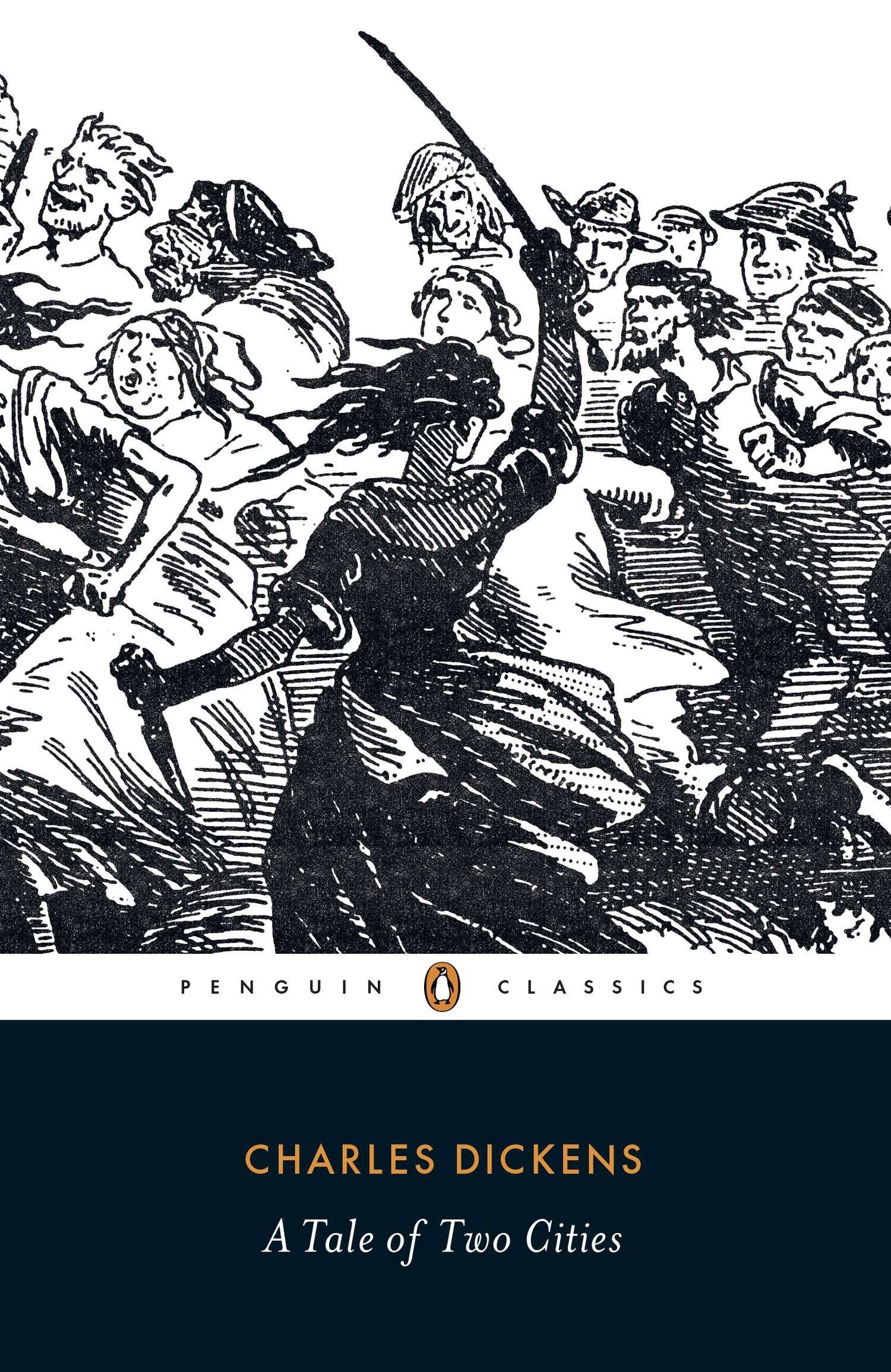
A while back I decided to copy Susan Hill‘s excellent idea of reading one Dickens novel a year. The volume of his work is such that it can be daunting knowing where to begin, (and thus never actually starting), whereas one novel a year is eminently achievable, and quickly builds up into a decent list. I read most of Dickens whilst at university, so I am making a point this time round of catching up with the ones I never got round to, of which the most prominent remaining is (or rather was) A Tale of Two Cities.Image result for tale of two cities images

It was the best of times, it was the worst of times, it was the age of wisdom, it was the age of foolishness, it was the epoch of belief, it was the epoch of incredulity, it was the season of Light, it was the season of Darkness, it was the spring of hope, it was the winter of despair, we had everything before us, we had nothing before us, we were all going direct to Heaven, we were all going direct the other way.

There are very few better openings lines to a novel than this. When I bought the copy of A Tale of Two Cities for this read, the shop assistant, (who was otherwise perfectly pleasant), took the opportunity to tell me how she ‘couldn’t stand’ Dickens. It’s not an uncommon reaction. Why do so many people feel this way? Dickens is often given to children as young as 10 or 11 to read. I can only imagine that this is done on the misguided basis that his works are considered accessible to the younger reader. But they clearly are not, on the basis of length and complexity alone. That might be one reason. The case against Dickens as a writer for adults is that his novels are slow-paced and overlong, his characters are two-dimensional, and his plots improbable. There is a lot in this. His novels are usually very long (possibly even too long, although how you could measure that I can’t imagine). The plots meander and take an age to develop. His characters are caricatures. Stupid characters are really stupid. Villains have not a single redeeming feature. Heroines are – well, you’ve got the picture. His plots, when they do finally reach a conclusion, depend massively on coincidence. His writing can be overblown and over the top. For all these reasons and more people struggle to appreciate Dickens. Which is a pity, because I think he is one of our greatest writers, and if evidence of this were required I give you the opening paragraph above. It is poetry in prose.

The case for the defence doesn’t just stand on this opening paragraph of course, but it is quoted in part as evidence of the strength of Dickens’ writing. While his characters may be two-dimensional, they are unquestionably memorable – Uriah Heep, Mr Micawber, Scrooge, the Artful Dodger and many others are known by people who would not come within a mile of one of his novels. They may be long, but reading isn’t a race. His plots wander, yes, but the wandering is the point, rather than the resolution. But all this would be as naught if he wasn’t a wonderful writer, and he is.

You will know the plot of A Tale even if you haven’t read a page of Dickens – and doesn’t that on its own tell you something about his abilities as a storyteller? Set in the time of the French Revolution, it follows the intertwined tales of an aristocrat refugee, Charles Evermonde (now known as Darnay), and the dissolute English lawyer, Sydney Carton. Dickens takes his time setting the scene, providing elements of the backstory that he will return to at the novel’s climax. In a vivid opening chapter the nightly mail-coach on route from London to Dover is flagged down by a messenger for Tellson’s Bank with the cryptic message “Recalled to Life.” We later learn that this refers to the release from the Bastille of a Dr Manette after 18 years inside. It is only at the end of the novel that we learn the reasons for his imprisonment. A reunion between the profoundly traumatised Dr Manette and his long lost daughter follows. The next chapters of the novel jump forward to 1780: Darnay is on trial for treason against the British Crown. Two spies claim that Darnay gave information about British troops in North America (where of course the American Revolutionary war was underway) to the French. Under cross-examination it is pointed out that fellow lawyer Sydney Carton bears a strong resemblance to Darnay. This coincidence is to play a key part in the novel’s resolution. Darnay is of course acquitted.

The novel’s focus then shifts to Paris, where Dickens shows the depravity of the aristocracy. The carriage of the evil Marquis St. Evrémonde runs over and kills a child. The Marquis casually tosses a coin to the parents as compensation. The Marquis is the uncle of Charles Darnay, who is also his heir, even though he has disavowed the family name. The die is thus cast – all the pieces are in place, and they fall domino-like, with the French Revolution leading swiftly to the reign of terror. At the height of the revolution Darnay suicidally travels to Paris where he is arrested as an emigrant and an aristocrat. In the novel’s least plausible development his wife, Lucie Manette, travels to try to secure his release. Bizarrely she takes an entourage with her – her father, Dr. Manette, her daughter, and two servants/travelling companions. Somehow they manage to live for over a year in the tumult of revolutionary Paris, a household of English people protected only by Dr Manette’s status as a former prisoner of the Bastille. I won’t spoil the novel’s ending for you, which you probably know anyway. I found it surprisingly moving, with that famous, resonant last line.

It is a far, far better thing that I do than I have ever done; it is a far, far better rest that I go to than I have ever known.

Dickens’ perspective on the revolution is crystal clear – the terror is a direct result of the appalling way the French working classes were treated by the aristocracy.

Along the Paris streets, the death-carts rumble, hollow and harsh. Six tumbrels carry the day’s wine to La Guillotine. All the devouring and insatiate Monsters imagined since imagination could record itself, are fused in one realization, Guillotine. And yet there is not in France, with its rich variety of soil and climate, a blade, a leaf, a root, a sprig, a peppercorn, which will grow to maturity under conditions more certain than those that have produced this horror. Crush humanity out of shape once more, under similar hammers, and it will twist itself into the same tortured forms. Sow the same seed of rapacious license and oppression over again, and it will surely yield the same fruit according to its kind.

This isn’t just a historical observation, but a pressing political point. The warning to the British ruling class is inescapable – abuse the working class and you will pay the price in blood. An academic analysis of the novel would talk at length about this being a work of opposites, a theme established clearly in that opening paragraph and indeed even in the novel’s title. I’m not going to dwell on that because it is so obvious. Instead I wonder what it would have been like reading this novel in those monthly installments in the 1850’s. In particular, would I have worked out what was going to happen, what was going to be the significance of the similarity between Darnay and Carton, and how the early promise of sacrifice by Carton was going to play out?

For you, and for any dear to you, I would do anything. If my career were of that better kind that there was any opportunity or capacity of sacrifice in it, I would embrace any sacrifice for you and for those dear to you.

The repetition of “dear to you” is in hindsight something of a clunking clue, but it comes fairly early on in the novel and would have been easy to forget. I’d like to think I would have worked it out sooner rather than later, but of course you can never be sure.

There are some weaknesses in the novel, admittedly. The heroine Lucie is a blank canvas, with nothing much in the way of personality. Not all Dickens’ female characters are so bland – Madame Defarge is a bloodthirsty monster, although even she, when her backstory is finally revealed, is not without some sympathy. The cast of secondary characters is less expansive that many Dickens novels, and they don’t play a significant role. The revolutionaries are all labelled Jacques One, Two etc – no need to differentiate the huddled masses there. Jerry Cruncher the part-time resurrection man, and Mrs Pross, Lucie’s maid, are wheeled on and off the stage at the plot’s convenience and left in storage off-stage when not required. Dickens may have hoped that the improbability of their extended stay in revolutionary Paris would not have been noticed given the focus on the main characters, but it seemed an unnecessary lack of realism to me.

These are minor quibbles. This is Dickens near his best, and is thoroughly recommended.

Standard
Book review

Raffles, the Amateur Cracksman, by E W Hornung, 1899

Raffles: The Amateur Cracksman has not aged well. While his contemporary Sherlock Holmes has prospered in the twenty-first century, with films, television adaptation and yet more ‘inspired by’ novels, Raffles languishes largely forgotten. In this post I am going to explore the reasons for this neglect and suggest a possible way back into the stories.Raffles

Raffles, conceived by Hornung as a counterpoint to his brother-in-law Conan-Doyle’s master detective, is the archetypal gentleman thief. By day, he is a member of London society, and a noted cricketer. By night he is a burglar – a ‘cracksman’. His accomplice and biographer is Bunny Manders, who narrates these stories and looks up to Raffles, one might even say adores him. But more of the homo-erotic undertones of the stories in a moment.

In his wonderful essay Raffles and Miss Blandish, George Orwell compared the Hornung stories with a more contemporary detective tale which offended his sensibilities. He described Raffles as

still one of the best-known characters in English fiction. Very few people would need telling that he played cricket for England, had bachelor chambers in the Albany and burgled the Mayfair houses which he also entered as a guest.

That was in 1944, but the same could certainly not be said now. Orwell’s anatomy of Raffles centres on the acute observation that the

“truly dramatic thing, about Raffles, the thing that makes him a sort of byword even to this day… is the fact that he is a gentleman. Raffles is presented to us and this is rubbed home in countless scraps of dialogue and casual remarks — not as an honest man who has gone astray, but as a public-school man who has gone astray. His remorse, when he feels any, is almost purely social; he has disgraced ‘the old school’, he has lost his right to enter ‘decent society’, he has forfeited his amateur status and become a cad…In making Raffles a cricketer as well as a burglar, Hornung was not merely providing him with a plausible disguise; he was also drawing the sharpest moral contrast that he was able to imagine.

But this is not all, because with his laser-like precision on matters of class, Orwell identifies that while Raffles may be a gentleman, his position in society is less secure than a casual reader might think:

Raffles…is a story of snobbery, and it gains a great deal from the precariousness of Raffles’s social position. A cruder writer would have made the ‘gentleman burglar’ a member of the peerage, or at least a baronet. Raffles, however, is of upper-middle-class origin and is only accepted by the aristocracy because of his personal charm. ‘We were in Society but not of it’, he says to Bunny towards the end of the book; and ‘I was asked about for my cricket’. Both he and Bunny accept the values of ‘Society’ unquestioningly, and would settle down in it for good if only they could get away with a big enough haul. The ruin that constantly threatens them is all the blacker because they only doubtfully ‘belong’. A duke who has served a prison sentence is still a duke, whereas a mere man about town, if once disgraced, ceases to be ‘about town’ for evermore. 

Well, as we will see, there are different forms of disgrace.

Much, perhaps too much, has been made of Raffles’s relationship with Holmes. Hornung didn’t help this reflex reaction by dedicating this book to “ACD” and suggesting the stories were a form of flattery. A criminal version of Holmes would indeed have been fascinating, but Raffles doesn’t fit the bill. He is far too clumsy a thief, relying on crude strategems including violence, and is very nearly caught by the police, something that would never happen to Holmes. In the second story in this collection, ‘A Costume Piece” Raffles tries to steal jewels from the millionaire Reuben Rosenthall. He breaks into his house, only to be captured red-handed by the alert Rosenthall and companions who were waiting for him all along. He escapes by the simple strategem of running away, although he does come back later to rescue the hapless Bunny, disguised as a policeman. In another story, ‘Gentlemen and Players’, Raffles secures an invitation to a country house party. The rich visitors seem easy pickings, but a complicating factor involves a successful burglary by some professional thieves. Raffles takes the opportunity afforded by the theft of walking into the victim’s bedroom and taking her remaining jewels. No bravery, cunning nor skill required, just an invitation to the right kind of house party.

We are constantly told Raffles is a gentleman, but his code of ethics is not as clear cut as you would expect. He is quite prepared to murder his blackmailer for example, and only avoids doing so because someone has beaten him to it. In fact the scene where Raffles first contemplates murder is chilling in its amorality; Raffles seems alive with the thrilling prospect of the crime:

The biggest man alive is the man who’s committed a murder and not yet been fund out… Just think of it! Think of coming in here and talking to the men, very likely about the murder itself, and knowing you’ve done it; and wondering how they’d look if they knew! Oh it would be great, simply great! 

Bunny – and what a childish nickname for a grown man to have – adores him. The Wikipedia entry for Hornung  claims that Raffles and Bunny were “were based partly on his friends Oscar Wilde and his lover, Lord Alfred Douglas”. By 1898, the year the first Raffles story was published, Wilde had already completed his prison sentence for perjury, and was living in Paris. His name became synonymous with homosexuality, and it would have been a brave author who openly used Wilde’s relationship with Douglas as a model for his characters. But the homo-eroticism between Raffles and Bunny, albeit a somewhat one-sided attraction of the younger man for his hero, is undeniable. They first meet at school, where Bunny is Raffles’s “fag”; when the stories begin Bunny has lost all his money gambling, is facing disgrace, and is considering suicide. Raffles offers him a way out of his troubles – an exciting and seductive new life of sin and crime.

Once Raffles and Bunny’s ‘crimes’ are seen as a metaphor for gay love, the stories come alive as an “in plain sight” confession of “the love that dare not speak its name”. In fact it is hard to read many of their exchanges without spotting a gay sub-text.

I’ll do it again…I will…I’ll lend you a hand as often as you like! What does it matter now? I’ve been in it once. I’ll be in it again. I’ve gone to the devil anyhow. I can’t go back, and wouldn’t if I could. Nothing matters another rap! When you want me I’m your man.

Bunny repeatedly tries to break away (break up?) from Raffles – he knows what he represents is wrong, but finds it compellingly attractive, both hating and wanting it at the same time. When in “The Return Match” Raffles seeks him out, lays his hand on his arm and says “Come up to my place”, Bunny can’t resist:

“To me, at all events, there was never anybody in the world so irresistible as Raffles…I made my excuses …but his arm slide through mine…and even while I argued we were on his staircase in the Albany.”

Elsewhere Bunny is openly affectionate towards Raffles, and comes close to accepting his feelings:

It was Raffles I loved. It was not the dark life we led together, still less its base rewards; it was the man himself, his gayety, his humour, his dazzling audacity, his incomparable courage and resource. And a very horror of turning to him again in mere need of greed set the seal on my first angry resolution. But the anger was soon gone out of me, and when at length Raffles bridged the gap by coming to me, I rose to greet him almost with a shout.

This affection burns at its brightest when Bunny is tortured by jealously seeing Raffles flirt with a young Australian women on their ill-fated cruise in The Gift of the Emperor:

What he could see in her—but that begs the question. Of course he saw no more than I did, but to annoy me, or perhaps to punish me for my long defection, he must turn his back on me and devote himself to this chit from Southampton to the Mediterranean. They were always together. It was too absurd. After breakfast they would begin, and go on until eleven or twelve at night; there was no intervening hour at which you might not hear her nasal laugh, or his quiet voice talking soft nonsense into her ear. Of course it was nonsense! Is it conceivable that a man like Raffles, with his knowledge of the world, and his experience of women (a side of his character upon which I have purposely never touched, for it deserves another volume); is it credible, I ask, that such a man could find anything but nonsense to talk by the day together to a giddy young schoolgirl? I would not be unfair for the world.

I think I have admitted that the young person had points. Her eyes, I suppose, were really fine, and certainly the shape of the little brown face was charming, so far as mere contour can charm.

I admit also more audacity than I cared about, with enviable health, mettle, and vitality. I may not have occasion to report any of this young lady’s speeches (they would scarcely bear it), and am therefore the more anxious to describe her without injustice. I confess to some little prejudice against her. I resented her success with Raffles, of whom, in consequence, I saw less and less each day. It is a mean thing to have to confess, but there must have been something not unlike jealousy rankling within me.

References to their physical attraction for one another, the compelling nature of their relationship, the enjoyment of one another’s company, and the recognition that what they are engaged in is wrong by the moral code of society, but thrilling and rewarding nonetheless, crowd the stories’ pages. Raffles toys with Bunny’s affection, keeping him guessing at all times about his motivation. Bunny blindly follows wherever Raffles leads, even when it ends up in a prison cell.

I suspect the simple reason why Raffles is no longer read widely, is that despite this interesting element of modernity, the stories are just not very good. Raffles rarely has a cunning plan of any kind, and Bunny is so dim that the fun of understanding more than him about what is going on palls quickly. Raffles isn’t half as charming or interesting as he thinks he is. Add to that some appalling racism which yes, is of its time, but which Conan Doyle somehow managed to largely avoid, and these stories are not yet ready for a revival. Perhaps when this inevitably happens it will involve a degree of reinvention that they sorely need.

Standard