
My binge reading of Chandler continues with ‘The Lady in the Lake‘, a title that does two things. It tells us to expect a body to turn up sooner or later in a lake, and hints more obliquely that there may be Arthurian elements to the narrative.
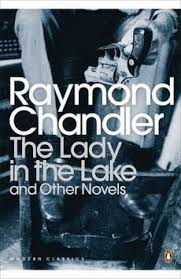
Marlowe takes a case that he would normally avoid – a MisPers (missing person). Crystal Kingsley has run out on her husband, Derace, sending him a telegram saying she was divorcing him and marrying her lover Chris Lavery. But Lavery denied all knowledge of an elopement plan when Derace met him a few days after he received his wife’s letter. Marlowe begins his investigation with a visit to Lavery in Bay City, somewhere Marlowe has had run ins with the local cops before. It’s no surprise therefore that while watching Lavery’s house, Marlowe is threatened local cop Al Degarmo, who accuses him of watching Lavery’s neighbour, Dr. Almore. Almore’s wife had died in suspicious circumstances about a year earlier. Anyone with any experience of detective fiction will jump to the conclusion that Marlowe’s missing persons case and Mrs Almore’s death will, in some way, be connected.
Lavery leads Marlowe nowhere except the run in with the local law enforcement, so he decides to drive up to the Kingsley’s holiday cabin at Little Fawn Lake, where Mrs Kingsley was staying before she went missing. Yes, that’s the lake we were waiting for. Marlowe meets the caretaker, Bill Chess, who in a highly suspicious, red lights flashing coincidence, has just been walked out on by his wife, Muriel. The scene where Marlowe and Chess chat on the boardwalk by the lake, and eventually discover the secret hidden in the water, is a masterpiece of controlled writing:
“The depths cleared again. Something moved in them that was not a board. It rose slowly, with an infinitely careless languor, a long dark twisted something that rolled lazily in the water as it rose. It broke surface casually, lightly, without haste. I saw wool, sodden and black, a leather jerkin blacker than ink, a pair of slacks. I saw shoes and something that bulged nastily between the shoes and the cuffs of the slacks. I saw a wave of dark blond hair straighten out in the water and hold still for a brief instant as if with a calculated effect, and then swirl into a tangle again.”
Chess is arrested for his wife’s murder, although Marlowe is sceptical. Marlowe tries not to be distracted by this discovery, although even he begins to wonder why death seems to follow him around:
It’s only Marlowe, finding another body. He does it rather well by now. Murder-a-day Marlowe, they call him. They have the meat wagon following him around to follow up on the business he finds.
He goes back to interview Lavery again, and it is no surprise to anyone when he finds him shot in his bathroom. Without a solid lead, he picks up the Almore case, and visits Mrs Almore’s parents, who suspect their daughter was murdered. Another run-in with the local police who are trying to prevent Marlowe investigating the Almore case derails this thread of the investigation for now, but there is no time to pause for breath before he receives a call from Derace Kingsley saying that Crystal has telephoned him asking for money to help her leave town. He asks Marlowe to make the pay-off – by now he just wants rid of his wife, even if she seems the most likely suspect for Lavery’s murder.
Marlowe is never going to give money to help a murder suspect flee the jurisdiction, but when he confronts and accuses her she pulls a gun on him. As they struggle Marlowe is sapped. Some time later he comes round:
“I smelled of gin. Not just casually, as if I had taken four or five drinks of a winter morning to get out of bed on, but as if the Pacific Ocean was pure gin and I had nosedived off the boat deck. The gin was in my hair and eyebrows, on my chin and under my chin. It was on my shirt. I smelled like dead toads.”
Crystal lies strangled to death on the bed, presumably by whoever sapped Marlowe, and with a view to framing him for the murder. Degarmo the Bay City cop, who we have learned was in love with Muriel Chess, arrests Marlowe but quickly accepts he was not responsible for Crystal’s murder. He drives him back to Little Fawn Lake to arrest Kingsley, now chief suspect. There a final confrontation ensues and all the complex threads of the mystery are drawn together in a very satisfying finale.
I’ve raved enough in recent posts to make it unnecessary to write further about the magnificence of Chandler’s prose. His imagery in particular is to my mind some of the best in modern fiction. Can you find a better simile than this, anywhere?
“She looked playful and eager, but not quite sure of herself, like a new kitten in a house where they don’t care much about kittens.”
His descriptive passages are vivid and his character portraits have a wonderful economy. Here’s Kingsley’s assistant for example – note how the imagery just can’t be kept out of his writing even if he wanted it to:
“She wore a steel gray business suit and under the jacket a dark blue shirt and a man’s tie of lighter shade. The edges of the folded handkerchief in the breast pocket looked sharp enough to slice bread.”
‘The Lady in the Lake’ is not one of Chandler’s most popular or well-known Marlowe novels. It should be; it is classic Chandler, in full control of his material and at the top of his game. Marlowe is cynical but not bitter, hard-boiled but still open to romance. For me Chandler transcends detective fiction, while at the same time defining it. I guess if my reviews haven’t persuaded you of this now then I probably should quit trying, but in case you are in any doubt, give him a try, you won’t regret it.
 The Reading Bug