Book review

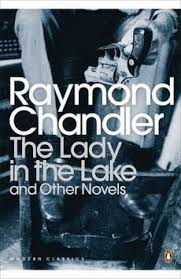
The Lady in the Lake, by Raymond Chandler, 1943

My binge reading of Chandler continues with ‘The Lady in the Lake‘, a title that does two things. It tells us to expect a body to turn up sooner or later in a lake, and hints more obliquely that there may be Arthurian elements to the narrative.
Marlowe takes a case that he would normally avoid – a MisPers (missing person). Crystal Kingsley has run out on her husband, Derace, sending him a telegram saying she was divorcing him and marrying her lover Chris Lavery. But Lavery denied all knowledge of an elopement plan when Derace met him a few days after he received his wife’s letter. Marlowe begins his investigation with a visit to Lavery in Bay City, somewhere Marlowe has had run ins with the local cops before. It’s no surprise therefore that while watching Lavery’s house, Marlowe is threatened local cop Al Degarmo, who accuses him of watching Lavery’s neighbour, Dr. Almore. Almore’s wife had died in suspicious circumstances about a year earlier. Anyone with any experience of detective fiction will jump to the conclusion that Marlowe’s missing persons case and Mrs Almore’s death will, in some way, be connected.

Lavery leads Marlowe nowhere except the run in with the local law enforcement, so he decides to drive up to the Kingsley’s holiday cabin at Little Fawn Lake, where Mrs Kingsley was staying before she went missing. Yes, that’s the lake we were waiting for. Marlowe meets the caretaker, Bill Chess, who in a highly suspicious, red lights flashing coincidence, has just been walked out on by his wife, Muriel. The scene where Marlowe and Chess chat on the boardwalk by the lake, and eventually discover the secret hidden in the water, is a masterpiece of controlled writing:

“The depths cleared again. Something moved in them that was not a board. It rose slowly, with an infinitely careless languor, a long dark twisted something that rolled lazily in the water as it rose. It broke surface casually, lightly, without haste. I saw wool, sodden and black, a leather jerkin blacker than ink, a pair of slacks. I saw shoes and something that bulged nastily between the shoes and the cuffs of the slacks. I saw a wave of dark blond hair straighten out in the water and hold still for a brief instant as if with a calculated effect, and then swirl into a tangle again.” 

Chess is arrested for his wife’s murder, although Marlowe  is sceptical. Marlowe tries not to be distracted by this discovery, although even he begins to wonder why death seems to follow him around: 

It’s only Marlowe, finding another body. He does it rather well by now. Murder-a-day Marlowe, they call him. They have the meat wagon following him around to follow up on the business he finds.

He goes back to interview Lavery again, and it is no surprise to anyone when he finds him shot in his bathroom. Without a solid lead, he picks up the Almore case, and visits Mrs Almore’s parents, who suspect their daughter was murdered. Another run-in with the local police who are trying to prevent Marlowe investigating the Almore case derails this thread of the investigation for now, but there is no time to pause for breath before he receives a call from Derace Kingsley saying that Crystal has telephoned him asking for money to help her leave town. He asks Marlowe to make the pay-off –  by now he just wants rid of his wife, even if she seems the most likely suspect for Lavery’s murder.

Marlowe is never going to give money to help a murder suspect flee the jurisdiction, but when he confronts and accuses her she pulls a gun on him. As they struggle Marlowe is sapped. Some time later he comes round:
“I smelled of gin. Not just casually, as if I had taken four or five drinks of a winter morning to get out of bed on, but as if the Pacific Ocean was pure gin and I had nosedived off the boat deck. The gin was in my hair and eyebrows, on my chin and under my chin. It was on my shirt. I smelled like dead toads.”

Crystal lies strangled to death on the bed, presumably by whoever sapped Marlowe, and with a view to framing him for the murder. Degarmo the Bay City cop, who we have learned was in love with Muriel Chess, arrests Marlowe but quickly accepts he was not responsible for Crystal’s murder. He drives him back to Little Fawn Lake to arrest Kingsley, now chief suspect. There a final confrontation ensues and all the complex threads of the mystery are drawn together in a very satisfying finale. 

I’ve raved enough in recent posts to make it unnecessary to write further about the magnificence of Chandler’s prose. His imagery in particular is to my mind some of the best in modern fiction. Can you find a better simile than this, anywhere?
“She looked playful and eager, but not quite sure of herself, like a new kitten in a house where they don’t care much about kittens.” 

His descriptive passages are vivid and his character portraits have a wonderful economy. Here’s Kingsley’s assistant for example – note how the imagery just can’t be kept out of his writing even if he wanted it to:
“She wore a steel gray business suit and under the jacket a dark blue shirt and a man’s tie of lighter shade. The edges of the folded handkerchief in the breast pocket looked sharp enough to slice bread.”

‘The Lady in the Lake’ is not one of Chandler’s most popular or well-known Marlowe novels. It should be; it is classic Chandler, in full control of his material and at the top of his game. Marlowe is cynical but not bitter, hard-boiled but still open to romance. For me Chandler transcends detective fiction, while at the same time defining it. I guess if my reviews haven’t persuaded you of this now then I probably should quit trying, but in case you are in any doubt, give him a try, you won’t regret it. 
Standard
Book review

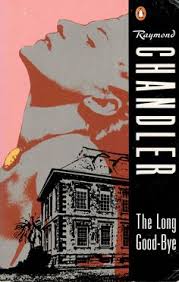
The Long Goodbye, by Raymond Chandler, 1953

I first read ‘The Long Goodbye‘ around 25 years ago, and returning to it was an absolute pleasure. It is another Marlowe novel, and is (as they all are), a gem. Some novels change over time, but Chandler’s work has a timeless quality. It doesn’t matter what is happening in the outside world, Marlowe will always be there with a smart line and a stiff drink, even if he has just discovered a body and been socked over the head.  ‘The Long Goodbye’ is late Marlowe/Chandler, with a reflective quality that shows that both men have been through a lot, and are beginning to feel their age.chandler

The plot is complex, as you would expect. Marlowe meets a drunk, Terry Lennox, outside a club. Lennox is a lush, married to a rich women who is serially unfaithful to him, and has a mysterious past, testified to by the scars down one side of his face. Marlowe and Lennox become unlikely and occasional drinking friends until Lennox shows up late one night needing a ride to the airport, no questions asked. Marlowe knows he must have very good reasons for this request, but doesn’t ask any awkward questions. He is a good enough detective to know there are only one or two reasons why someone in Lennox’s position would want to fly the country in the middle of the night. So it is no surprise when on his return from the airport, the police confirm that Mrs Lennox has been murdered. Marlowe refuses to co-operate with the police, and is slung in jail for his efforts. But his interrogation is cut short when news arrives that Lennox has committed suicide leaving a confession. Marlowe later receives a letter from Lennox containing a Madison, a $5,000 bill, and some cryptic comments that leave Marlowe with some questions about what has happened.

Chandler’s novels are often built around earlier magazine stories. Knowing this I was expecting a new storyline to be introduced at this point, and it comes when Marlowe is asked by a publisher to work out the dark secrets of one of his (the publisher’s) writers, Roger Wade. Wade is being driven to drink by whatever is troubling him, and when drunk he becomes violent, not least towards his wife. Wade has also gone missing.

Marlowe quickly tracks Wade down to a detox facility in an isolated ranch. Case solved. Inevitably that is not the end of Marlowe’s involvement with the Wades. They try to convince him to work for them as what we would now call Roger’s sober companion, but Marlowe is not interested. Meanwhile, the Lennox ‘case’ refuses to go away, even though there appears nothing left to investigate. Marlowe’s work with the Wades leads other people to conclude that he is still looking into the deaths of Mrs Lennox and her husband. This is a close-knit community where everyone knows everyone else, and there is a suggestion that Wade and Mrs Lennox were lovers . Marlowe is menaced by a mobster friend of Lennox’s, Mendy Menendez, and by Lennox’s ultra-rich father-in-law, to drop the case, even though he tells them repeatedly that he is not investigating it. Slowly, details emerge of the lives of these troubled people. Marlowe learns that Terry Lennox had lived in England, fought in the Second World War, and had been previously married.

Wade starts drinking again, and then apparently commits suicide. Marlowe is suspicious, but because he was alone with Wade at the time of his death it is he that becomes a suspect, although never seriously. In a traditional reveal scene Marlowe walks us through who really killed Mrs Lennox and Wade, and finally what really happened to Terry Lennox.

Chandler’s byzantine plots mean that even though I have read this novel before I was constantly kept guessing as to who killed whom. But as I have said before you shouldn’t read Chandler for the plots, but the wonderful prose:

When I got home I mixed a stiff one and stood by the open window in the living room and sipped it and listened to the groundswell of traffic on Laurel Canyon Boulevard and looked at the glare of the big angry city hanging over the shoulder of the hills through which the boulevard had been cut. Far off the banshee wail of police or fire sirens rose and fell, never for very long completely silent. Twenty four hours a day somebody is running, somebody else is trying to catch him. Out there in the night of a thousand crimes, people were dying, being maimed, cut by flying glass, crushed against steering wheels or under heavy tires. People were being beaten, robbed, strangled, raped, and murdered. People were hungry, sick; bored, desperate with loneliness or remorse or fear, angry, cruel, feverish, shaken by sobs. A city no worse than others, a city rich and vigorous and full of pride, a city lost and beaten and full of emptiness. It all depends on where you sit and what your own private score is. I didn’t have one. I didn’t care. I finished the drink and went to bed.” 

This is a melancholy and reflective novel in which the portraits of two serious drinkers, Wade and Lennox, are both considered self-portraits of the author.  Marlowe still takes a punch with the best of them, but it takes him just that little bit longer to come round. He is still a sucker for a pretty face, and when he takes a lover it forms part of the long goodbye of the novel’s title. I can’t rank Chandler’s novels against one another, and they are equally hard to compare to other detective fiction, such is their distinctiveness. All I can say is that if I had a desert island disc decision to make, Chandler would be very near if not at the top of my list. He is one of the language’s great stylists, and if you haven’t read him before, and aren’t offended too easily, I can’t recommend his work highly enough.

Standard
Book review

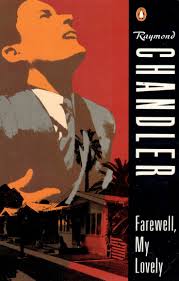
Farewell, My Lovely, by Raymond Chandler, 1940

farewell

I’ve written previously on this blog about my admiration of Chandler’s prose. His flair for dramatic imagery is really unsurpassed in the detective fiction genre. People have tried to copy it, but never achieved the same vividly imaginative description.
Plot is in many ways secondary in these novels, which is surprising given that in most detective fiction whodunnit is the central question. For Chandler the journey is more important than the destination and when we arrive at the novel’s denouement the reveal can be a little anti-climactic.

‘Farewell My Lovely’ has a typically byzantine plot, where it is really easy for the reader to get lost as to what is happening, even after several rereads. (Where I say ‘the reader’ I am thinking of one specific reader in particular, me – other people may not have these issues. See what you think)

Marlowe is investigating a missing person’s case when he crosses the path of the novel’s anti-hero, Moose Malloy. Malloy is a prodigiously large man, and has just got out of prison after serving an eight years sentence. He is looking for his former girlfriend, Velma. Malloy is slow on the up-take, but extremely persistent. In the course of a visit to a club where Velma once worked, Malloy casually kills the owner. Having witnessed the killing, Marlowe decides to track down Velma.

He locates the widow of the nightclub’s former owner but this seems a dead end as she claims Velma is dead. That evening Marlowe picks up another case in which he is asked to act as a bodyguard for a man delivering a ransom for some stolen jewellery. The reader is hardly surprised when this payment goes badly wrong, and while Marlowe escapes with a bump on the head, his client, Lindsay Marriott, is murdered.

Anne Riordan, daughter of a former chief of police, finds the coshed Marlowe, and decides to help him with his investigation. She is not the typical sidekick – Marlowe doesn’t seem to welcome her help – but she races ahead with the case, finding out that the jewellery that was to be ransomed belonged to a Mrs Grayle, the young wife of a wealthy industrialist. Prompted by Anne, Marlowe visits Mrs. Grayle. There is an immediate spark between them, and after making out they agree to go on a date at a club owned by the local kingpin, Laird Brunette. Experienced detective fiction readers will be twitching at this point, knowing that there is more to both Mrs Grayle and Laird than meets the eye, but the speed of the action is such that there is little time to contemplate this development before Marlowe is off pursuing another red herring.

While investigating Marriott’s possessions, Marlowe finds some cannabis cigarettes, and inside these the business cards of a psychotherapist, as we would now call him, called Amthor. Marlowe begins to formulate an idea that Amthor identified his clients as potential victims, and then passed their details to Marriott, who gets to know them, sets up the robbery, and then manages the payment of the ransom. Confronting Amthor turns out to be a big mistake, as Marlowe is beaten up by first his bodyguard and then two local policemen on Amthor’s payroll, then kept drugged in a private hospital run by the sinister Dr. Sonderborg. He escapes, but on the way out he sees Malloy in another room. Marlowe subsequently works out that Malloy may now be hiding out on a gambling boat anchored beyond the city’s three-mile limit, and run by Brunette Laird, who we have met before.

The novel now moves swiftly to a conclusion. In a tense scene Marlowe sneaks on board the gambling boat, before the final confrontation between Malloy, such a strong presence in the novel despite only the briefest of appearances, Marlowe, and the ghosts of the past.

As was often the case with Chandler’s novels, ‘Farewell my Lovely’ is something of a Frankenstein’s monster in which earlier short stories are welded together to create the one narrative. If you look hard for the joints you can find them, but the fact that detectives will often pursue several cases at once gives this a plausibility it might otherwise lack. But as I have said earlier, you shouldn’t read Chandler for the plot. He is above all a superb stylist.

The eighty-five cent dinner tasted like a discarded mail bag and was served to me by a waiter who looked as if he would slug me for a quarter, cut my throat for six bits and bury me at sea in a barrel of concrete for a dollar and a half, plus sales tax.”

“She gave me a smile I could feel in my hip pocket.”

“1644 West 54th Place was a dried-out brown house with a dried-out brown lawn in front of it. There was a large bare patch around a tough-looking palm tree. On the porch stood one lonely wooden rocker, and the afternoon breeze made the unpruned shoots of last year’s poinsettias tap-tap against the cracked stucco wall. A line of stiff yellowish half-washed clothes jittered on a rusty wire in the side yard.”

Just occasionally Chandler goes over the top – “The wet air was as cold as the ashes of love.” – but you feel happy to overlook this given the percentage of hits to misses. But it is as king of the simile that Chandler reigns supreme:

“Even on Central Avenue, not the quietest dressed street in the world, he looked about as inconspicuous as a tarantula on a slice of angel food.”

and

“It was a blonde. A blonde to make a bishop kick a hole in a stained glass window” (a line that can still make me laugh out loud).

Having said all that, I can’t finish this review without mentioning the racism that is scattered throughout this novel. It’s painful to read and hard to separate out the racism of 1940’s America which is I am sure being accurately portrayed from the racist attitudes of the author. I don’t think it fatally damages the novel as a whole, but it does a good job at trying. A politically correct Philip Marlowe would be an abomination, agreed, but there is something about the casual way that racist terms are used that is distasteful.

Standard