
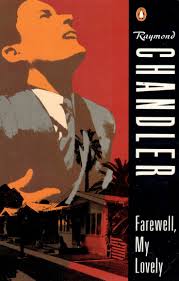
I’ve written previously on this blog about my admiration of Chandler’s prose. His flair for dramatic imagery is really unsurpassed in the detective fiction genre. People have tried to copy it, but never achieved the same vividly imaginative description.
Plot is in many ways secondary in these novels, which is surprising given that in most detective fiction whodunnit is the central question. For Chandler the journey is more important than the destination and when we arrive at the novel’s denouement the reveal can be a little anti-climactic.
‘Farewell My Lovely’ has a typically byzantine plot, where it is really easy for the reader to get lost as to what is happening, even after several rereads. (Where I say ‘the reader’ I am thinking of one specific reader in particular, me – other people may not have these issues. See what you think)
Marlowe is investigating a missing person’s case when he crosses the path of the novel’s anti-hero, Moose Malloy. Malloy is a prodigiously large man, and has just got out of prison after serving an eight years sentence. He is looking for his former girlfriend, Velma. Malloy is slow on the up-take, but extremely persistent. In the course of a visit to a club where Velma once worked, Malloy casually kills the owner. Having witnessed the killing, Marlowe decides to track down Velma.
He locates the widow of the nightclub’s former owner but this seems a dead end as she claims Velma is dead. That evening Marlowe picks up another case in which he is asked to act as a bodyguard for a man delivering a ransom for some stolen jewellery. The reader is hardly surprised when this payment goes badly wrong, and while Marlowe escapes with a bump on the head, his client, Lindsay Marriott, is murdered.
Anne Riordan, daughter of a former chief of police, finds the coshed Marlowe, and decides to help him with his investigation. She is not the typical sidekick – Marlowe doesn’t seem to welcome her help – but she races ahead with the case, finding out that the jewellery that was to be ransomed belonged to a Mrs Grayle, the young wife of a wealthy industrialist. Prompted by Anne, Marlowe visits Mrs. Grayle. There is an immediate spark between them, and after making out they agree to go on a date at a club owned by the local kingpin, Laird Brunette. Experienced detective fiction readers will be twitching at this point, knowing that there is more to both Mrs Grayle and Laird than meets the eye, but the speed of the action is such that there is little time to contemplate this development before Marlowe is off pursuing another red herring.
While investigating Marriott’s possessions, Marlowe finds some cannabis cigarettes, and inside these the business cards of a psychotherapist, as we would now call him, called Amthor. Marlowe begins to formulate an idea that Amthor identified his clients as potential victims, and then passed their details to Marriott, who gets to know them, sets up the robbery, and then manages the payment of the ransom. Confronting Amthor turns out to be a big mistake, as Marlowe is beaten up by first his bodyguard and then two local policemen on Amthor’s payroll, then kept drugged in a private hospital run by the sinister Dr. Sonderborg. He escapes, but on the way out he sees Malloy in another room. Marlowe subsequently works out that Malloy may now be hiding out on a gambling boat anchored beyond the city’s three-mile limit, and run by Brunette Laird, who we have met before.
The novel now moves swiftly to a conclusion. In a tense scene Marlowe sneaks on board the gambling boat, before the final confrontation between Malloy, such a strong presence in the novel despite only the briefest of appearances, Marlowe, and the ghosts of the past.
As was often the case with Chandler’s novels, ‘Farewell my Lovely’ is something of a Frankenstein’s monster in which earlier short stories are welded together to create the one narrative. If you look hard for the joints you can find them, but the fact that detectives will often pursue several cases at once gives this a plausibility it might otherwise lack. But as I have said earlier, you shouldn’t read Chandler for the plot. He is above all a superb stylist.
“The eighty-five cent dinner tasted like a discarded mail bag and was served to me by a waiter who looked as if he would slug me for a quarter, cut my throat for six bits and bury me at sea in a barrel of concrete for a dollar and a half, plus sales tax.”
“She gave me a smile I could feel in my hip pocket.”
“1644 West 54th Place was a dried-out brown house with a dried-out brown lawn in front of it. There was a large bare patch around a tough-looking palm tree. On the porch stood one lonely wooden rocker, and the afternoon breeze made the unpruned shoots of last year’s poinsettias tap-tap against the cracked stucco wall. A line of stiff yellowish half-washed clothes jittered on a rusty wire in the side yard.”
Just occasionally Chandler goes over the top – “The wet air was as cold as the ashes of love.” – but you feel happy to overlook this given the percentage of hits to misses. But it is as king of the simile that Chandler reigns supreme:
“Even on Central Avenue, not the quietest dressed street in the world, he looked about as inconspicuous as a tarantula on a slice of angel food.”
and
“It was a blonde. A blonde to make a bishop kick a hole in a stained glass window” (a line that can still make me laugh out loud).
Having said all that, I can’t finish this review without mentioning the racism that is scattered throughout this novel. It’s painful to read and hard to separate out the racism of 1940’s America which is I am sure being accurately portrayed from the racist attitudes of the author. I don’t think it fatally damages the novel as a whole, but it does a good job at trying. A politically correct Philip Marlowe would be an abomination, agreed, but there is something about the casual way that racist terms are used that is distasteful.

