Book review

Was Fanny Price adopted?

(And more specifically, does her legal status within the Bertram household offer the reader any insight into her character?)
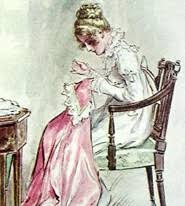
Fanny Price - Wikipedia

Was Fanny adopted? Strictly speaking, no. Adoption as a legal concept did not exist in the UK until the twentieth century. The first legislation relating specifically to adoption was not passed until the 1920s. Before then the legal status of anyone brought up as the child of another family was unclear. The construction of non-nuclear families was often a necessity given how common early death was in nineteenth-century Britain, but the law was rarely involved in the process.

Why does this matter? I think it’s because it introduces another way of looking at Mansfield Park. It can be read as a story of profound childhood trauma. A child is uprooted from her family home, her parents and many siblings and taken halfway across the country to live with an aunt, uncle and cousins she has never met before. Apart from periodic letters from her brother William she has no further contact with her family until she is eighteen. She is treated moderately well in her new home, but is never considered a full member of the family. When she does finally return to her family after eight years their poverty alienates her further (although even the Prices are not above having at least two servants! I have mentioned before the phenomenon whereby no matter how poor people become in nineteenth century literature they are always still able to employ a servant or two).

We are not told anything directly about Fanny’s feelings about her move to Mansfield Park, but there are some hints in the text about how traumatic it might have been. When considering her return to Portsmouth Fanny wonders at the reception she will receive from her mother “who had certainly shown no remarkable fondness for her formerly”. Fanny is sure this lack of maternal affection (and by extension the decision to send her away) must be her fault:

She had probably alienated love by the helplessness and fretfulness of a fearful temper, or been unreasonable in wanting a larger share than any one among so many could deserve. Now, when she knew better how to be useful and how to forebear, and when her mother could no longer be occupied by the incessant demands of a house full of little children, there would be leisure and inclination for every comfort.” (Chapter 37):

In other words she has understood all this time that the decision to send her to live with her aunt and uncle was a rejection of her by her parents, a punishment for an unknown fault. She has carried the burden of this belief in her unworthiness since the age of ten. She has also had to live with constant reminders of her lack of intelligence, grace and attractiveness compared to her older cousins. This is how she is introduced at the opening of the second chapter:

“Fanny Price was at this time just ten years old, and though there might not be much in her first appearance to captivate, there was, at least, nothing to disgust her relations. She was small of her age, with no glow of complexion, nor any other striking beauty; exceedingly timid and shy, and shrinking from notice; but her air, though awkward, was not vulgar, her voice was sweet, and when she spoke her countenance was pretty.”

Fanny is defined here by a flood of negatives. From this point on she is treated as a second-class member of the family – whenever her cousins arrange an outing or activity, Fanny is left behind to sit with her docile aunt.

Fanny had no share in the festivities of the season…as to her cousins’ gaieties, she loved to hear an account of them, especially of the balls, and whom Edmund had danced with; but thought too lowly of her own situation to imagine she should ever be admitted to the same,

The details of her move from Portsmouth to Mansfield Park are arranged so hurriedly in the novel’s opening chapter that they are easy to overlook. Initially when Mrs Price approaches her sister for help she asks

Her eldest was a boy of ten years old, a fine spirited fellow, who longed to be out in the world; but what could she do? Was there any chance of his being hereafter useful to Sir Thomas in the concerns of his West Indian property? No situation would be beneath him; or what did Sir Thomas think of Woolwich? or how could a boy be sent out to the East?

It seems as if help is indeed given to find William a situation in the navy, but in addition:

“What if they were among them to undertake the care of her eldest daughter, a girl now nine years old, of an age to require more attention than her poor mother could possibly give? The trouble and expense of it to them would be nothing, compared with the benevolence of the action.”

Sir Thomas is more cautious about the idea of bringing an unknown child into his family. He has the foresight to see some of the potential complications, even if not the sense to act on his doubts:

Sir Thomas could not give so instantaneous and unqualified a consent. He debated and hesitated;—it was a serious charge;—a girl so brought up must be adequately provided for, or there would be cruelty instead of kindness in taking her from her family. He thought of his own four children, of his two sons, of cousins in love, etc.;—but no sooner had he deliberately begun to state his objections, than Mrs. Norris interrupted him with a reply to them all, whether stated or not.

“My dear Sir Thomas….you know I am a woman of few words and professions….I don’t say she would be so handsome as her cousins. I dare say she would not…do not you know that, of all things upon earth, that is the least likely to happen, brought up as they would be, always together like brothers and sisters? It is morally impossible. I never knew an instance of it. It is, in fact, the only sure way of providing against the connexion….. Breed her up with them from this time, and suppose her even to have the beauty of an angel, and she will never be more to either than a sister….

Of course these are prophetic words, in that the risk of an attraction between cousins is not ultimately negated by the children having been brought up together.

When Fanny finally returns to Portsmouth (in chapter 39), she finds herself alienated from her family, and can no longer consider it her home. The Price family home in Portsmouth is, in Fanny’s eyes, an “abode of noise, disorder, and impropriety. “ Fanny thinks her mother to be “a partial, ill-judging parent, a dawdle, a slattern, who neither taught nor restrained her children, whose house was the scene of mismanagement and discomfort from beginning to end, and who had no talent, no conversation, no affection towards herself; no curiosity to know her better, no desire of her friendship, and no inclination for her company that could lessen her sense of such feelings.”

Fanny’s status in Mansfield Park is profoundly ambiguous. There are few precedents for a relationship of this nature, and it is for Fanny and the Bertrams, with the ever-helpful advice of Mrs Norris, to negotiate. Bringing a young man into a family to inherit a family estate and name was not unknown, and long term fostering of a child was necessary from time to time, but always with a clear objective – either to provide an heir (in which case a name change was also necessary) or to provide respite to the child’s birth parents. Jane had first-hand experience of the former type of adoption – her brother Edward having been ‘adopted’ by the Knight family, changed his name, (although retaining the Austen as a middle name) and made their legal heir. Wikipedia describes this adoption of sorts rather bluntly

When Edward was twelve years old he was presented to Thomas and Catherine Knight, who were relatives of his father and were wealthy. Thomas had given George Austen (jane’s father) the living at Steventon in 1761.They were childless and took an interest in Edward, making him their legal heir.”

Here the reasons for providing a home to Fanny are less clear-cut – essentially it is to help her parents financially, although offering some money would have done the job just as easily. This decision, so central to the novel, seems lightly done.

Mrs Norris attempts to delineate Fanny’s status in the Bertram household by her allocation of sleeping quarters:

I suppose, sister, you will put the child in the little white attic, near the old nurseries. It will be much the best place for her, so near Miss Lee, and not far from the girls, and close by the housemaids, who could either of them help to dress her, you know, and take care of her clothes, for I suppose you would not think it fair to expect Ellis to wait on her as well as the others. Indeed, I do not see that you could possibly place her anywhere else.”

Lady Bertram made no opposition.

Fanny is placed with particular precision, nearer the governess (Miss Lee) than the daughters, and close by the maids. She may not be a servant but neither is she a member of the family.

Sir Thomas also frets about the question of Fanny’s status in his household:

“There will be some difficulty in our way, Mrs. Norris,” observed Sir Thomas, “as to the distinction proper to be made between the girls as they grow up: how to preserve in the minds of my daughters the consciousness of what they are, without making them think too lowly of their cousin; and how, without depressing her spirits too far, to make her remember that she is not a Miss Bertram. I should wish to see them very good friends, and would, on no account, authorise in my girls the smallest degree of arrogance towards their relation; but still they cannot be equals. Their rank, fortune, rights, and expectations will always be different. It is a point of great delicacy, and you must assist us in our endeavours to choose exactly the right line of conduct.”

The novel’s silence on Fanny’s feelings about her move to Mansfield Park leaves it to the reader to construct this part of the narrative. Are we intended to assume that her distress at removal from her family is brief, and she easily comes to terms with the changes in her life? Or does it emotionally cripple her, causing her to withdraw into herself and become the passive observer of life we see her as?
Standard
Book review

Supplemental: A closer look at Alec D’Urberville

I wanted to take a closer look at the portrait of Alec D’Urberville in Thomas Hardy’s Tess. Alec is an archetypal rogue of fiction, one in a long line of roues that can be traced back to Robert Lovelace in Richardson’s Clarissa and beyond. These men are always attractive, but dangerous and amoral. Alec is largely a two-dimensional character. As early as Chapter 12 he tells Tess

I suppose I am a bad fellow—a damn bad fellow. I was born bad, and I have lived bad, and I shall die bad, in all probability.” (77).

So one has to ask, is there anything else to him than a symbol of male oppression and sinfulness?

I’m going to look more closely at how Hardy represents Alec. When he first meets Tess he is dressed as a young country gent:

“The driver was a young man of 3 or 4 and twenty, with a cigar between his teeth; wearing a dandy cap, drab jacket, breeches of the same hue, white neckcloth, stick-up collar, and brown driving gloves” (52).

Earlier we are told he has “a well-groomed black moustache with curled points” which completes the picture – this is someone confident in his appearance and his attractiveness to the opposite sex, over-dressed for the role of driver. This establishes a template for virtually every time Alec appears – he is never recognised straightaway by Tess. Or to be more precise his identity is never immediately acknowledged by the narrator, usually because he appears in disguise.

If Tess and Angel are consistently characterised as Adam and Eve, both before and after the Fall, Alec is the tempter. In his multiple disguises he promises her riches or a better life.

“”About the children – your brothers and sisters,” he resumed. “I’ve been thinking about them”. Tess’s heart quivered – he was touching her in a weak place. Since returning home her soul had gone out to those children with an affection that was passionate.....if your mother does not recover, somebody ought to do something for them; since your father will not be able to do much I suppose”.

(Tess angrily rejects him, and in response )

“D’Urberville in anger retreated from her to the hedge, where he pulled off the long smockfrock and red neckerchief which had mainly disguised him”.

350

He disappears from the narrative for a several chapters while Tess and Angel are falling in love at the dairy, only to return in dramatic fashion. At the end of chapter 44, coming back from an unsuccessful visit to Angel’s parents, Tess meets Alec preaching to a small crowd. He is a reformed man and has found god. She hears him before she sees him, and it dawns on her that the voice, preaching “a vehement form of the views of Angel’s father” is that of Alec. (305-6). From this point he begins to haunt Tess, seeking her out time and again. He next appears (314) as “a black speck” and is “perceived to be a man in black…in a semi-clerical costume(my emphasis). He tracks her down to her cottage, and then pesters her while she works on a threshing machine:

“Just before the dinner-hour a person had come silently into the field by the gate, and had been standing under a second rick watching the scene, and Tess in particular. He was dressed in a tweed suit of fashionable pattern, and he twirled a gay walking-cane”. (327).

We don’t have long to wait before Alec resumes his persistent attempts to persuade Tess to resume her relationship with him. She returns home to Marlott where her mother has been taken ill. One evening she is working on the family’s small-holding when she becomes aware of someone working alongside her in the twilight:

Tess did not speak to her fellow-worker, nor did he speak to her. Nor did she think of him further than to recollect that he had not been there when it was broad daylight….by and by he dug so close to her that the fire-beams were reflected as distinctly from the steel prongs of his fork as from her own. On going up to the fire to throw a pitch of dead weeds upon it, she found that he did the same, on the other side, the fire flared up, and she beheld the face of D’Urberville. “

Alec’s demonic appearance, pitchfork and all, is re-emphasised. Once again he is in disguise – almost one might say in fancy dress:

“The unexpectedness of his presence, the grotesqueness of his appearance in a gathered smockfrock, such as was now worn only by the most old-fashioned of the labourers, had a ghastly comicality that chilled her as to its bearing. …

“A jester might say this is just like paradise. You are Eve, and I am the old Other One come to tempt you in the disguise of an inferior animal. I used to be quite up in that scene of Milton’s when I was theological.”

349

Their penultimate meeting is in Kingsbere church, among the tombs of the ancient D’Urbervilles. Tess is looking round the old church, home to her ancestors:

“She musingly tuned to withdraw, passing near an altar-tomb, the oldest of them all, on which was a recumbent figure. In the dusk she had not noticed it before, and would have hardly noticed it now but for an odd fancy that the effigy moved. As soon as she drew close to it she discovered all in a moment that the figure was a living person; and the shock of her sense of not having been alone was so violent that she was quite overcome, and sank down nigh to fainting, not however till she had recognised Alec D’Urberville in the form.

(363).

What are we to make of this presentation of Alec? The references to his demonic appearance aren’t that hard to decode (!) but the narrator’s persistent failure to identify him on his first appearance in each scene is more problematic. Is this just a stylistic quirk, a way of allowing the reader to guess his identity before it is confirmed, giving the false impression that the reader is slightly ahead of the narrator in their understanding of the story? Possibly, but if this was all that is going on it would be quite a tired device. When a mysterious stranger appears in the Sherlock Holmes stories (by comparison) the real surprise is when it is not Holmes in disguise. We quickly learn that it will be Alec who appears out of the gathering darkness whenever someone appears.

With regard to his disguises and costumes, I think these are a way for the author to signal Alec’s instability and unpredictability, the mercurial nature of his character and his insincerity. He presents himself to the world in the way he wants to be seen, and when that character has served its purpose it is discarded. He may even be sincere in his presentation, but it is no less shallow and superficial for all that. It is this that makes him so dangerous.

Literature has worse villains than Alec D’Urberville, but it is hard to feel sorry for him when Tess finally extracts the retribution he has coming to him.

I’d be interested what any readers of this post make of Alec – is there more to him than the stage-villain with a curled moustache and a cloak?

Standard
Book review

Supplementary: Sense and Sensibility and Pride and Prejudice – a comparison

As I read Sense and Sensibility‘ earlier this month I was struck by the many similarities between the novel and ‘Pride and Prejudice‘. My initial theory was that ‘Sense‘ was an early draft of ‘Pride‘, but that didn’t withstand much research – as Claire @ nerdslikeme.co.uk pointed out in a comment on an earlier post, although ‘Pride‘ was published second it was written first. Nevertheless, ‘Sense‘ is, to me, the junior or lesser work. Components of ‘Sense‘ which work well are even more impressive when portrayed in ‘Pride‘.

Both novels focus on the romantic affairs of a family of women, in which a father figure is to all intents and purposes missing. Mr Bennet is of course alive, but disastrously abdicates any involvement in his daughters’ romances, until in Lydia’s case it is too late. In both novels the families’ inheritance situation is precarious – if Mr Bennet dies the family will have to leave Longbourn; Mr Dashwood’s death leaves his second family in a position where they have to leave their home and take a cottage donated by a charitable family member, taking at the same time a large step down the social ladder.

The events of the novels are each described through the narrative perspective of an older sister. Elinor and Elizabeth are both sensible, mature young women who are embarrassed and scandalised by the conduct of their younger sisters. They are not completely reliable narrators – they withhold information from the reader and perhaps themselves, but their judgment is the one we are invited to trust. In terms of the family dynamics they take the place of their mothers who are portrayed as less intelligent and lacking in mature judgment. Younger teenage sisters are a cause of drama in each household. Marianne nearly engages herself to an unsuitable young man; Lydia does so, and goes further. Willoughby is immature and flirts with Marianne while never seriously contemplating an engagement – his financial affairs and his profligacy means he has to marry well; Wickham is equally focused on marrying for money while having fun as a single man, with little concern for the feelings of the women he dallies with.

Each novel also has a spare sister. Margaret Dashwood plays little or no part in ‘Sense’, in terms of the plot nor as a commentator or observer; Mary Bennet plays arguably a slightly more important  role in Pride, but is easily forgotten amongst the noise generated by her siblings.

Secrets and lies are at the heart of both novels. Much of what occurs in the texts is hidden from the reader. Marianne has no idea why Willoughby leaves Devon so suddenly, nor why he gives her the cold shoulder when they meet in London; all Mr Darcy’s efforts to salvage the situation with Lydia and Wickham is equally hidden from the Bennet family until near the end of the novel. Elinor has to bear the secret of Mr Ferrars’ engagement with Lucy Steele until it is finally broken; at least Elizabeth has someone to share her secrets with in her sister, Jane.

Finally, it all comes down to money. This is the central obsession of both novels. Many conversations revolve around character’s income, their savings, the inheritance they are likely to receive, etc. In ‘Pride’ there is an inflation of expectations – the sums Mrs Bennet talks about as being suitable for her daughters’ prospective and theoretical husbands gradually increase through the course of the novel. The despicable Mr Collins explains to Elizabeth that he is prepared to overlook her relative poverty, and later Mr Darcy makes a similar point, with broadly the same result. The same conversations dominate ‘Sense’; we are never far away from speculation about the worth of an individual in terms of income and savings, and Willoughby’s marriage to an heiress allows other characters scandalised by his behaviour towards Marianne to quickly overcome their scruples.

In comparing the novels I am not of course suggesting that Austen has recycled her material. She famously accepted that her work was narrow in scope, once writing:

“What should I do with your strong, manly, spirited sketches, full of variety and glow? How could I possibly join them on to the little bit (two inches wide) of ivory on which I work with so fine a brush, as produces little effect after much labour?”

It is her ultimate achievement that she produced such stunning novels with such fine material. Van Gogh painted sunflowers many times, but each painting is unique. In considering ‘Pride‘ the more successful novel, that’s a personal view mainly in relation to how the central romance is portrayed – I enjoy the love story of Elizabeth and Darcy, while Edward and Elinor never really go through the same journey or face the same challenges. What do you think?

Standard
Book review, Conan Doyle, Detective, Detective fiction, Holmes, Holmes and Watson

Supplementary: The Mystery of Sherlock Holmes

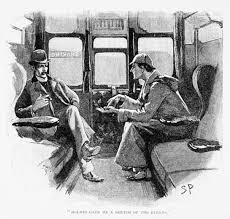
If you read the comments on my recent post about ‘The Adventures of Sherlock Holmes’ you may have seen I postulated that there is a paradox at the core of how we perceive Sherlock Holmes. On the one hand he is (and so far as I can make out, always has been) enormously popular; on the other his stories are formulaic and (in the words of Bookertalk) “preposterous”.download (3)

The case for the prosecution  is easily made. The Holmes stories are rigidly structured – Holmes and Watson are chatting, Holmes casually tosses over a letter he has received from his most recent client, telling him they will call at a certain hour which precisely arrives at the moment their initial assessment of the case has concluded.

“DEAR MR. HOLMES:—I am very anxious to consult you as to whether I should or should not accept a situation which has been offered to me as governess. I shall call at half-past ten to-morrow if I do not inconvenience you. Yours faithfully, “VIOLET HUNTER.”
“Do you know the young lady?” I asked.

“Not I.”

“It is half-past ten now.”

“Yes, and I have no doubt that is her ring.” (The Adventure of the Copper Beeches).

Holmes performs his parlour trick of determining the visitor’s background – “Beyond the obvious facts that he has at some time done manual labour, that he takes snuff, that he is a Freemason, that he has been in China, and that he has done a considerable amount of writing lately, I can deduce nothing else.” – (The Red-Headed League)

The game is then afoot, and Holmes quickly resolves the mystery by dint of some off-camera background research, investigations using a disguise or two, and a good dose of luck. I pointed out in my previous post that the resolution of each case is often not what the client hoped for. Of the twelve stories in ‘The Adventures’, one case fails completely (A Scandal in Bohemia), in another the client is murdered and the murderers escape (The Five Orange Pips) and in yet another Holmes solves the mystery but decides not to reveal the solution to his client (A Case of Identity).

Beyond this rigid structure, there are other issues. Apart from Holmes and Watson few other characters are brought to life – certainly not in the way they are in Sherlock for example, where they are given complex and interesting back stories. The writing is nothing out of the ordinary, and the author frequently ‘cheats’ by way of undetectable poison or by withholding information key to the resolution of the case until the last moment. Some if not many of the situations are indeed preposterous – for example in ‘The Adventure of the Speckled Band’ a  bell pull is installed in the victim’s bedroom, but it is not connected to anything (did people have bell-pulls in their bedrooms anyway? Perhaps the senior aristocracy who needed help dressing, but not in a small household as in this story).

The case for the defence would probably point out that the Holmes stories are some of the best loved in literature. Holmes has inspired many other writers, film-makers and artists, and the rich range of secondary characters in the books, from Mrs Hudson to Irene Adler, Lestrade, and of course not forgetting Moriarty may indeed be sketched briefly but are powerfully brought to life. The defence would also mention Conan Doyle’s virtual invention of the detective story, the cleverness of many of his plots, the inventiveness of Holmes’s deductions, and the strength of his enduring relationship with Watson. Descriptive writing may not be Conan Doyle’s strength, but London is brilliantly evoked.

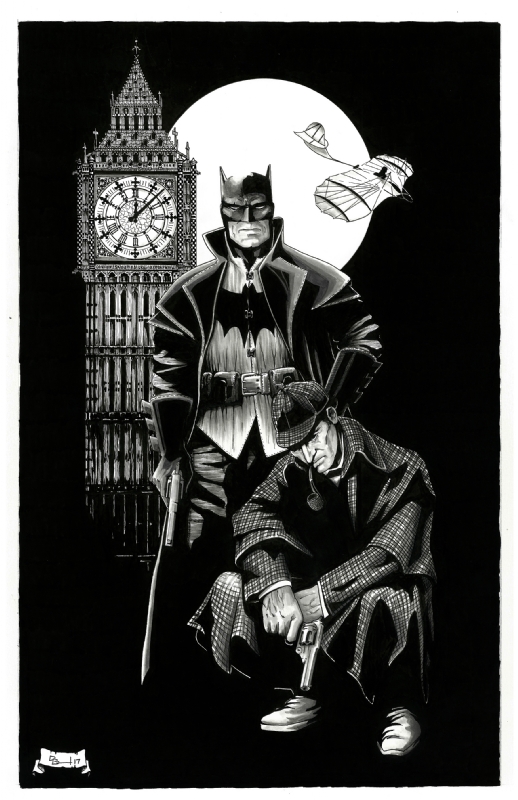
Thus far a fairly balanced case. But I think the enduring power of the Holmes stories lies elsewhere. Holmes was one of the earliest super heroes.  He has enormous strength – he can straighten a bent poker. He is utterly fearless. He has almost super-human powers of observation, deduction and intelligence, and well as a vast array of scientific and other information at his fingertips. He fights for the poor and the oppressed as well as the prosperous. He is a master of disguise, and sometimes wears a cloak. He lives among us, but apart. The country would fall without him. Yes, he’s Victorian Batman.Sherbat.jpg

And we all love a good super hero. The MCU franchise is not the most successful series of films in Hollywood history for nothing. What is more we need heroes. In Victorian England the readers of the Strand magazine would have felt threatened by trade unions, rising crime, the poor, suffragettes, and Germans, not in any particular order. Today we fear rising crime, lawlessness, terrorism, Trump. We still need Holmes out there stopping the bad guys, which is why we still have him.

Being a conscientious blogger I always try and find out if what I think is an original observation is just a cliche, and no surprise – I am not the first person by a long way to draw this parallel. Apologies, but I think the point still stands. Incidentally I don’t think it is important to get hung up on the specific super hero – the point is he plays the same role in society, offering hope to the vulnerable and scared. Which is why Holmes has developed such a rich life outside the Conan Doyle stories, and why he will remain a source of fascination and inspiration for many decades to come. Inevitably the original source material might look a little jaded in this context, but that would be to miss the point. Which I think, in my previous post, I did.

Standard