
Authors of classic works of literature tend to gain a reputation in popular culture – Lawrence is raunchy, Dickens is long-winded and a bit preposterous, Joyce impenetrable, Pinter full of pauses, and Shakespeare “difficult”. Sometimes these reputations are justified; more often they are cliches that are dispelled as soon as one reads the author concerned. But they are astonishingly pervasive, and sometimes damagingly so. Tell a student that Shakespeare is difficult often enough and sooner or later they will believe it. I am sometimes guilty in falling for these stereotypes and I did with Hardy. Based on the evidence of a reading of the undeniably bleak ‘Jude the Obscure‘ (which I can’t believe I reviewed six years ago!) I accepted the idea that Hardy is depressing, slow, and that his characters invariably come to an unfortunate end.
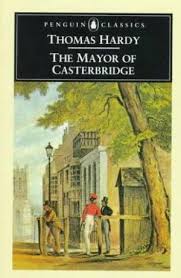
‘The Mayor of Casterbridge‘ confounded many of those expectations. It is fast paced and packed with incident. But literary clichés don’t come from nowhere and most have some truth in their origins. True to his instincts Hardy ensures that this novel’s protagonist and his family are never able to escape completely the consequences of the fatal decision taken in the opening chapter. That decision, as you may know, is made by the eponymous Thomas Henchard, then a lowly agricultural labourer. In a fit of drunken anger Henchard decides to sell his wife and child. Wife sales were by this time a well-established form of divorce, in particular in rural communities. It was widely believed that they legalised the process of separation. The ‘purchaser’ was usually the man that the wife had left her husband for. The sales were conducted publicly on market days. In other words they were akin to a piece of theatre, in which the old relationship was formally dissolved, and the new recognised and legitimised. The Wikipedia entry on wife sales is highly recommended by the way. All the textual indications are that the wife sale in ‘Casterbridge’ is not like this at all, but a spontaneous decision, done in a drunken fit of anger, regretted thereafter, and that the buyer is a stranger. In other words not an informal rural divorce at all, but a vicious form of spousal abuse in which the wife and child were treated as the husband’s property to be bought and sold.

From this dramatic and unexpected opening, the novel jumps forward 18 years. Shocked into sobriety, Henchard has risen in the world and become a successful grain merchant and Mayor of Casterbridge. Somehow he has avoided anyone finding out his dark secret. (This if you think about it is surprising – this part of the world was very isolated, but people did travel to find work and attend country fairs, and a spontaneous wife sale would have been a thing to remember). His not quite ex-wife Susan unexpectedly appears in Casterbridge with her daughter, Elizabeth-Jane, seeking her long lost husband. At around the same time Henchard fatefully meets Donald Farfrae, a corn merchant on his way to America. He helps Henchard with some advice and as a result is offered a job.
Hardy moves his pieces around swiftly. Henchard and Susan ‘remarry’ to keep up public appearances. Henchard discards another former lover, Lucetta, from his time in Jersey. For a moment it looks as if the wrong of 18 years ago has been righted and the Henchard family restored. With Farfrae’s appointment proving a success, the Henchard business prospers. But this is Hardy and this happy state of affairs is not going to last. Henchard and Farfrae argue and Farfrae sets himself up in a rival business. The fledgling romance between Farfrae and Elizabeth-Jane founders in the face of her father’s opposition. Susan dies in the manner of so many Victorian novel characters, fading quietly and gracefully away, at which point Henchard learns he is not Elizabeth-Jane’s father after all. On cue Lucetta arrives in Casterbridge and both she and Henchard assume they can pick up where they left off. This is never going to happen – instead she falls for Farfrae, who she eventually marries. She now has good reason to keep her former relationship with Henchard secret, but secrets don’t stay kept forever in Casterbridge.
All is revealed when a trove of old love letters fall into the wrong hands. As soon as the reader finds out about the existence of this collection of letters the chances of them revealing their secrets are, let’s face it, pretty near inevitable. The working class elements of the town shame Henchard and Lucetta in a ‘skimmington ride’. This is another of those near extinct rural tradition which fascinated Hardy, but they don’t support the idea that these fading traditions are worth preserving! Lucetta, by this point pregnant, dies of what appears to be a seizure – which is the alternative method of choice for novelist wanting to kill of your characters without taking time for the ‘fading away gracefully’ technique. Henchard resumes his drinking, and his end is not long in coming. Farfrae marries Elizabeth-Jane to tidy away the pieces, and the moral of the story – don’t drink, as it leads to you selling your wife and child, and all the unpleasantness that follows, which you will never be able to escape – is reinforced once more.
There is more than a whiff of soap-opera about ‘Casterbridge’, all sudden romances, long-lost lovers reappearing, missing love letters and so on. The spiralling, unavoidable consequences of Henchard’s drunken spousal abuse mean that no matter how hard he tries a mis-step is always just around the corner. He can try to live a good life but his past will catch up. After a while the reader can see the next plot device lumbering into view – it is hardly a surprise when Henchard’s business goes bust, when it turns out Elizabeth-Jane is not his daughter, and so on. The pace of the novel allows Hardy to get away with this predictability – just – as there is always a new event appearing over the horizon to distract our attention. But looking back over the novel as a whole, as one inevitably does in a review, you can see the joints more clearly and the effect is that the sum of the parts is less than the whole.
 The Reading Bug
Really enjoyed reading your reaction to one of my favourite Hardy novels. I also dislike Jude – mainly because I am so frustrated with him and his awful cousin Sue
LikeLiked by 1 person
Thanks for the feedback. I read Jude for my reading challenge – thought it was a bad choice considering what else Hardy wrote.
LikeLike
What I haven’t yet completely decided on is whether the problem is Jude or Hardy? Casterbridge is a good corrective to the gloom or Jude, but which is the more representative novel – and do I have the appetite to find out?
LikeLike
Oh boy, what a difficult question. Hardy is of course always accused of being miserable and dark and to be fair most of his novels are a bit gloomy. I suppose for me i can empathise with Henshaw even though he is a fool at times whereas I have not one jot of sympathy for Jude
LikeLiked by 1 person