
What a disconcerting, puzzling book this is. At barely 100 pages it is little more than a long short story, but Spark gives the reader a lot to think about in this strange tale of her lead character’s last few hours on earth.
“She will be found tomorrow morning dead from multiple stab wounds, her wrists bound with a silk scarf and her ankles bound with a man’s necktie, in the grounds of an empty villa, in a park of the foreign city to which she is travelling”.
Spoiler? Perhaps, but this is how Spark opens chapter three of this novel, 20 pages in. So there is no suspense about how the novel is to end, and the reader’s interest switches (or is switched) to why the central character, Lise, is going to die and why she behaves in the way she does.
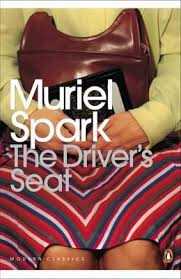
Lise behaves erratically throughout the novel. At first this behaviour is mildly eccentric – she takes offense when a shop assistant tells her the dress she is trying on is stain resistant. Only in hindsight does this reaction have any sinister connotations. As the novel progresses her behaviour becomes stranger and more reckless. Is she unwell or “driven to distraction” as the blurb to the Penguin Modern Classics edition would have it. In going on holiday to an unnamed European city she exposes herself to danger from sexual predators. At one point she takes refuge from a student protest (very 1960s) in a garage. The owner sees an opportunity for a casual sexual encounter:
“The big man takes her hand and holds on to it tightly as if his grasp itself was a mental resolution not to let go this unforeseen, exotic, intellectual, yet clearly available treasure.”
Note the use of the present tense – the narrator describes the action as it happens in a neutral, filmic way, (“he takes”) but is also able to understand and explain this character’s unspoken thoughts. He interprets Lise’s friendly, open manner as suggesting that she is “clearly available”, and goes on to assault her after driving her to the outskirts of the town, and loses his car in the process.
It is significant that this occasion – the taking of the garage owner’s car – is the one time when Lise drives. The driver’s seat is one she rarely occupies. In the brief 24 hour or less span of the novel she takes a number of rides in vehicles – from her flat to the airport, from the airport to her hotel, back to her hotel in the garage owners car, and so on – but in only one of them is she the driver. Being ‘in the driver’s seat’ is idiomatic English for being in control, and it is only here when Lise begins to take control of her narrative. I think this gives us a way of understanding the central enigma of this novel, which is that Lise unambiguously chooses to be murdered. She seeks out someone prepared to kill her, and encourages him to do so. The realisation that this might be her suicidal intention slowly builds through the novel, and comes to a climax in the closing pages:
“She says: ‘I’m going to lie down here. Then you tie my hands with my scarf; I’ll put one wrist over the other, it’s the proper way. Then you’ll tie my ankles together with your necktie. Then you strike.’ She points first to her throat. ‘First here’ she says. Then, pointing to a place beneath each breast, she says ‘Then here and here. Then anywhere you like’.”
And her killer complies. This is a shocking, horrific scene, and Spark offers no easy explanations for Lise’s behaviour. I offer what follows therefore as one interpretation, but I am acutely aware that this is not in any way a definitive or conclusive account – it is offered simply as one way of reading the novel.
Imagine for one minute that you are reading a newspaper account of Lise’s murder. You read about how her body was found, how her limbs were tied, how she was raped and stabbed. Police and media investigations tell the story of Lise’s last hours and the various brief interactions she has with other people. Her comments are viewed from the perspective of what happened to her. What was taken at the time as a throwaway comment or silly joke is now given deeper meaning in the light of her death. This is what happens to many crime victims – their deaths are explained by their conduct, often with the suggestion that this was a causal chain of events, in which the victim was in some way the author of their own fate.
What I think Spark does here is start with the murder, then goes back to reconstruct the preceding hours in exactly this way. The victim is shown as being responsible for her death, in the way that rape and murder victims, particularly women, are often portrayed in the media. There are several references throughout this novel to Lise’s brief interactions with people being told through the lens of a police investigation. For example she has a short conversation with a traffic policeman in which her comment “Do you carry a revolver…because if you did you could shoot me’ becomes portentous: The policeman is still finding words when she drives off, and in the mirror she can see him looking at the retreating car, probably noting the number. Which in fact he is doing, so that, on the afternoon of the following day, when he has been shown her body, he says “Yes, that is her”.
Read this way the novel is a critique of victim-shaming, highlighting the ridiculousness of the notion that simply because someone is vulnerable, dresses eccentrically, and takes risks, that they are inviting their rape and/or murder. Of course Lise didn’t tell her attacker to stab her, but this re-imagining of the day of her death is the only coherent way to justify any suggestion of her culpability.
This is not a novel where the author presents easy answers. But if this reading is in any way coherent, then the novel is more shocking than I initially thought. This is not in other words one of those novels were people do strange things and it is simply left to the reader to fill in the gaps and explain their actions. I do appreciate this approach is reductive, and it is unlikely that Spark ever wrote with such a one-dimensional didactic purpose. But the alternative, posed for example, by John Lanchester in the introduction to the Penguin Modern Classics edition – “Lise is mad, of course” – isn’t particularly satisfactory either given for example her long term ability to hold a responsible job. No-one in her life or who meets her thinks she is simply mad. It is only because the narrator tells us that she wanted to be killed that we could ever conclude that she is deranged, rather than any other aspect of her otherwise mildly eccentric behaviour.
I’ve possibly spent longer writing this review than I did reading this novel. Which tells you how thought provoking it was.

