Book review

Memento Mori, by Muriel Spark, 1959

In an interview in 1960, Muriel Spark gave this account of the origins of Memento Mori:

“It happened that a number of old people I had known as a child in Edinburgh were dying from one cause or another, and on my visits to Edinburgh I sometimes accompanied my mother to see them in hospital. When I saw them I was impressed by the power and persistence of the human spirit. They were paralysed or crippled in body, yet were still exerting characteristic influences on those around them and in the world outside.”

Author’s stories about the origins of their novels always have to be taken with a pinch of salt, but if this account is correct then it suggests that Spark approached her story and her characters with empathy and compassion. Older people, in this account, are impressive and even dignified, they are “exerting characteristic influences on those around them” – which is rather an ambiguous turn of phrase don’t you think? Spark went on to say “I saw a tragic side to this situation and a comic side as well”.

I think anyone who has spent time with people coming to the end of their lives can appreciate that the tragedy of death can on occasion be illuminated by moments of black or even absurd comedy, which relieves the sadness of the situation. But dying people are still people and I am not sure that Spark delivers on her intention of illustrating the complexity of this situation in her portraits of her characters, many of whom are rather awful. To be fair the smaller number of younger characters are all pretty appalling as well!

The plot of Memento Mori revolves around a group of older (aging, but not dying, other than in the sense that we are all dying sooner or later) metropolitan people: brothers and sisters, husbands and wives, and friends and lovers. The extensive cast includes at its core Dame Lettie Colston, her brother Godfrey, retired head of a brewing company, his wife Charmian, a successful novelist, and Charmian’s former maid, Jean Taylor. Apart from Mrs Taylor, these are upper-middle class people who can afford maids and housekeepers. Mrs Taylor is bedridden and lives in a nursing home, the ‘Maud Long Medical Ward’, with eleven other “grannies”. Grannies is the slightly disparaging title given to the patients by the staff, not all of who are happy with the description:

“Miss or Mrs Reewes-Duncan threatened for a whole week to report anyone who called her Granny Duncan. She threatened to cut them out of her will and to write to her MP. The nurses provided writing paper and a pencil at her urgent request.”

Calling someone by a title they don’t choose or like is disrespectful and a mild form of bullying. The ‘grannies’ exercise the little autonomy they have in their lives by threatening to change their wills whenever anyone crosses them, even though most of them have little or nothing to bequeath. Life in the ward is reduced to the bare essentials, a dull routine of meals and conversation, most of which revolves around discontent with the nursing staff or the daily horoscopes read out for them all by Granny Valvona. These characters act as a form of chorus to the rest of the events of the novel. Outside the ward, former lovers and old friends call in for tea and something stronger and little happens to disturb their calm and pleasant existence – until the day Lettie starts to receive anonymous phone calls with the message “Remember you must die.” Instead of taking this reminder as an encouragement to live life to the full while you can, Lettie finds it menacing and upsetting. Other members of the group start to receive similar calls and respond in the same way. The police are baffled and begin to suspect that no such calls are being made. Is this a shared delusion or just a childish prank? A retired policeman is hired to investigate, but makes no progress and falls under suspicion himself. Eventually a new normal emerges in which the calls are mostly accepted as part of the routine of life, and any menace they contained is thus neutralised.

Most readers will have anticipated that one of the peripheral characters – and there are plenty of possible suspects – would at some point be exposed as the mystery caller, but this never happens. The caller is never identified nor caught. It is suggested that there might be a supernatural or psychological explanation for the calls, but this is not followed up. I felt rather short changed by this lack of a resolution. If you build your novel round a mystery then surely you need to have an outcome in which the mystery is explained? I appreciate that is very old-fashioned of me. I know Godot never arrives, that the world is not neat and tidy and mysteries remain unsolved. But this is not an existential novel on the unknowingness of the universe, it is a domestic comedy in which the anonymous calls are a central part of the plot. Imagine reading a version of The Hound of the Baskervilles, at the end of which Holmes and Watson wander off shrugging their shoulders saying, “Yeah, it might have been a dog, who knows”.

Other subsidiary plot lines are less frustrating and in some respects compensate for this decision. Lisa Brooke, a friend of the group, dies early in the novel, leaving a substantial estate to be argued over by her husband, her siblings and her housekeeper, Mrs Pettigrew. Mrs Pettigrew is the novel’s villain, blackmailing the people she looks after, nosing her way into their secrets and forcing them to change their will or risk exposure.

Writing in the Guardian in 2010, David Lodge agreed with Martin Stannard’s conclusion in his 2009 biography of Spark that Memento Mori “remains one of the great novels of the 1950s,” I can’t agree. I admire Spark as a writer but this is one of the least interesting of her novels that I have read. It patronises and looks down on the elderly and treats them as disposable objects rather than well-rounded characters. Instead of giving a voice to the elderly, rarely centred in fiction, it objectifies them. I kept being reminded of Kingsley Amis’s The Old Devils, which has many of the same flaws but at least invests the elderly characters with some passion and lust for life. It is not a coincidence that Amis was a lot closer in age to his characters than Spark was, and could therefore portray them with more empathy. To illustrate this point consider the following exchange between Godfrey, his wife Charmain and his sister Lettie. Bear in mind that Charmian has suffered a stroke, possibly several, and is struggling with cognitive decline, made all the worse by the fact that she was once a successful author:

“Would you like me to read you the obituaries, dear?” Godfrey said . . .

“Well, I should like the war news,” Charmian said.

“The war has been over since nineteen forty-five,” Dame Lettie said. “If indeed it is the last war you are referring to. Perhaps, however, you mean the First World War? The Crimean perhaps . . .?”

Is this funny, in a ‘you have to laugh’ way, or is it mocking someone with memory loss? Arguably Charmian has the last laugh – her books are reissued, she is ‘rediscovered’ and becomes popular, and recovers much of her cognition. Spark ends her novel with a quick summary of what happens to all her characters after the events of the novel, and unsurprisingly (almost) all of them die one way or another. Memento Mori indeed.

Memento Mori, by Muriel Spark, 1959

Aside
Book review

The Bachelors, by Muriel Spark, 1960

Muriel Spark’s The Bachelors revolves around a group of single young(ish) men in 1950’s London. The plot centres on a case of fraud against a bogus spiritualist Patrick Seton. Seton, a leading member of spiritualist group, The Wider Infinity, is accused (and is clearly guilty of) forging a letter from his landlady, to explain his embezzlement of £2,000. Barrister Martin Bowles is prosecuting Seton, and friend Ronald Bridges, a handwriting expert, is going to be an expert witness in the trial. Other minor characters have bit-arts including an art-critic, a journalist and a teacher.

While the story is ostensibly about the men in the novel, the women play an equally central role – the novel could easily have been called ‘The Bachelors and the Spinsters’. I suspect the choice of title reflects the women’s apparent lack of agency – they are usually subservient to and manipulated by the men, in particular Alice, Patrick’s pregnant and vulnerable girlfriend. The novel takes a sinister turn from the mildly comic when it becomes apparent that he is planning to kill her by depriving her of the insulin she needs to stay alive.

And I will release her from this gross body. He looks with justification at the syringe by her bedside, and is perfectly convinced about how things will go in Austria (all being well), since a man has to protect his bread and butter, and Alice has agreed to die, though not in so many words.

Worse, one of his fellow bachelors suspects his plot but does little to prevent it. Patrick is something of a psychopath – his murderous intentions are not really financial but sadistic, possibly triggered by Alice’s refusal to abort the baby she is carrying. She gullibly believes Patrick’s assurances that they will marry as soon as his divorce is made final. Elsie, her friend, distrusts Patrick, and seeks to secure his conviction in the forgery/fraud case to help Alice escape his malign influence.

Modern (that is to say, 1950’s) spiritualism is a central theme of the novel, and it doesn’t come particularly well out of it, as you can probably imagine. It is a means to manipulate and defraud the simple-minded. Seton, an obvious villain, is protected his supporters within the Society, who are convinced he is a genuine medium, and his trial is the satisfying climax of the novel, where just desserts are granted.

The Bachelors is a quite dark novel, despite the overall jaunty tone. Ronald’s epilepsy is presented as a parallel to the spiritualists’ attempts to contact the ‘other side’ (they use the same drugs for example) in a way I couldn’t quite understand. I appreciate epilepsy as a condition was looked at very differently in the 1950’s compared to the way it is now – it was still under the shadow of the idea of possession, more part of the middle ages than a twentieth century attitude.

This wasn’t one of Spark’s stronger novels. The characters, especially the minor ones, are not clearly defined, and I think most readers will share my experience of struggling at times to work out who is speaking and what there relationships are to the other characters present. The reader has to do a lot of the work, and while sometimes that is justified, here is simply felt frustrating. The humour doesn’t always land and the portrait of living with epilepsy as if it were a curse was depressingly out of date.

I remain convinced that Spark is an under-appreciated writer who is always worth the short time it takes to read her very condensed novels, but overall this was a miss for me.

The Bachelors, by Muriel Spark, 1960

Aside
Book review

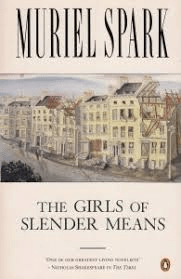
The Girls of Slender Means, by Muriel Spark, 1963

Utterly wonderful. Truly superb and written with extraordinary economy, so that even every word of the title is working hard. I haven’t read anything close to this this good in the novella format since J L Carr’s A Month in the Country.

That’s the short review: the full review is going to be a bit longer. I’ve written before about how when one summarises ‘what happens’ in a novel the tendency is to present it as a chronological sequence of events, a straightforward ‘this happens then that happens’ narrative. But of course many novels simply aren’t like that at all and such summaries while useful in some respects do the novel a disservice. They undermine the complexity of the structure and in this case the extremely clever way Spark slowly reveals her plot. It’s so well done that this is one of those novels that you immediately turn to the opening pages once you have finished (which doesn’t take long, this is less than 140 pages) and start again, looking at the text in a completely different light. I don’t want to spoil that experience for you, so if you have any intention of reading this one I’d avoid the section of this review marked ‘Spoilers’ – but it would be great if you would come back once you have read it and see if you agree with what I have said.

Muriel Spark is one of those writers whose books I always buy if I come across them in second-hand or charity stores. She is always interesting. The Girls of Slender Means was her next novel after The Prime of Miss Jean Brodie, and I am convinced it is its equal – perhaps Jean Brodie gets the accolades because of the exceptional film version. It is set in the May of Teck Club, a hostel for young women, just after the end of the war in Europe in 1945. It follows the adventure of the residents of the hostel, young women navigating life in a suddenly changed world, in which the carelessness and danger of the war years is being replaced by something less clear. The election of Attlee’s radical Labour Government is mentioned and forms a backdrop to the novel, but it’s not just politics that is changing. The role of women in society changed radically during the war years – young women went out to work and had romantic adventures – but it is not obvious whether these changes will be sustained or whether things will go back to the way they were. Against this backdrop the small dramas of the women’s lives unfold and come to a crisis point focussing on, of all things, the bathroom window that leads to the secluded rooftop shared with the hotel next door. Only the slenderest of girls can manage to wriggle through this window onto the rooftop but this seemingly insignificant fact goes on to become a key turning point in the story.

This is a gem of a novel, perfectly formed and full of interesting things to say about the changing role of women in society, religion, sex, and so much more. I can’t recommend it highly enough, and it definitely has found its way into the top ten or even five best novellas that I have read. Admittedly not much happens before the crisis that it has been leading up to and arguably some of the characters are only lightly sketched, and well, those are the only minor negatives I can come up with! Against that the novel sparkles with wit and interest and humour.

Spoilers

I wanted to talk about some of the techniques Spark uses to draw the reader into the novel. It opens with a description of the club and some of its residents. There’s some heavy foreshadowing in the opening paragraph:

“The streets of the cities were lined with buildings in bad repair or in no repair at all, bomb-sites piled with stony rubble, houses like giant teeth in which decay had been drilled out, leaving only the cavity. some bomb-ripped buildings looked like the ruins of ancient castles until, at a close view, the wallpapers of various quite normal rooms would be visible, room above room, exposed, as on a stage, with one wall missing; sometimes a lavatory chain would dangle over nothing from a fourth or fifth-floor ceiling”.

It’s no coincidence that the narrator notices a lavatory chain dangling from a fourth floor – the key moments of the novel happen in just such a room. Later, on the novel’s second page, there is more ominous foreshadowing:

The May of Teck Club stood …in one of a row of tall houses which had endured, but barely; some bombs had dropped nearby, and in a few back gardens, leaving the buildings cracked on the outside…but habitable for the time being.

Although we are encouraged to see this as a slightly flippant comment on life in post-Blitz, war weary London, the threat of unexploded ordnance was very real, even in the time of the novel’s publication (1963) and was to be for a long time afterwards. (Unexploded bombs still crop up from time to time, especially during construction and tunnelling works.)

Once the scene is set the text is then broken by that most cryptic of punctuation marks, the asterisk. The following paragraph starts thus:

*

“‘I’ve got something to tell you’ said Jane Wright, the woman columnist.” (Interesting that she is the woman columnist, not just the columnist, suggesting that women in these roles is still something of a novelty.) Jane speaks on the telephone to a friend, Dorothy “owner of the flourishing model agency” (again, ‘the’ not ‘a’) about a third friend, Nicholas Farringdon, who has been killed while on a missionary mission in Haiti. They knew him when he came to the May of Teck Club “just after the war“. A careful reader will put some pieces together at this point and conclude that the asterisk marked a time jump, and that this conversation is being held years after the setting of the first paragraphs. Another asterisk takes us straight back to 1945, and an announcement by the club’s management about the new wallpaper in the drawing room, setting off a faint echo of the exposed and torn wallpaper mentioned in the description of the bombed buildings that the novel opens with.

At one point a pretentious poet, commenting on the end of the war, quotes the Greek poet C F Cavafy:

“Now what’s going to happen to us without barbarians? Those people were a kind of solution.”

We are invited to mock the young man with his now rather redundant copy of Peace News and his condescending manner, but the point is actually a very serious one – the war against the Nazis did give the country a purpose, a ‘kind of a solution’ and the future was uncertain at that moment after the certainties of total war.

We are introduced to a series of characters in the opening chapters, and it’s easy to just assume we will get to know these characters better as the novel progresses. Another interpolated paragraph marked by asterisks records a phone call from Jane, this time to ‘Anne’, repeating the news about Nicholas. Anne asks if ‘Selina’ has been told the news, but “You know what Selina is like these days, she won’t answer the phone personally, you have to go through thousands of secretaries or whatever they are“. So whoever Selina is, and we will meet her in 1945 shortly, she has done well for herself.

Amongst the detailed description of the Club we are told about the top floor of the house:

“Nothing but the rooftops lay above this floor, now inaccessible by the trap-door in the bathroom ceiling – a mere useless square since it had been bricked up long ago before the war after a girl had been attacked by a burglar or a lover who had entered by it – attacked or merely confronted unexpectedly, or found in bed with him as some said“. The fact this closes off an escape route is noticed: “‘If there was a fire we’d be stuck'” said Selina Redwood who was exceedingly beautiful.” Selina and the others are reassured that there is a fire escape, so the bricked up trap-door is left closed.

The last quarter of the novel is compressed into a few minutes, as the returns on all this development – the unexploded bombs, the bricked up trapdoor and the bathroom window so narrow that only the slenderest of girls can squeeze through – come together in an unlikely yet breathlessly dramatic finale.

You will have worked out by now that I loved this novel. It’s intelligent, interesting, daring, and challenging. I will definitely be looking out for more of her novels.

The Girls of Slender Means, by Muriel Spark, 1963

Aside
Book review, Muriel Spark, The Driver's seat

The Driver’s Seat, by Muriel Spark, 1970

What a disconcerting, puzzling book this is. At barely 100 pages it is little more than a long short story, but Spark gives the reader a lot to think about in this strange tale of her lead character’s last few hours on earth.

“She will be found tomorrow morning dead from multiple stab wounds, her wrists bound with a silk scarf and her ankles bound with a man’s necktie, in the grounds of an empty villa, in a park of the foreign city to which she is travelling”. Continue reading

Standard