
Memento Mori, by Muriel Spark, 1959
In an interview in 1960, Muriel Spark gave this account of the origins of Memento Mori:
“It happened that a number of old people I had known as a child in Edinburgh were dying from one cause or another, and on my visits to Edinburgh I sometimes accompanied my mother to see them in hospital. When I saw them I was impressed by the power and persistence of the human spirit. They were paralysed or crippled in body, yet were still exerting characteristic influences on those around them and in the world outside.”
Author’s stories about the origins of their novels always have to be taken with a pinch of salt, but if this account is correct then it suggests that Spark approached her story and her characters with empathy and compassion. Older people, in this account, are impressive and even dignified, they are “exerting characteristic influences on those around them” – which is rather an ambiguous turn of phrase don’t you think? Spark went on to say “I saw a tragic side to this situation and a comic side as well”.
I think anyone who has spent time with people coming to the end of their lives can appreciate that the tragedy of death can on occasion be illuminated by moments of black or even absurd comedy, which relieves the sadness of the situation. But dying people are still people and I am not sure that Spark delivers on her intention of illustrating the complexity of this situation in her portraits of her characters, many of whom are rather awful. To be fair the smaller number of younger characters are all pretty appalling as well!
The plot of Memento Mori revolves around a group of older (aging, but not dying, other than in the sense that we are all dying sooner or later) metropolitan people: brothers and sisters, husbands and wives, and friends and lovers. The extensive cast includes at its core Dame Lettie Colston, her brother Godfrey, retired head of a brewing company, his wife Charmian, a successful novelist, and Charmian’s former maid, Jean Taylor. Apart from Mrs Taylor, these are upper-middle class people who can afford maids and housekeepers. Mrs Taylor is bedridden and lives in a nursing home, the ‘Maud Long Medical Ward’, with eleven other “grannies”. Grannies is the slightly disparaging title given to the patients by the staff, not all of who are happy with the description:
“Miss or Mrs Reewes-Duncan threatened for a whole week to report anyone who called her Granny Duncan. She threatened to cut them out of her will and to write to her MP. The nurses provided writing paper and a pencil at her urgent request.”
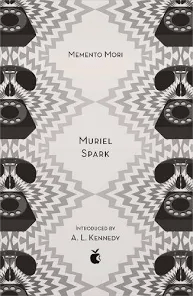
Calling someone by a title they don’t choose or like is disrespectful and a mild form of bullying. The ‘grannies’ exercise the little autonomy they have in their lives by threatening to change their wills whenever anyone crosses them, even though most of them have little or nothing to bequeath. Life in the ward is reduced to the bare essentials, a dull routine of meals and conversation, most of which revolves around discontent with the nursing staff or the daily horoscopes read out for them all by Granny Valvona. These characters act as a form of chorus to the rest of the events of the novel. Outside the ward, former lovers and old friends call in for tea and something stronger and little happens to disturb their calm and pleasant existence – until the day Lettie starts to receive anonymous phone calls with the message “Remember you must die.” Instead of taking this reminder as an encouragement to live life to the full while you can, Lettie finds it menacing and upsetting. Other members of the group start to receive similar calls and respond in the same way. The police are baffled and begin to suspect that no such calls are being made. Is this a shared delusion or just a childish prank? A retired policeman is hired to investigate, but makes no progress and falls under suspicion himself. Eventually a new normal emerges in which the calls are mostly accepted as part of the routine of life, and any menace they contained is thus neutralised.
Most readers will have anticipated that one of the peripheral characters – and there are plenty of possible suspects – would at some point be exposed as the mystery caller, but this never happens. The caller is never identified nor caught. It is suggested that there might be a supernatural or psychological explanation for the calls, but this is not followed up. I felt rather short changed by this lack of a resolution. If you build your novel round a mystery then surely you need to have an outcome in which the mystery is explained? I appreciate that is very old-fashioned of me. I know Godot never arrives, that the world is not neat and tidy and mysteries remain unsolved. But this is not an existential novel on the unknowingness of the universe, it is a domestic comedy in which the anonymous calls are a central part of the plot. Imagine reading a version of The Hound of the Baskervilles, at the end of which Holmes and Watson wander off shrugging their shoulders saying, “Yeah, it might have been a dog, who knows”.
Other subsidiary plot lines are less frustrating and in some respects compensate for this decision. Lisa Brooke, a friend of the group, dies early in the novel, leaving a substantial estate to be argued over by her husband, her siblings and her housekeeper, Mrs Pettigrew. Mrs Pettigrew is the novel’s villain, blackmailing the people she looks after, nosing her way into their secrets and forcing them to change their will or risk exposure.
Writing in the Guardian in 2010, David Lodge agreed with Martin Stannard’s conclusion in his 2009 biography of Spark that Memento Mori “remains one of the great novels of the 1950s,” I can’t agree. I admire Spark as a writer but this is one of the least interesting of her novels that I have read. It patronises and looks down on the elderly and treats them as disposable objects rather than well-rounded characters. Instead of giving a voice to the elderly, rarely centred in fiction, it objectifies them. I kept being reminded of Kingsley Amis’s The Old Devils, which has many of the same flaws but at least invests the elderly characters with some passion and lust for life. It is not a coincidence that Amis was a lot closer in age to his characters than Spark was, and could therefore portray them with more empathy. To illustrate this point consider the following exchange between Godfrey, his wife Charmain and his sister Lettie. Bear in mind that Charmian has suffered a stroke, possibly several, and is struggling with cognitive decline, made all the worse by the fact that she was once a successful author:
“Would you like me to read you the obituaries, dear?” Godfrey said . . .
“Well, I should like the war news,” Charmian said.
“The war has been over since nineteen forty-five,” Dame Lettie said. “If indeed it is the last war you are referring to. Perhaps, however, you mean the First World War? The Crimean perhaps . . .?”
Is this funny, in a ‘you have to laugh’ way, or is it mocking someone with memory loss? Arguably Charmian has the last laugh – her books are reissued, she is ‘rediscovered’ and becomes popular, and recovers much of her cognition. Spark ends her novel with a quick summary of what happens to all her characters after the events of the novel, and unsurprisingly (almost) all of them die one way or another. Memento Mori indeed.

