
Coming from Behind by Howard Jacobson, 1983
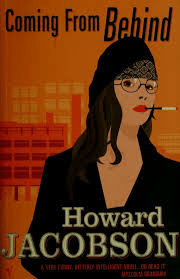
One of the most tired propositions about novel writing is ‘write about what you know’. In this his first novel, Howard Jacobson, stretched that saying to its limit. Jacobson is a Jewish man from Manchester who studied English at Cambridge, followed by a teaching post in Australia, then came back to teach at Wolverhampton Polytechnic. In this 1983 novel his protagonist is Sefton Goldberg, a Jewish man from Manchester who studied English at Cambridge, taught in Australia, before coming back to teach in England at ‘Wrottesley’ Polytechnic. It is hard not to see this novel therefore as at least in part autobiographical, albeit with lots of dramatic exaggeration. The novel’s title is a fairly crude pun – it opens with a scene of Sefton having sex with a student in his office, something he seems to think is one of the perks of his job. But he is not enjoying himself – he can’t stop wondering whether he has properly locked his office door, recalling a similar incident when he taught in Australia – obviously a common occurence.
Jacobson came late to the ‘campus novel’ genre – arguably Kingsley Amis kicked this off in the 1950’s with Lucky Jim, followed by Malcolm Bradbury’s The History Man in 1975, and the same year David Lodge’s Changing Places. Academia in all these novels is not portrayed as a privileged place of learning but instead as a wholly depressing experience. These fictional universities are staffed by grumpy, largely male, amoral lecturers overwhelmed by the non-academic requirements of academia.
The novel has very little of what could be called a plot. Sefton is divorcing his wife, but she never appears. His colleagues and students are all lightly sketched, one-dimensional characters with amusing idiosyncrasies such as the professor who specialises in “all the twentieth century poets whose first or last names were Tom or Thomas”. The exception to this beige brigade is the misogynistic portrait of the teacher of creative studies, Cora Peck, defined by her unconventional outfits – blue cowboy boots, white jump suits and black leather jackets. Inevitably Sefton attempts to seduce Cora but surprisingly she rejects him. I say surprisingly because the general rule of thumb in novels written by male novelists of this era is that no matter how clumsy, awkward and unappealing the male protagonists are, they are nevertheless unaccountably irresistible to almost all female characters (see for example pretty much anything ever written by Kingsley Amis.) That rule is broadly followed by Jacobson in this novel, with Cora forming the sole exception. Cora has had a number of her works accepted by a publisher, which gives Sefton another reason to despise her.
An implausible ‘twinning’ deal with the local football club in which some of the departments are going to be moved into the football stadium is introduced as a plot development – but unfortunately it makes no sense, football clubs being notoriously short on classrooms, offices and lecture halls, and is never taken seriously even within the confines of the novel. When he is not having sex with his students Sefton spends his time applying for any and all jobs broadly connected to academia, with the sole objective of getting out of Wrottesley. A Cambridge college invites him for an interview, which provides the opportunity for a set piece college dinner scene in which Sefton feels totally out of place, and where he is inevitably propositioned by the female Director of Studies.
Coming from Behind is the broadest of comedies, more Carry on Teaching than Lucky Jim. There are a series of comic set piece scenes such as when Sefton is confronted by a group of Geography lecturers, outraged that he has parked in their section of the Polytechnic’s awful car park. Throughout Jacobson relentlessly focuses on Sefton’s Jewish identity. Everything he does is seen through this lens. It is mentioned on almost every page, with long meditations on what it means for Sefton to be a Jewish man in education, at Cambridge, making love, discussing sport, walking in the countryside, being ignorant of fishing (“Being Jewish, Sefton didn’t know much about the names or breeds or needs of fish. (p.24)) and so on ad nauseum. At times Sefton specifically resents the fact that he is not being discriminated against because of his Jewish identity! That’s obviously not to say that one’s heritage and religion is not important, but when it is the only defining characteristic of an individual, the only way of looking at and experiencing the world, it gets a bit wearing.
There are moments of bad taste in the novel and language used that was common in the 80’s but today considered offensive. This is just one more barrier to squeezing any pleasure or enjoyment out of this book. I took a quick look at Amazon to see if it is still in print – it is – and while there two reviews jumped out at me. The first was the bizarre “the wife liked it” (!!) but the other was I think on the nose in describing the novel as “spiteful and intellectually snobbish”.
‘

