
The Watsons, by Jane Austen, 1803/1871
The Watsons is an abandoned fragment of a novel started by Austen in 1803 but only published in 1871. It contains themes and characters reminiscent of those in her completed works and reveals aspects of her methods of composition and construction of her novels. As a fragment of probably less than a quarter of a novel it has very little merit in its own rights, but as an insight into her working processes it is fascinating.
The epistolary format adopted in Lady Susan has been abandoned, and Austen begins experimenting with a third person narrator, although much of the narrative is told through conversation. We are introduced to the Watson family through the perspective of the youngest daughter, Emma, (who bears no similarity to the character who was to later have her own novel). Emma has been brought up by a wealthy aunt in one of those informal adoption arrangements which appears, if Austen’s portrait of the gentry of the Regency period is to be relied upon, quite common (see also Mansfield Park of course, as well as the example from real life of Austen’s older brother). Children seemed to be loaned to other families almost indefinitely largely but not exclusively for reasons of convenience. This aunt has now remarried and moved to Ireland, (in the views of the family this remarriage is highly inappropriate, already establishing the idea that making a good marriage is more important than making any kind of marriage at all) forcing Emma to return to the embrace of her now unfamiliar family. She struggles to adapt to the change in circumstances, not least because her family is significantly less well off than her aunt. We have only brief introductions but it is clear her sisters are actively seeking partners as a route out of the family home, as are almost all the daughters she was to go on to write about.
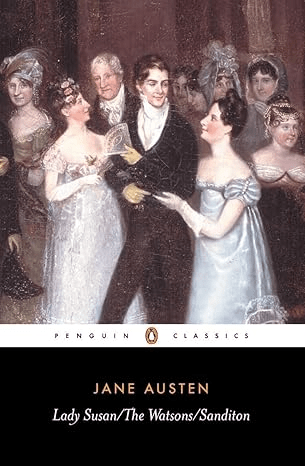
We are also introduced to the Osbornes, a titled family living nearby. Emma is quickly thrown into the social life of the community and while attending a ball in the nearby town she meets the young and rather awkward Lord Osborne. It is difficult to tell if this relationship was going to be the core of the novel – quite possibly but one can’t be sure. Emma dances with a young boy attending the ball as a kindness after he is let down by another potential partner (I don’t know enough about the social conventions of these social occasions to be able to tell whether the attendance of a ten year old, albeit one with quasi-aristocratic status, was usual or simply here as a plot device to illustrate Emma’s kindness.)
This kindness introduces a Mrs Blake, who in turn introduces Emma to her brother, Mr Howard, vicar of the parish church near Osborne Castle. It seems most likely that Mr Howard was to become Emma’s primary romantic interest – less well off than Lord Osborne, and of a lower social status, but more mature and more reliable, a classic Austen hero.
Shortly thereafter the novel ends. An Austen family memoir hints at how it was to continue:
“Mr Watson was soon to die; and Emma to become dependent for a home on her narrow-minded sister-in-law and brother. She was to decline an offer of marriage from Lord Osborne, and much of the interest of the tale was to arise from [the dowager] Lady Osborne’s love for Mr Howard, and his counter affection for Emma, whom he was finally to marry.”
Other than these glimpses of the novelist Austen was to become, there are only limited points of interest in the story for anyone other than an Austen completist. One is the author’s description of Emma:
“Emma Watson was not more than of the middle height, well made and plump, with an air of healthy vigour. Her skin was very brown, but clear, smooth, and glowing; which, with a lively eye, a sweet smile, and an open countenance, gave beauty to attract, and expression to make that beauty improve on acquaintance.”
Skin tone here is not a racial indicator but used as a mark of social standing and value. A very brown face could derive from long periods spent outdoors, something more commonly associated with farm labour, or it could derive from long periods spent abroad in the Americas. Conversely paleness was commonly associated with a withdrawn isolated but aristocratic lifestyle. But equally there were associations with healthiness or lack thereof and a robust ‘healthy vigour’ is in many cases preferable in a potential partner if children were planned. Austen notes that Emma’s skin is very brown but is nevertheless clear, smooth and glowing – in other words she looks attractive despite the brownness of her skin.
One day I might do a deep dive into this issue and see how skin tone is used to portray characters in other nineteenth century novels. The one example of a dark-skinned character that I do recall is Heathcliff, where the author repeatedly connects his dark skin with his demonic character – Nelly Dean recounts him being “as dark almost as if it came from the devil.“


Pingback: Sanditon by Jane Austen, 1817 | The Reading Bug