Life’s Little Ironies by Thomas Hardy, 1894
I confess I’ve never been a particular fan of Hardy. I’ve not really worked out why, but I don’t think his novels have aged well, even if various film and television adaptations have postponed any risk of obscurity. I thought I would try some of his short stories to see if they could offer something different. Life’s Little Ironies is a collection put together by the author and his publisher shortly before Hardy published his last novel (Jude the Obscure) and went into self-imposed poetical exile. All the stories had originally been published in various Victorian magazines and this is reflected in their length and subject matter.
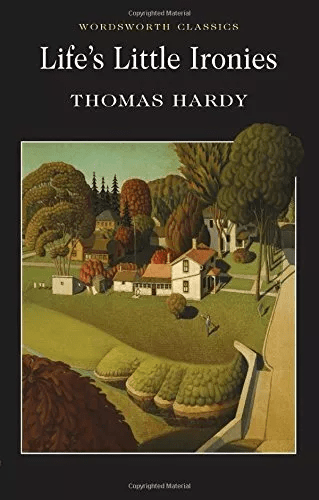
If you didn’t know this collection was by Hardy it would take a matter of seconds to work it out. The settings are very familiar – Melchester, Casterbridge, etc – and the characters are all eminently recognisable – honest, hard-working rural folk prone to making unfortunate choices. The theme that links the stories, we are invited to accept, is that they are sketches of ironic moments in people’s lives, although the irony is quite often hard to identify.
An Imaginative Woman opens the collection with the story of a woman who conducts an affair with a young writer entirely in her imagination, but does so so convincingly that her husband strongly suspects her of having cuckolded him. Ella Marchmill is bored in her marriage to an older, unsympathetic man, and when she finds out that the previous tenant of the seaside rooms they are renting was an author she admires, she begins to spin a fantasy in which they meet and run away together. Despite her tentative efforts to reach out to the writer they never actually meet, but she leaves enough clues behind her when she dies in childbirth to cause her husband to suspect that the child is not his and to reject him. Is this ironic? Contrived certainly, depending on “a known but inexplicable trick of Nature (whereby) there were undoubtedly strong traces of resemblance to the man Ella had never seen...” What trick of nature is that then? Surely the author’s convenient plot device trick?
The Son’s Veto is again quintessential Hardy. It’s a complex little tale of disappointed love, with the main character’s happiness being frustrated by the wishes of her son. (hence the title). The story is also about class, and how marrying outside of one’s class can cause complications. It’s a polished, densely packed story barely longer than ten pages, and one of the stronger, more complete tales of the collection.
For Conscience’ Sake is another tale in which the central character has left Wessex and returns to complete unfinished business, in this case driven by his conscience. Mr Millbourne left Wessex when he fled from a relationship, leaving the young woman alone and pregnant – “the old story”. Pregnancy out of wedlock is a theme Hardy returns to frequently, but here the protagonist is determined to right the wrong even though many years have passed. Sadly he learns that the past cannot be rewritten and some wrongs cannot be righted.
A Tragedy of Two Ambitions follows two dour young men trying to carve out a career in the priesthood. Their ambitions are frustrated by their drunken reprobate of a father. How they deal with him when his appearance threatens to ruin them is rather predictable but becomes a heavy burden for them to bear.
On the Western Circuit could easily have been expanded into a novel. It tells of Charles Bradford Raye a London lawyer who while travelling to courts in the Western Circuit (for judicial purposes England and Wales is divided into six or seven ‘circuits’ i.e. regions) meets Anna, a pretty young servant girl, something of a Hardy stereotype. Normally he would not have considered Anna a suitable wife, and instead pursues her for less honourable purposes, but while they are apart her letters persuade him she is far more educated and sophisticated than she actually is – her letter are drafted for her by her employer, Mrs. Edith Harnham, the wife of a wine merchant, who is attracted to Raye and uses these letters as a form of literary infidelity. Raye finds out too late that he has been fooled and accepts his fate with resignation. This is a variant of the Cyrano de Bergerac story in which someone falls in love with a false representation of their partner, although in fact the Hardy story actually pre-dates the French play. It is a sophisticated and complex story which once again features an out of wedlock pregnancy, euphemistically described thus: “she made confession that the result of her relations with her lover it would soon become necessary to disclose”. The story also pivots around class differences – Raye would never consider marrying his lover if he knew she was a barely literate working girl as it would seriously impede his career, as if eventually does.
To Please his Wife is a short tragic story in which a seaman chooses a wife unwisely, and pays the price. Another unhappy marriage ending in tragedy – not a collection of stories to cheer anyone up!
The Fiddler of the Reels. The concept of a fiddler with quasi-demonic powers, able to charm people into dancing manically or against their will, can be found in folk-lore. Hardy draws on this idea to weave a tale of a fiddler who uses his mastery of his instrument to be seduce young women. This folk element of the story is interwoven with an account of a local mechanic who, disappointed in love, leaves rural Wessex to go and work in London, his young lady having become besotted with Wat ‘Mop’ Ollamoor, the charismatic fiddle player. This happens at the time the great Exhibition of 1851 is on in London, and this event is described as more than a background to event, but as a central marker in the country’s history, as important as the Norman Conquest. Several years later he receives a letter from his young lady, asking for a second chance, but it is only when she arrives (by an open-carriage train) that he discovers she has a young daughter, the result of an affair with Mop: “I was so unlucky to be catched the first time he took advantage o’ me“. Nevertheless he accepts the proposed reconciliation, marries her and accepts the child as his own. When they eventually return to Wessex a re-encounter with Mop is inevitable, although the precise outcome is unexpected and troublingly ambiguous.
A Few Crusted Characters concludes the collection and is comprised of a series of recollections of local characters and the often mysterious events of their lives. The stories are told by the passengers on a stage coach – there is a nod to Chaucer in the structure of the work. Each has a slightly incomplete feel, as if they were drafts of intended longer works that had been set aside but kept just in case they were to be of any use, and are finally set to work here.
Overall, these stories don’t improve on Hardy’s status as an author, but neither do they diminish it. They didn’t make me want to rush back to the novel and they lack of variety in the subject matter and themes was a little disappointing. As an introduction to Hardy you could do a lot worse.