
How They Broke Britain, by James O’Brien, 2023
How They Broke Britain comprises ten essays on familiar characters from early twenty-first century British politics, constructed round the framing device that all of those portrayed have contributed to the degradation of political life in the UK. Some are very well known – it is surprising that O’Brien found anything new to say about Rupert Murdoch for instance – others much less so, for example the recently ennobled Matthew Elliott.
Very little of what O’Brien writes will be new to anyone who has been paying attention to the news over the last thirteen years. That’s not to say it is not convenient to have so much detail collected together in this way – in some respects this will probably work better as a reference book than as an attempt to change anyone’s mind. Conservative supporters will either not read this in the first place, or will do so with the specific intention of finding flaws and weaknesses. The Telegraph review, for example, described it as a ‘wild polemic’, both weak and childish, and hilariously finds fault that O’Brien has not correctly understood the hierarchy of the English aristocracy (“He’s wrong: the rank below an earl is viscount.”)
O’Brien’s style invites disagreement, so here goes. Firstly, the breaking of Britain (and it is really difficult to argue with the proposition that the country has been deeply wounded in recent years) is not the result of the behaviours and characters of ten or so individuals. There are systemic, structural flaws in the way our nation is constructed and organised, and basing his analysis on the ten people in question means O’Brien doesn’t really have to address those structural issues. In fact there’s no real attempt at all to understand or identify what’s gone wrong other than through the characters of the people portrayed. But without an understanding of these issues then any attempt to address them is doomed – there’s every chance we will end up with another set of chancers and crooks running our country and its institutions, even if we were to clear out the existing cabal.
Second, keeping a modern political commentary up to date is admittedly really difficult, because O’Brien is charting something that is happening right now. There’s never a right time to end the analysis, never a point at which he or any other commentator can say (along with Andrew Lincoln) “enough”. This was really driven home to me when I read that Matthew Elliot, Chief Executive of the TaxPayers Alliance and latterly the Vote Leave campaign, the subject of chapter three of this book, has been nominated for a life peerage by Liz Truss in her ‘I’m no longer Prime Minister’ honours list.
Third, O’Brien argues that the bad behaviour he records, the lying, bullying, abuse of power, is all the more egregious because by and large the people doing it got away with it unpunished. This is clearly wrong. Boris Johnson and Liz Truss were both hounded from office and Johnson had to resign from Parliament when found guilty of breach of parliamentary procedure by the Privileges Committee. Johnson was also fined by the police over Partygate, as was Rishi Sunak (who doesn’t, yet, merit his own chapter, although I suspect later editions may remedy that omission). Johnson may have behaved as if he was above the rules that the rest of us had to comply with and some of his more egregious behaviour may have still to be addressed (by, for example, the Covid enquiry), but the idea he got away with everything without consequence is demonstrably incorrect. Jeremy Corbyn is a surprise inclusion in the text, perhaps thrown in for ‘balance’, but more likely because O’Brien holds him personally accountable for the Brexit referendum outcome. Corbyn never really came close to power during his five years as leader of the Labour Party, and now sits as a independent backbencher having been thrown out of the Parliamentary Labour Party – again hardly the best example of someone getting away with bad behaviour.
This is not a book for reading at one sitting. Take it a chapter at a time and allow yourself plenty of breaks to absorb the detail and for your blood pressure to reset. The piling on of fact upon fact in intense detail can at times be hard to absorb and at moments almost becomes incoherent. The overall effect can feel like being shouted at by someone almost desperate to convey their point but struggling to overcome the weight of detail and present compelling evidence and argument. History won’t be kind to Liz Truss, Boris Johnson, Dominic Cummings and Nigel Farage, all of them currently a long way from the levers of power and likely to stay that way (even though Rishi Sunak was reportedly flirting with the idea of returning Dominic Cummings to Number 10 to run the election campaign, a truly bizarre idea if ever there was one), and history may use How They Broke Britain as a reference work when judgment is being passed and obituaries are written. Until then I would recommend this book to anyone looking to get their heads around how this country has so badly lost its way, even if it won’t really help in finding any answers on how we find out way out of this mess.
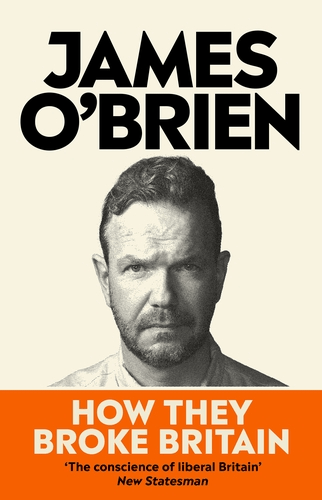
It’s worth noting that the hardback version of this book uses a large picture of O’Brien on its front cover, and a supportive quote about the author rather than the book (“The conscience of Liberal Britain” – the New Statesman). It wouldn’t have been difficult to have come up with a cover that used mugshots of the ten people featured in ‘Usual Suspects’ style (just for example – the kind of thing Private Eye front covers do so well). This approach exposes O’Brien to criticisms that this is just an ego trip, preaching from a public pulpit while unprepared to accept the same level of challenge in return, other than to rage bait callers to his LBC show. But the ‘O’Brien brand’ sells well, and How they Broke Britain will have sold by the lorry load over Christmas.
 The Reading Bug
Nice post 📕
LikeLike
Pingback: How They Broke Britain, by James O’Brien, 2023 – Live Site