
The Turn of the Screw was initially published as a serial in an American weekly magazine from January to April 1898. In many ways it is a simple, old-fashioned ghost story. Stories featuring the supernatural and ghosts in particular were immensely popular in the nineteenth century. They were a way of helping people cope with the grief arising from high mortality rates (especially infant mortality) and sudden deaths from what are today simple, curable conditions. In other words ghost stories offered a way to process grief. The dead aren’t gone, they are just in another place. (Hence also the creepy Victorian tradition of taking photographs with the dead posed as if they were alive). It was also the case that the advance of science in the nineteenth century challenged traditional religious belief and ghost stories provided a way of reconciling the two apparently contradictory ideas. Science can’t, they say, explain everything. Supernatural tales satisfied the need to prove the soul survived after death, and that we are not just animals, even if we are descended from them. Add to all that the explosion of periodical presses and mass-produced magazines in this period which fuelled demand for short, thrilling stories. These stories were particularly popular at Christmas time, and of course Dickens had both tapped into and amplified this association with A Christmas Carol and others.
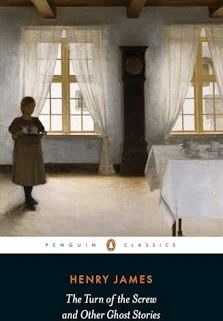
James follows this tradition by setting the framing narrative of his story on Christmas Eve (which is otherwise irrelevant to the rest of the story). His unnamed narrator and friends gather around a fire. One of them reads a manuscript telling the story of a governess hired by a man who has recently been appointed the guardian of his young niece and nephew following the deaths of their parents. He lives in London but has a country house in Essex where the children live.
The governess assumes the narration from this point. She tells of her interview with the children’s guardian in which he explains he wants no involvement in their care. Arriving at his grand country house in Essex she meets Flora, the beautiful and well-mannered young girl for whom she will be responsible, and Mrs. Grose, the housekeeper. There are a number of other unnamed servants who remain peripheral figures. She quickly learns that Miles, Flora’s brother, has just been expelled from his residential school and will be returning home shortly. The reasons for his expulsion remain mysteriously sinister. Both children are apparently delightful and well-behaved, and the governess cannot imagine what Miles could have done to lead to his expulsion.
For a short period everything seems normal, and the governess establishes a simple domestic routine revolving around the care and tutoring of the children. But one evening while out for a walk, she sees a strange man looking out from one of the house’s towers. (A house with towers? Well yes, in traditional ghost stories all houses follow a gothic architectural template which contribute to the creepy atmosphere). This causes her to wonder:
“Was there a “secret” at Bly—a mystery of Udolpho or an insane, an unmentionable relative kept in unsuspected confinement?”
These references are carefully chosen. The Mysteries of Udolpho is widely considered the Ur-text of the gothic genre, and serves to manage the reader’s expectations of the story they are reading. Charlotte Bronte’s 1847 Jane Eyre built on this tradition by cementing the insane relative in the attic trope into gothic fiction. The important element of the latter story is that the apparently supernatural events of the novel are eventually shown to have a naturalistic explanation. In Northanger Abbey published eighty years earlier Jane Austen had already effectively parodied the conventions of this genre, pointing out that a young woman’s heightened expectations of mysterious events in a strange setting could be self-fulfilling. So our expectations are that there will be a normal explanation for the stranger in the tower, and anything else creepy that the governess experiences. Or will there?
The strange man reappears to the governess one afternoon, staring at her through a window. She tells Mrs. Grose about this man, describing him in detail. Mrs. Grose identifies him as Peter Quint, a servant on the estate who died recently. (Some critics interpret the ghosts in The Turn of the Screw as figments of the governesses imagination. Of course that’s a perfectly valid interpretation, but James leads the reader away from that explanation at this point in the story by having the governess able to identify the man very accurately. Can he be imaginary if she can describe him so clearly. If the reader wants to they can imagine a scenario in which someone else has previously told her about Quint, but there is no textual evidence for this.)
It is not long before a second ghost appears. While walking by the estate’s lake with Flora, the governess sees a woman dressed in black. Back at the house she describes this woman to Mrs. Grose who tells her it had to be Miss Jessel, the children’s previous governess who died in mysterious circumstances. It is then also revealed that Quint and Miss Jessel were involved in a relationship that scandalised the staff of the house. They were also very close with the children. Further encounters with the ghosts leads the governess to be convinced that there is a relationship of some kind between them and the children, but the nature of that relationship is never clear.
The governess does not know what to do. Speaking to the children’s guardian has been forbidden. They do not appear to be in any immediate danger, but she never lets them out of her sight. A final encounter with the ghost of Miss Jessel, which Flora and Mrs Grose both claim to be unable to see (fuelling the idea that the ghosts are figments of the governesses imagination) leads to Flora becoming very distressed. Finally Flora is sent away from the house, accompanied by Mrs Grose to London to seek shelter with her guardian, leaving the governess and Miles alone with the ghosts. The governess sees Quint and she grabs Miles, apparently to protect him. In the novel’s closing sentence he dies in her arms and the text stops suddenly with this revelation. The unexplained death of Miles is lazy writing of the worst variety as far as I am concerned, simply a way to end the story rather than acting as any kind of effective resolution.
Is this a successful ghost story? Is it spooky, disturbing? James’s technique to build the atmosphere is simple – everything is left implied, ambiguous and opaque. Almost all sentences in which the supernatural events of the story are discussed trail off unfinished. Ideas are hinted at but the reader is left to fill in the gaps. As ghost stories go this is highly effective. James uses the innocence of the children as a powerful symbol of the potential of evil, even in the young. The ambiguity of the social place of the governess, not a servant but not a member of the family, occupying that undefined space in between the two, is used as a further source of narrative tension, complicated by the fact that the governess in this story is effectively the acting head of the house. It is revealed that Miss Jessel and Peter Quint were romantically involved and their relationship scandalised the household:
“And he so dreadfully below,” said Mrs. Grose. I felt that I doubtless needn’t press too hard, in such company, on the place of a servant in the scale; but there was nothing to prevent an acceptance of my companion’s own measure of my predecessor’s abasement.“
James sometimes – too often – uses the technique of ambiguity and implication to leave the reader having to follow the narrative thread. At times this makes the story difficult to follow. I wrote about this feature of his writing in my review of The Golden Bowl which I found to be extremely difficult to read. James’s sentence structures were often so ridiculously complex that they lost, to me, all meaning. I was reassured by some commenters that this was a feature of James’s writing towards the end of his career and his earlier work was more accessible. However The Turn of the Screw was published only six years before The Golden Bowl, so I should have been prepared. Despite this, some sentences from this novella left me completely at a loss:
It took of course more than that particular passage to place us together in presence of what we had now to live with as we could—my dreadful liability to impressions of the order so vividly exemplified, and my companion’s knowledge, henceforth—a knowledge half consternation and half compassion—of that liability.
I think what James is saying here that now that the narrator and Mrs Grose both knew that the house was haunted, they had to live with it. It’s not just that this sentence is totally unclear, it is also ugly. I have no problem with writing that makes the reader pause, reread, and reconsider, but this doesn’t do that – it just confuses and irritates.)
It’s not just long rambling sentences that are the only issue here – James can make even shorter sentences totally confusing.
The good thing, after all, was that we should surely see no more of him. This was not so good a thing, I admit, as not to leave me to judge that what, essentially, made nothing else much signify was simply my charming work.
Or how about?
Nothing was more natural than that these things should be the other things that they absolutely were not.
I have said all I want to say on this feature of James’s writing in the post linked to above, so I am not going to labour the point, but at the same time I couldn’t ignore it.
The bottom line is this – if you enjoy ghost stories you will love The Turn of the Screw. It is an extremely effective example of the genre. If you don’t appreciate this type of thing, and find it childish, you won’t be converted and it will leave you cold and perhaps even slightly irritated.

