
When I was drafting my review of Fforde’s recent novel, Early Riser, I planned to refer back to an earlier review of his first published novel, The Eyre Affair – only to find that in fact I hadn’t written it! I must have read this novel before I started my blog, although I have reviewed some of the later novels in what was to go on to become the Thursday Next series.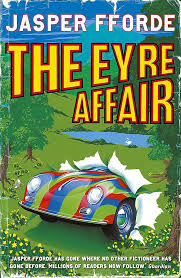
The Eyre Affair is a brilliantly original genre-busting novel. It follows the adventures of Literary Detective Thursday Next, on the trail of a genuinely sinister villain, Acheron Hades. The novel is set in a strangely recognisable parallel universe, in which England and Imperial Russia are still fighting the Crimean War, Wales is an independent nation, and where literature is given its rightful value by society (one of my favourite scenes is where Thursday and her on/off boyfriend Landen Parke-Laine go to a performance of Richard III which is a parody of the audience-participation showings of the Rocky Horror Picture Show).
Some of the jokes – a character is called Braxton Hicks, for example – are groan-inducing, but the literary references are very clever. There’s a throw-away joke about Cardenio and the repartee about the Shakespearean authorship “question” for example shows a depth of knowledge and love of literature you won’t find in many mystery/adventure/detective novels, let alone comedies.
Thursday is a strong central character around which Fforde builds his narrative. She is a veteran of the Crimean war, where she lost her brother in a modern version of the Charge of the Light Brigade. She is in the career doldrums when she is unexpectedly recruited to track down criminal mastermind Acheron Hades, her former university professor. Hades is a formidable and ruthless criminal, kills without hesitation or any trace of remorse, and nearly kills Thursday herself until the fortunate intervention, and this is where it gets really wild, of Mr Rochester from Jane Eyre. Yes, that Mr Rochester. Because in this universe it is possible, somehow, to move from the world of literature to what I am going to refer to as the round world, and vice-versa.
This fluidity between worlds allows Thursday and others to intervene in texts and change their outcomes. Some of what happens to Thursday, such as the supernatural message that leads her to change her life, is paralleled in the events of Jane Eyre, but Thursday is no Jane. She is not a passive figure but a woman of action and ideas.
Fforde’s achievement is that he doesn’t just parody genres, he delivers a series of interwoven narratives that all succeed in their own right. The detective story is an enjoyable mystery; the adventure elements are exciting, and the romance between Thursday and Parke-Laine, albeit kept in the background, is believable and touching, and plays its part in the novel’s finale. Fforde’s world building relies on the contrast between the familiar and the bizarre – for example in this world the dodo has been genetically re-engineered. Best of all, for me, were the literary jokes, which are done with respect for the source material. Both of the novel’s endings, one in Jane Eyre, the other in the ‘real world’ are borrowed from the Bronte text but with a clever twist.
Basically, I loved it. I can’t understand why it’s not been adapted for television I will never know, I can see it working brilliantly.

