
Jasper Fforde is one of our most consistently inventive writers. In The Constant Rabbit he has once again shown this with a surreal allegory which at its heart is about difference. What could so easily have been a heavy-handed satire on Brexit and racism becomes a thoughtful discussion of how people cope with discrimination, both from the perspective of the discriminated against and that of the prejudiced. But I was left wondering whether Fforde at times overstepped the invisible line between dark humour and bad taste.
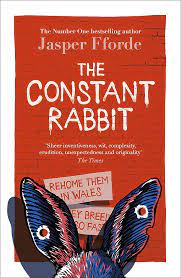
The central premise of the novel is that in 1965 an “anthropomorphising event” in the UK transformed a small number of rabbits into intelligent, talking, human-scale rabbits. By 2020 their population has grown to over a million. In response to concerns about their impact on the country, the United Kingdom Anti-Rabbit Party, originally a fringe protest group, has taken office in Westminster. Attacks on the rabbit community by hate groups such as TwoLegsGood (a nod to Orwell, of course) are frequent and the courts have decided that rabbits do not merit the protection of the law (any more so than any other animal). For their ‘protection’ the Government is planning to herd all rabbits into an isolated community ominously labelled the Mega-Warren. Society has subtly changed after the years of human/rabbit coexistence, with institutions such as RabCoT, the Rabbit Compliance Task Force, emerging to deal with the Event. Rabbits have developed their own culture of course, a blend of animal and human behaviours, which Fforde expounds on in detail – it’s a strangely recognisable version of our own society but adapted to cope with rabbit life-spans, libidos and compulsion for digging burrows.
Other animals were anthropomorphised as well, most notably foxes, who now murderously predate the human rabbit population without fear of consequences or reprisal. It must be pretty terrifying to be a rabbit in these circumstances, but (we are told) they are used to a life where sudden death is an every day possibility, so are not as bowed by the experience as one might expect. There’s a long and respected tradition of authors using animals as avatars for humanity, looking at our behaviour towards animals as a lens through which to see our behaviour towards one another. This tradition dates through Swift’s Houyhnhnms and beyond to Greek drama. Apart from Beatrix Potter and Watership Down rabbits have rarely been at the centre of this tradition – I suspect mainly because they aren’t very anthropomorphic.
The narrative is told from the point of view of Peter Knox, a rabbit “spotter”. As most humans are unable to distinguish one rabbit from another, spotters play a niche role in enforcing laws against the rabbit population. Knox is uncomfortable with his role within an oppressive state apparatus that spies on its population. He lives with his daughter in the village of Much Wenlock, a rural idyll full of small-mindedness and anti-rabbit bigotry. Into this dangerous and toxic environment comes Constance. Constance was Peter’s friend in university until she was expelled for the offense of being a rabbit. While at university Peter had a huge crush on her, and meeting her again caused all those feelings to come flooding back. Cross species relationships are frowned upon in this alternative reality, but not unheard of. We are invited to think of Connie as cross between Jessica Rabbit and the (inappropriately sexualised) Caramel Bunny. She is also several times smarter than Peter, and manipulates him very easily into supporting the rabbit resistance and leaking sensitive information from his work. Once Peter is sucked into this intrigue, forced to choose between his job and his sympathies for the oppressed rabbit-kind, the adventure rapidly accelerates towards a showdown between the apparatus of the state and the rabbit population.
This was at times a slightly awkward mix of political allegory and lowbrow humour. There are powerful echoes of different national and liberation struggles throughout the novel, from apartheid – the rabbits are prevented from going to university and forced to live in fenced-off communities; to Palestine, the civil rights movement in the USA – rabbits live in fear of sudden attacks from mobs in which they are ‘jugged’ (that is to say, murdered in a grotesque parody of lynching), and many others. Some of the targets are fairly explicit – the Anti-Rabbit Party, lead by Nigel Smethwick, is an obvious reference to UKIP/The Brexit party and Nigel Farage – indeed Rabxit is mentioned a few times.
I never thought I would say this of Fforde, who usually has a very deft touch with his humour, but some of this was in poor taste. Are lynchings, or ‘jugging’, the rabbit equivalent, really a source of humour? I must admit Fforde lost me here – to try to draw laughs out of the obvious parallels with the lynching of black Americans was tasteless (the term ‘jugging‘ comes from the traditional practice of cooking an animal inside a jug which is placed in a pan of hot water). I appreciate this is dark humour for the purposes of satire, and we will all have our own lines that should not be crossed, but this was for me inappropriate – the satire is dark enough as it is. In this world foxes are able to kill rabbits with impunity, and take pleasure in doing so – the main fox character Torquil Ffoxe (Peter’s menacing boss) is credited with killing several thousand rabbits before he meets his well deserved end, and at one point is shown with a bloodied corpse of a rabbit in a sack in his office. This is gruesome stuff, but the tone of the novel rarely acknowledges the bleakness of rabbits’ lives – they are shown as happy-go-lucky, sexually adventurous characters who make a significant contribution to society including serving in the military. They are the good guys from whom humanity could learn a lot.
Satire has no obligation to identify solutions – it points out what’s wrong with the world but doesn’t have to tell us how to sort it out. True to form there’s no call to action here other than to be nice to one another, the standard liberal response to racism and bigotry. The novel’s ending suggests that there is no solution other than escape, an option not available to most oppressed sections of society. If it makes us look afresh at the oppression of marginalised people across the world then it has done its job.

