Book review

Talking to Strangers, by Malcolm Gladwell, 2019

Another ‘popular science’ read. I had previously bought but was unable to read Gladwell’s highly successful Blink, a study of what he termed the ‘adaptive unconscious’. It’s not that I didn’t finish it – it just never got to the top of my to-be-read pile, and is probably still lurking at the back of a bookcase somewhere. So my selection of Talking to Strangers was in part a strange form of apology – I may not have read your earlier book, but I will make up for it with this one. Another reason for this choice was that the title was encouraging – the ability to talk to strangers is a important skill that comes easily to some but causes angst and distress to others, and it would be good to know more about it.

I shouldn’t have worried because the title is misleading – the book is not a how-to guide on speaking to unfamiliar people, but about what happens when people talk to one another for the first time, the different assumptions and mistakes people make when dealing with those that they don’t know. Obviously the mistakes continue even when we know the people quite well – but I suppose “Talking to People” wouldn’t have made as interesting a title. Gladwell has a relaxed anecdotal style. He draws examples from all over the place (although with admittedly an American emphasis) – Cuban spies, dodgy sports trainers, Adolf Hitler, Bernie Madoff, and Amanda Knox, to name just a few. Whether these anecdotes cohere into an overall narrative or line of argument is debatable. My impression at the time was that they were just interesting stories stitched thinly together without a consistent thread. That’s not to say the stories and the analysis aren’t interesting, just that at the end of the book we really can’t say we know that much more about how to talk to strangers. Often the points made are unremarkable – of course we aren’t as good at telling when people are lying as we think we are; of course some people are better liars than others, and of course social norms are important when assessing behaviour.

The book opens and closes with an analysis of the case of a young American woman, Sandra Bland, stopped by the police for a minor traffic violation. Gladwell tries to work out why this routine stop went so badly wrong that it ended up with Bland being arrested and jailed, where three days later she tragically ended her life.

One of Gladwell’s main themes is the ‘default to truth’, our tendency to assume the person we are speaking to is being honest. There are obviously good evolutionary reasons why we trust more than we are suspicious, not least the need to cooperate with one another for common, social enterprises. Gladwell isn’t suggesting the default to truth is a bad thing – just that we need to be aware it happens. Sadly in the Sandra Bland case it did not. The officer did not assume she was telling the truth – quite the opposite in fact. Gladwell argues that the reason this routine traffic stop went the way it did was because the officer had been trained to a) aggressively stop everyone he possibly could, because criminals drive cars, and b) to interpret normal behaviours such as irritation and nervousness as indicators of guilt – guilt about what isn’t clear. But what is almost completely missing in Gladwell’s analysis is any recognition of the role of racism in the Bland case, because almost inevitably Sandra Bland was black. I say almost because the idea that she was treated differently because of her skin colour is raised only to be quickly discounted. It is hard to look back at that traffic stop now since the murder of George Floyd and not make the case for the arrest of Sarah Bland as being part of the systematic attack upon African-American citizens by the state.

This is a book designed to make the reader feel well-informed without learning much other than a series of anecdotes. Here’s an example of the level of analysis in the book:

“The first set of mistakes we make with strangers—the default to truth and the illusion of transparency—has to do with our inability to make sense of the stranger as an individual. But on top of those errors we add another, which pushes our problem with strangers into crisis. We do not understand the importance of the context in which the stranger is operating.

That’s a distillation of some of the central concepts in the book – “we do not understand the context in which the stranger is operating”. Really? That’s it?

There is an excellent demolition of the book in the Atlantic if you want to read more along these lines. One of the very perceptive points made in this article is that readers come to consider Gladwell’s books as:

“the high-journalism version of Bond or Bourne movies, breakneck adventures that take us on a tour of exotic intellectual locales. He introduces us to historical oddities, revisionist interpretations of the past, the frontiers of social science, the backstories behind recent headlines, all strung together along a single provocative thesis.”

This is the approach used in Talking to Strangers – with the difference here that the provocative thesis goes missing, leaving us with a disjointed series of anecdotes. It’s an easy read, but not one of those popular science books that is going to change the way I look at the world in the way that the best of the genre can do.
Standard
Book review

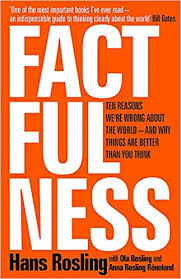
Factfulness, by Hans Rosling, Ola Rosling and Anna Rosling Rönnlund 2018

Subtitled “Ten Reasons We’re Wrong About the World – and Why Things Are Better Than You Think

Which is a really encouraging subject isn’t it? We spend so much time reading how terrible the world is, wouldn’t it be nice if things are better than we think they are? That’s the central compelling thesis of Factfulness: that the things we think we know about the state of the world are often wrong. It’s more prosperous, safer, more developed than we believe.

Factfulness: Ten Reasons We're Wrong About The World - And Why ...

In a way that shouldn’t be surprising – of course our perceptions of the world aren’t constantly updated, so our belief that everyone in Africa lives in poverty, that immunisations are not widely available in developing countries (Rosling challenges this terminology; he instead proposes that the world is classified into four groups based on average income, which seems a little arbitrary (why four not five or three?)) and so on. Charities feed that narrative – “things aren’t that bad in African so send us some money if you can” is hardly a winning approach. The news does the same – not many people killed by tsunami because their sea defences were well built – isn’t much of a story.

Many years ago I had a light-bulb moment when I read about the Whig view of history, an insight which has stayed with me and influenced much of my thinking. I think it may have been something by E,P, Thompson, but anyway if you haven’t come across it, it is the argument that history is always presented in the form of a narrative of progression and improvement – things are getting better. Back in history people did bad things – public hanging, slavery, denying women the vote, etc – and now we have seen the light, we no longer do those bad things. Thompson calls it (quickly checks Google) the ‘enormous condescension of posterity‘. Why it this version of history so powerful? Partly because generally speaking it is right – things do generally get better. Fewer people live in slavery, most countries have abolished capital punishment, many more people have the vote, life expectancy is going up incrementally, and so on. More to the point we want this version of history to be true – we cannot stand the idea that people in the past may have been more tolerant, enlightened or educated than ourselves.

But this version is not the whole story – some rights have only been temporarily won, and we stand to lose them if we are not alert; most states may not publicly execute people, but they still die from the actions of the state in huge numbers, and the vote is constantly being removed from people for minor reasons (such as in the UK being unable to provide a form of written identification).

So there are two competing tensions when considering Rosling’s central claim – we want it to be true, we desperately hope that the population crisis isn’t going to lead to mass starvation for example (of course we do) and will welcome anyone with a chart that shows us everything is going to be OK because it fits into our general expectation that things are steadily getting better. On the other hand, unless offered that bar chart we stay in our fixed view of the world that vast numbers of other people are poor, that populations are exploding around the world, that fossil fuels are running out, and the ice-caps are melting.

Rosling very clearly proves that things probably aren’t as bad as many of the people he surveyed think. His audiences consistently believe the world to be poorer, less healthy, and more dangerous than it is. Whether this mis-perception is because we are being misled, or because we just haven’t updated our ideas, isn’t completely clear, and it is really this topic – why we get our ideas about the world consistently wrong – that is the focus of this book.

Most of the detail in Factfulness is available on the Roslings’ Gapminder website, either in the form of a series of Ted talks, or in other neatly presented tools. The Ted talks are highly recommended, around 20-30 minutes long and presented with humour, interesting graphics and other visual aids. We all learn differently, so you might prefer the level of detail in the book – personally I found the subject matter ideally suited to the Ted talk format.

Being an eternal sceptic I randomly checked a few of Rosling’s statistics. He claims 80% of the world’s children were immunised for measles. That seemed incredibly high – in fact the World Health Organisation said that in 2018 86% of children were so immunised, which is wonderful. The claim that girls on average go to school for seven years, and that the world’s population of children is forecast to remain at 2 million by 2100 also both checked out. Despite this I was left a little sceptical. Is the world really getting better? Dramatically better in fact if Rosling’s bar charts are to be believed. Of course the issue is not that his statistics are wrong. But there are two obvious objections to this narrative. The first Rosling acknowledges – the fact that people aren’t quite as poor as we think there are doesn’t mean the world isn’t riven by spectacular levels of poverty and inequality. The fact that girls on average go to school for seven years doesn’t hide the fact that millions of girls around the world are denied education, and so on. The other in some ways even more serious objection to the claim that we are wrong about the world is the absence of any underlying understanding of why the world is riven by inequality, poverty and injustice, Without that understanding, trusting to whatever forces are out there which are making the world a better place to keep on doing a good job is infantile.

This is a useful corrective to apocalyptic, we are all going to die, narratives about nanobots, climate change, viruses or whatever is the latest end of the world, Anything that helps us see the world more clearly has got to be a good thing. For a book that is essentially about statistics, it is entertaining and accessible. Definitely worth checking out, although I still would recommend the website first.

Standard
Book review

A Brief History of Everyone who ever lived, by Alex Rutherford, 2016

Genetics is science still in its infancy. The structure of DNA was only identified in the 1950’s, and the human genome was mapped in 2003. Compare that to the study of physics or chemistry where the key building blocks of our understanding have been in place much longer. A lot of what we thought we knew about genetics ten years ago now is considered out of date and inaccurate; what we think in 20 years of what we think we know now, who can say? As such this is more a progress report on genetics in 2016 than a definitive survey of the science, comprehensive though it is.

I have always been fascinated by the puzzle that we all have increasing numbers of great grand parents as you go back each generation, but that the total human population in much higher now than it has ever been. Rutherford calculates that it you go back to the eighth century we will each have required 137,438,953,472 people in our family tree. I make that about 33 generations, but of course many times more than the number of people who have ever lived. It follows that family trees are a misleading presentation of our genealogy. There must be many points across our family history were the lines cross and blend. “What this means is that pedigrees begin to fold in on themselves a few generations back, and become less arboreal, and more mesh or web-like”. Rutherford expresses this point by looking at the genealogy of some of the Royal families of Europe. Charles 2nd of Spain should have had 62 ancestors in his preceding six generations, (2 parents + 4 grandparents + 8 great grand parents and so on). In fact he had only 32 – many of his great aunts were also his great grandmothers, for example. Go back another two generations and instead of over 250 ancestors he had 82. This is obviously an extreme example caused by the shallow gene pool from which the royal families chose their partners, but go back far enough and the same pattern would be seen in all our families.

The other riddle that Rutherford answers definitively here is whether, as is often suggested, we are all eventually related to Attila the Hun. The short answer is if you go back around ten centuries or so then we all share some genetic material from everyone who lived at that point. This is obviously highly counter-intuitive, but Rutherford demonstrates it with precision and statistics. I would struggle to repeat the analysis for myself – it’s complicated – but I take some comfort from knowing where to find it if I need it!

This is an eclectic look at the state of genetics today, including issues as diverse as why the distribution of wet and dry ear wax in humans suggests that the people of South Korea might be the least smelly on earth; why the idea of a Danish Viking conquest of the British Isles involving rape and pillage is not borne out by a genetic legacy; and why monoamine oxidase A, the so-called “warrior gene”, ought not to be a valid defence in criminal trials. Rutherford charts our progression as a species from out of Africa, using evidence provided by ancient DNA. A toe bone of a Neanderthal who died 50,000 years ago in the Siberian reveals our ancestors appetite to mate with other humanoids now extinct, explaining why we all have a little caveman DNA in our genome.

Genetics is complex, and there were pages in the book were my non-scientific eyes glazed over, there’s no point in denying otherwise, however accessible this book was intended to be. The analysis of whether race is a genetic characteristic, or whether it actually exists or not, was a case in point. I think Rutherford concludes that it both does and does not, but I would need to check. The relationship of disease to genetic is equally complex. You start out by looking at the more obvious inherited illnesses such as Tay-Sachs disease or sickle cell anemia, and think yep, that makes sense. But once you start looking at more complex conditions and characteristics, even those most obviously inherited such as height, tracing the precise role our genes play in this process has proven elusive. Or that was what I understood Rutherford to be saying anyway!

I know a little more about genetics than I knew last week, which has got to be a good thing. But I must admit I will return to the comfort of fiction in the coming days with a small sense of relief.

Standard
Book review

Mistakes Were Made (but Not by Me): Why We Justify Foolish Beliefs, Bad Decisions and Hurtful Acts by Carol Tavris and Elliot Aronson

When I use the term “challenging” to describe a book, this is usually a euphemism for “hard to read” – either because it is badly written, or just long-winded. ‘Moby Dick’ is a challenging novel, for example. So are ‘Ulysses’ and ‘Middlemarch’, and any other number of Victorian blockbusters (I know Ulysses isn’t Victorian!)  But I found ‘Mistakes Were Made’ challenging in a very different way – it challenged some of my deeply held beliefs. Which was unusual and very refreshing. I didn’t agree with everything the authors wrote or argued, but being shown a different perspective has to be a good thing.

‘Mistakes were made, but not by me’ is a book of popular (i.e accessible, rather than academic or textbook) psychology, exploring the concept of cognitive dissonance, the mental discomfort (psychological stress) experienced by us all when we simultaneously hold contradictory beliefs, ideas, or values. Cognitive dissonance is a consequence of a person performing an action that contradicts personal beliefs, ideals, and values; and also occurs when confronted with new information that contradicts said beliefs, ideals, and values. So for example you believe the NHS I being under-funded, but when you look the statistics up you find that investment is going up above the rate of inflation. Instead of saying, how interesting, you tart to look for other statistics that will undermine this, and tell you what you really want to hear – that relative to other countries funding is down for example. This is an entirely natural response. When we experience CD we all have the impulse to minimise the uncomfortable feeling by refusing to accept the new information (“fake news”). On social media we are much more likely to be believe (and retweet or share) a post that endorses our ideas than one that challenges them. This is the reason for the so-called echo chamber phenomenon.

The authors go on to examine how cognitive dissonance causes mistakes to be made – we find it hard to accept our initial thoughts or conclusions are wrong, and seek out any number of ways to defend ourselves against the discomfort this causes, to the extent of denying or ignoring hard facts against us.

While this is a very accessible, readable account, the 40 pages of footnotes are clear evidence that this is also well-researched. Most of the examples are drawn from the United States, but that’s fine – the authors are American and write about the area they know best.

So why did I find it challenging? At the heart of the issue is the compelling section of the book about repressed memory. This really got me thinking, and reading other sources. I had accepted for a long time, without really thinking about it very much, that the repressed memory was a real thing. It’s a Freudian concept, and there is evidence (not discussed here) that the idea was not previously thought of before Freud. The authors make the familiar point that for most trauma, the challenge is forgetting the pain and distress, rather than remembering it. They also highlight research that shows how easy it is to implant false memories of childhood trauma – the so-called ‘Lost in the Mall’ experiment, where adults were easily persuaded that they had a childhood experience if being lost in a shopping centre, when they hadn’t.

So why am I still resisting the idea that repressed memory doesn’t exist? I think there are three main reasons: first, it sounds plausible. That’s obviously a cognitive dissonance coping strategy – ignore the evidence, and rather than presenting counter evidence just say that your original ideas are valid because they just are. Second, I think I have read about examples of repressed memory – but have I? Or were these fictional representations, in films or books? I have a sneaking suspicion they might have been. Lastly, while the concept of repressed memory is less widely supported than twenty years ago or so, the fact remains that large numbers of psychiatrists and psychologists still accept the concept. So I think the jury is still out, but the authors don’t have any doubts. They don’t hedge their position by referring to the evidence that suppressed memories exist – they would argue there is none. There’s obviously a baby/bathwater risk here – if all recovered repressed memories of childhood trauma or abuse are implanted or otherwise false, there is a risk that people take the wrong next step of concluding that all memories of such abuse are equally open to question or challenge? These are deep waters, and I still don’t know what I think about them – I certainly haven’t accepted the authors’ position unsceptically – but I am sure you can see why I found the book so thought-provoking.

If you are interested in how memory works, enjoy having your preconceptions challenged, and don’t mind revisiting some familiar psychological experiments, then ‘Mistakes Were Made (but not by me)’ is recommended. We can all benefit from acknowledging that we are as vulnerable to mis-remembering or making mistakes – we alone are unlikely to be infallible, while all around are prone to error – and that challenging our preconceptions (“I think I can remember that, but I might be wrong”) is a healthy reflex.

Standard