Book review

There was some controversy about The Curious Incident of the Dog in the Night-Time when it was first published, a controversy which has died down but rumbles on to this day. The central character and narrator of the novel is Christopher Boone, a 15-year-old young man who has ‘some behavioural difficulties’. This is a deliberate understatement – Christopher struggles with the everyday world, despite his obvious acute intelligence, and when he suffers from sensory overload he starts screaming, hitting out at people, and losing control of his bodily functions. This is not a flattering portrait of this condition, whatever the condition may be. Christopher’s exact medical diagnosis is never made clear in the novel, although the book’s blurb (when it was first published – later editions have corrected this) refers to Asperger syndrome (which the internet reminds me today would be described as an autism spectrum disorder). Some years after publication Haddon attempted to correct this perception, writing “The Curious Incident is not a book about Asperger’s…if anything it’s a novel about difference, about being an outsider, about seeing the world in a surprising and revealing way. The book is not specifically about any specific disorder”. Subsequently he further wrote about his regret that the term was used in the blurb at all.
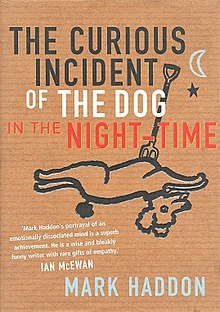
In this ambition – to show the word in a surprising and revealing way – I think he undoubtedly succeeds. Christopher is a compelling guide to the incidents that form the core of the narrative – the ‘murder’ of his neighbour’s pet dog, and the unexpected fallout from that crime. His different way of experiencing the world and the challenges he faces in doing so does reveal events unlike that of any conventional narration. It is also a source of humour, although this is mostly kindly done – Christopher is laughed at by some characters he meets, but not by the reader. If the situations he finds himself in are potentially amusing they are also potentially tragic, not least the disintegration of his family who he depends on so completely. At the same time I can understand the concerns people have about the portrayal of autism – Christopher is violent and aggressive towards people who try to help him, including menacing them with a pocket knife (even if Haddon blunts this threat somewhat by making it the saw blade of a Swiss Army knife). The portrait of autism is also inconsistent – Christopher is at pains to explain that he cannot understand any language that is indirect or uses imagery – “metaphors are lies” but he also uses imagery in his narrative. And of course there is a fundamental contradiction in the idea of a novel written by an autistic person who claims “this is another reason why I don’t like proper novels, because they are lies about things which didn’t happen and they make me feel shaky and scared. And this is why everything I have written here is true” – when clearly it is not.

The mystery element of the narrative is a parody or pastiche of the Sherlock Holmes stories, suggesting that Holmes and Christopher share some of the same ways of looking at the world. Christopher is certainly intelligent and he remembers virtually everything he sees (the myth of eidetic memory is incredibly strong) although elsewhere in the novel Christopher accurately describes how people don’t actually’ see everything all the time – our eyes aren’t video recorders, and our brains have limited storage, which contradicts this aspect of his characterisation. Like Holmes Christopher has substantial gaps in his knowledge and his understanding of the world, particularly in relation to people and human behaviour, and is extremely scornful of others who have a different interests and views.

Sympathetic portraits of people (especially children) with learning or behavioural difficulties, which present the world from their point of view with the intention of helping the reader understand that different perspective, are few and far between. So I think we can forgive Haddon for any mistakes (or vagueness) in his characterisation of this condition. Sometimes the pressures of the narrative require Christopher to be able to do things (such as travel on the tube) when this would clearly have been beyond the abilities of the character a few chapters earlier. (To be fair, he does find this extremely difficult, but he’s not alone in that!) But a flawed autistic hero is still a hero, achieving things far beyond the expectations of others (for example he is the first person at his school to pass an A level).

The novel ends on a positive note – Christopher’s family situation settles down and he appears to be coming to terms with his father’s decisions that have caused him so much distress. Adult readers will no doubt empathise more closely with Christopher’s parents and the difficulties they faced in raising him, while younger readers will be supportive of Christopher himself. He is given a puppy, passes his Maths A Level, and has a plan for the next few years of his life – he will take two more A levels and go to university. Young readers will cheer him on and be hopeful that this can happen – older readers will worry for Christopher, knowing the hurdles he faces and the demands this will put on his already worn down parents.

The Curious Incident won several prizes including the Whitbread Book Awards for Best Novel and Book of the Year, the Commonwealth Writers’ Prize for Best First Book and the Guardian Children’s Fiction Prize. It has also been adapted as a very successful stage play. Although it was originally published in separate editions for both children and adults, I think it ideal audience would be young adults, who will be charmed by Christopher’s unique way of looking at the world and recognise in themselves some of the same challenges such as how to navigate their way through a complex, noisy world. If Christopher can make it, with the support of his parents, perhaps we all can?
The Curious Incident of the Dog in the Night-time by Mark Haddon, 2003

Aside
Book review, Malorie Blackman, Noughts and Crosses

Noughts and Crosses by Malorie Blackman, 2001

untitled‘Noughts and Crosses’ is set in an alternative society in which the dark skinned people of the world conquered and enslaved the lighter skinned. As a consequence, although slavery has now been abolished, black people are prosperous, have good schools and hospitals and hold senior positions through society, white people are disenfranchised, hold most menial jobs, and are economically disadvantaged. Relationships between noughts and crosses are frowned upon – they are not unheard of, but still considered transgressive and likely to lead you to end up being assaulted. Critics have called this society dystopian (“relating to or denoting an imagined place or state in which everything is unpleasant or bad, typically a totalitarian or environmentally degraded one”), but I am not so sure about that – I think Blackman intended it to be as realistically close to our own as possible.
This inversion of society and race is an inspired way of encouraging people to look at the power relationships in society, and the many ways in which black and minority ethnic people are still treated as second-class citizens, despite the progress that has been made in some areas. Certain scenes, such as when four “blanker” children (‘blanker’, we can deduce, is a shockingly offensive term similar to way the n-word is used in our own society) are allowed to attend a “Cross” school, are based on incidents in the Civil Rights movement in the United States in the 1950s and 60s. However a knowledge of this history is in no way essential for an appreciation of the novel.

One reason why this is not simply a dystopian nightmare is that there is some evidence that society is in transition. There appears to be a democratic Government, albeit one in which Crosses dominate, and an international organisation, the Pangean Economic Community, which promotes racial equality. Noughts can now attend cross schools. There is hope that the oppression of noughts is being eased, albeit slowly.

This world is portrayed through the eyes of two teenagers, Sephy, (short for Persephone) a prosperous Cross, and the son of her nanny, Callum, a nought. Callum and Sephy narrate alternative chapters in the novel, similar to the turns taken in a game of noughts and crosses. Their fledgling romance is disrupted when Callum’s mother is spitefully dismissed by Sephy’s mother for failing to provide an alibi for one of her affairs. Callum’s father and older brother Jude are slowly drawn into the dangerous world of the nought resistance movement, the Liberation Militia. As you can probably guess, things don’t go well for the star-crossed youngsters. I will eschew my normally strict policy on spoilers; suffice to say this is not the traditional teen romance the opening chapters might have led the reader to expect.

The target readership for ‘Noughts and Crosses’ is finely calibrated. Readers need to be young enough to forgive the simplistic structure, the use of clichéd scenarios (spurned young love, letters read moments too late, parental neglect, etc.) and the reliance of heavy handed narration in which teens sigh a lot and complain about how no-one understands them:

“I pulled him closer to me, wrapping my arms around him, kissing him just as desperately as he was kissing me. Like if we could just love long enough and hard enough and deep enough, then the world outside would never, could never hurt us.”

“That’s why I started crying. That’s why I couldn’t stop. For all the things we might’ve had and all the things we’re never going to have”.

However, the caution on the novel’s front cover – “Not suitable for younger readers” – is a warning that this is more than a teenage romance novel. The characters a bit wooden, even two dimensional, and in particular Jude is the world’s worst terrorist, but this is nevertheless a challenging novel of ideas where easy answers are avoided.

It is difficult for adults to review books written specifically for children and young adults. If we point out their bland characterisation, flaccid language, and clichéd storylines, we miss the point – children are looking for different things in their fiction, such as strong themes, identifiable characters, and just the right amount of danger. ‘Noughts and Crosses’ is a modern children’s classic, but there’s no doubt I would have enjoyed it so much more if I had read it as a teenager.

Standard
Book review, John Green, Turtles all the way down, Young adult

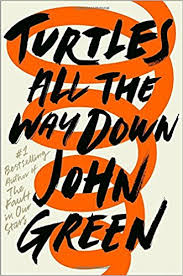
Turtles All the Way Down – John Green, 2017

Should one use the same criteria when judging young adult novels as one does when assessing full-grown adult fiction? I ask because if one were to do so, ‘Turtles’ would probably suffer by comparison, when judged on its own merits as a thoughtful novel for young adults, it is a success.

Turtles

The central character of John Green’s ‘Turtles All The Way Down’ (loving that title), Aza Holmes (‘Holmesy’) suffers from Obsessive Compulsive Disorder (OCD). This makes her extremely anxious, and she self harms as part of her control rituals, opening a wound on her hand, then being terrified it will become infected. As her condition deteriorates she takes to drinking hand sanitizer, in a deluded attempt to purge her body of infection. (NB Do not do this!). She is also haunted by thoughts that she is a fictional creation (which of course she is, although Green does nothing with this paradox). Most of the time she remains in control of her obsessive behaviour, although her internal monologue tells us that she is tortured by harmful thoughts. Despite her condition Aza is in many ways a typical, relatable American teenager – she drives to school in her beloved truck Harold, eats pizza with friends, and watches television with her mum. Green doesn’t spell it out in so many words, but we are invited to conclude that Aza’s OCD was triggered following the sudden death of her father from a heart attack when she was seven.

A fledgling romance with a neighbour whose incredibly rich father has gone missing triggers a more serious episode, and she is eventually hospitalised. The parallels with the loss of her own father are quietly underlined, and form the basis of her relapse. She eventually recovers sufficiently to overcome her anxiety and in a strange conclusion to the novel attends an art exhibition in a sewer, where she comes close to solving the mystery of the missing billionaire. I probably shouldn’t focus on this detail, but I doubt whether many OCD suffers would be prepared to go into a sewer for any price, let alone wander around in the dark in one. This ending to the novel was for me its weakest part, and fails on any level, providing an unsatisfactory ending to the ‘mystery’ element of the novel, which had a lot of potential but which Green seemed to lose interest in.

What elements do you look for in an adult novel that we can forgive being missing from a YA novel? Characterisation? Obviously not, we need the characters to be fully fledged and believable. Green does reasonably well here – some of his characters are generic, off-the shelf quirky teenagers distinguishing themselves from one another by their choice of hair style or interest in music. I quite liked Daisy, the inevitable reliable best friend, but Davis, the missing billionaire’s son, who provides the only significant romantic interest in the novel, isn’t well developed – in fact his brother Noah, who is mourning the loss of his father, but hides his grief and distress in video games, was more believable. There’s a whole missing novel there in fact – the two brothers waiting for their father to return, unable to draw any solace from their preposterous riches.

Plot? The story line in ‘Turtles’ goes missing quite early on, and never resurfaces until the hurried and unconvincing conclusion. Green starts out writing a conventional if slightly Scooby Dooish mystery, but this element fizzles out early on, and the focus shifts instead to Aza’s illness and its impact on her life.

Quality of writing. Green does a good job, so far as I can tell, in representing the voice and thoughts of a teenage OCD sufferer. His writing is straightforward and extremely easy to read – this is the kind of novel that you can polish off in a few hours easily. There are no rhetorical flourishes or difficult passages.

Originality. It would be being harsh to say Green was on auto-pilot here, but there is a very familiar clichéd feel to this novel. Angsty teenagers have mild romantic entanglements to the backdrop of a high-school experience, something easy for US teenagers to identify with from real-life, (and other readers from anyone who has watched US television) the kind of high school where you pull up in front of the school and there is always a parking space waiting; where lessons take a few minutes and time is mainly spent being cool in the cafeteria, and pupils quote Shakespeare to one another in their texts. It was as believable as Buffy the Vampire Slayer, but a bit less glamorous.

Ultimately, the answer to my opening question is a clear no. This isn’t a book that adults will be able to take much from, but younger readers (I really wouldn’t get hung up on the YA label; I would have thought pre-teens could enjoy this as well. There are some adult themes such as references to dick pics, but that is about as strong as it gets) will find it an interesting and comforting read – or in the words of the Guardian’s reviewer “It will resonate with, and comfort, anxious young minds everywhere” , which I think is spot on.

P.S. What a disappointing book cover by the way – we get it that depression is like a spiral (not that that image is in any way helpful or clear) but the missed opportunity for pictures of some turtles will hopefully be rectified in the paperback!!

Standard