
There was some controversy about The Curious Incident of the Dog in the Night-Time when it was first published, a controversy which has died down but rumbles on to this day. The central character and narrator of the novel is Christopher Boone, a 15-year-old young man who has ‘some behavioural difficulties’. This is a deliberate understatement – Christopher struggles with the everyday world, despite his obvious acute intelligence, and when he suffers from sensory overload he starts screaming, hitting out at people, and losing control of his bodily functions. This is not a flattering portrait of this condition, whatever the condition may be. Christopher’s exact medical diagnosis is never made clear in the novel, although the book’s blurb (when it was first published – later editions have corrected this) refers to Asperger syndrome (which the internet reminds me today would be described as an autism spectrum disorder). Some years after publication Haddon attempted to correct this perception, writing “The Curious Incident is not a book about Asperger’s…if anything it’s a novel about difference, about being an outsider, about seeing the world in a surprising and revealing way. The book is not specifically about any specific disorder”. Subsequently he further wrote about his regret that the term was used in the blurb at all.
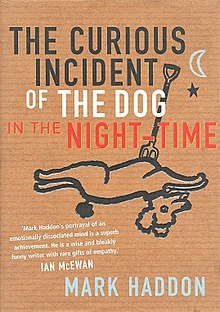
In this ambition – to show the word in a surprising and revealing way – I think he undoubtedly succeeds. Christopher is a compelling guide to the incidents that form the core of the narrative – the ‘murder’ of his neighbour’s pet dog, and the unexpected fallout from that crime. His different way of experiencing the world and the challenges he faces in doing so does reveal events unlike that of any conventional narration. It is also a source of humour, although this is mostly kindly done – Christopher is laughed at by some characters he meets, but not by the reader. If the situations he finds himself in are potentially amusing they are also potentially tragic, not least the disintegration of his family who he depends on so completely. At the same time I can understand the concerns people have about the portrayal of autism – Christopher is violent and aggressive towards people who try to help him, including menacing them with a pocket knife (even if Haddon blunts this threat somewhat by making it the saw blade of a Swiss Army knife). The portrait of autism is also inconsistent – Christopher is at pains to explain that he cannot understand any language that is indirect or uses imagery – “metaphors are lies” but he also uses imagery in his narrative. And of course there is a fundamental contradiction in the idea of a novel written by an autistic person who claims “this is another reason why I don’t like proper novels, because they are lies about things which didn’t happen and they make me feel shaky and scared. And this is why everything I have written here is true” – when clearly it is not.
The mystery element of the narrative is a parody or pastiche of the Sherlock Holmes stories, suggesting that Holmes and Christopher share some of the same ways of looking at the world. Christopher is certainly intelligent and he remembers virtually everything he sees (the myth of eidetic memory is incredibly strong) although elsewhere in the novel Christopher accurately describes how people don’t actually’ see everything all the time – our eyes aren’t video recorders, and our brains have limited storage, which contradicts this aspect of his characterisation. Like Holmes Christopher has substantial gaps in his knowledge and his understanding of the world, particularly in relation to people and human behaviour, and is extremely scornful of others who have a different interests and views.
Sympathetic portraits of people (especially children) with learning or behavioural difficulties, which present the world from their point of view with the intention of helping the reader understand that different perspective, are few and far between. So I think we can forgive Haddon for any mistakes (or vagueness) in his characterisation of this condition. Sometimes the pressures of the narrative require Christopher to be able to do things (such as travel on the tube) when this would clearly have been beyond the abilities of the character a few chapters earlier. (To be fair, he does find this extremely difficult, but he’s not alone in that!) But a flawed autistic hero is still a hero, achieving things far beyond the expectations of others (for example he is the first person at his school to pass an A level).
The novel ends on a positive note – Christopher’s family situation settles down and he appears to be coming to terms with his father’s decisions that have caused him so much distress. Adult readers will no doubt empathise more closely with Christopher’s parents and the difficulties they faced in raising him, while younger readers will be supportive of Christopher himself. He is given a puppy, passes his Maths A Level, and has a plan for the next few years of his life – he will take two more A levels and go to university. Young readers will cheer him on and be hopeful that this can happen – older readers will worry for Christopher, knowing the hurdles he faces and the demands this will put on his already worn down parents.
The Curious Incident won several prizes including the Whitbread Book Awards for Best Novel and Book of the Year, the Commonwealth Writers’ Prize for Best First Book and the Guardian Children’s Fiction Prize. It has also been adapted as a very successful stage play. Although it was originally published in separate editions for both children and adults, I think it ideal audience would be young adults, who will be charmed by Christopher’s unique way of looking at the world and recognise in themselves some of the same challenges such as how to navigate their way through a complex, noisy world. If Christopher can make it, with the support of his parents, perhaps we all can?

