Book review

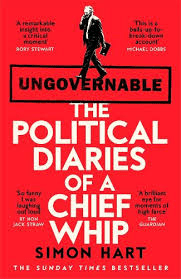
Ungovernable: The Political Diaries of a Chief Whip by Simon Hart, 2025

Simon Hart was a relatively minor figure in the appalling melodrama that was the 2019-2024 Conservative Government – he was Secretary of State for Wales for a couple of years, a post of minimal significance since devolution, but came with a place at the Cabinet table, and then Chief Whip for the duration of the Sunak Government (2022-24). He now sits in the House of Lords, despite having consistently poured scorn on the aspirations of his fellow MPs for the same privilege. Nevertheless, he undoubtedly had an insider’s perspective (the proverbial ‘front row seat’) on the chaos that engulfed the Tories during the 2019-24 Parliament and his heavily redacted diaries of that period give enough juicy details to keep the pages turning, even if the ‘real’ story remains elusive.
A feature of most political diaries is the temptation to remove references that make the author look like he or she had no idea what was going on, but at the same time to also leave sufficient minor ‘gaffes’ to make the account convincing. What do I mean by that? Well, if these diaries were to include glowing predictions of how wonderful Liz Truss’s premiership was going to be, Hart would lose any credibility as an observer of the political scene. On the other hand if every prediction proves unerringly accurate then the reader would be sceptical as to their authenticity. So when Hart says of Rishi Sunak in June 2022, “He is compelling and will be a contender for PM one day“, his editor would have been keen to keep this prediction in the final edit despite the fact that Sunak was to become Prime Minister only four months later – ‘one day’ being a stark understatement. In other words Hart was wrong, but in a mildly entertaining way rather than totally misjudging the situation. It was for the purposes of this category of memoir the ‘right’ kind of mistake. Most of his political predictions that survive the edit are reasonably accurate – for example as the process to replace Johnson as Prime Minister gets underway Hart pondered “I dread to think what a Truss Government would look like, or if it will even last”.

Looking back now over the 2019-2024 Government it really is quite breath-taking how bad it was. The rot started at the top of course and Hart is a frank observer of Johnson’s flaws as well as his abilities. Knowing how things ended we can see how entirely unsuited he was to senior office, even if that wasn’t glaringly obvious much earlier, but Hart, like the rest of the Conservative Party, was swept away by his Etonian bluster. He finds his performances in Parliament ‘brilliant’ and is charmed by his Woosterish schtick. Hart’s decision to join the eventual flood of Ministerial resignations which swept Johnson from office comes late and is done with much regret rather than in recognition of the Prime Minister’s arrogance and incompetence. His subsequent appointment as Sunak’s Chief Whip was intended to introduce some stability to the political process, but on every other page there is scandal, from the infamous ‘tractor porn‘ incident to a succession of entries about serious sex offences (allegedly and in some cases actually) committed by MPs, special advisors (SpAds) and others. 

Hart himself emerges as an affable, hard-drinking One Nation Tory, a remainer who was often out of his depth, like so many of his colleagues. If you want to know why the Tories went from a comfortable 80+ majority in the December 2019 General Election to an ignominious wipe-out five years later, there is plenty here both between the lines and directly from Hart himself. A good example of his lack of understanding as to just how existentially serious the crisis the party was facing comes in his entry for Friday 17 December 2021

“The North Shropshire by election goes against us and in favour of the Lib Dems with a 5000 majority. It’s the first time this seat has ever been held by a non-Conservative. This is manageable but serious and should probably be reversed at a General Election, but it has opened up the whole question of whether the BoJo electoral ‘magic’ has lost some of its potency.”

Is some ways it this is the most egregious of all Hart’s political miscalculations. In the 2019 General Election Owen Paterson won this seat for the Conservatives with a majority of over 20,000 (the chaos over Paterson’s breach of Parliamentary standards and the Government’s blatant attempt to subvert Parliamentary processes to avoid him having to face the consequences of his actions is a whole other story – readers of Hart’s account will need to turn to Wikipedia for the detail). The Lib Dems had come third in this seat in 2019 with fewer than half the votes of the Labour candidate, then leapfrogging Labour to beat the Tories comfortably at the by-election. At the 2024 General Election the Lib Dem incumbent increased her majority to over 15,0000, making North Shropshire a relatively safe LD seat. The arrogant assumption that the by-election result was simply a protest vote rather than part of a generational movement away from life-long Conservative hegemony reveals how little Hart understood what was really going on as the Johnson administration slowly but inevitably imploded.

Although the 2019-24 government was obviously deeply flawed and chaotic, it would be wrong to overlook the two significant external events that would have been challenging for the most competent of administrations – the Covid pandemic and the war in Ukraine. Both had dramatic impacts on the economy which we will be paying for for years to come. Boris Johnson was totally unsuited to running the serious type of Government required to manage the UK’s response to the pandemic (for example his early demonstration of his incompetence and bravado by ignoring medical advice and continuing to shake people’s hands) but it would have been difficult for any government. None of which justifies the casual indifference to economic stability demonstrated by Liz Truss and Kwasi Kwarteng of course.

Does Ungovernable tell us anything we didn’t already know? The detail of the collapse of the various administrations is already in the public domain. Central characters including Johnson have already published their memoirs and accounts of the period. Frustratingly, the really juicy gossip that Hart was privy to – the drunken calls from MPs in the middle of the night, one claiming to be stuck in a Bayswater brothel with a woman he thought was a KGB agent, or the reports of orgies and someone going to a party in a Jimmy Savile costume and having sex with a blow-up doll – is all sadly but inevitably anonymised. Anyone who starts this book with a positive opinion of politicians, as hard working and basically decent, will find themselves closing the pages at the end wondering just how wrong one can be!
Ungovernable: The Political Diaries of a Chief Whip by Simon Hart, 2025

Aside
Book review

The Blair Years (2) by Alastair Campbell, 2007

There were a few additional observations I wanted to add to my earlier review of Campbell’s fascinating diaries of the years he spent as Tony Blair’s press secretary, from 1994-2003.

One of the contentious policies the Starmer Government has been pursuing since the 2024 General Election is the levying VAT on the fees paid for private education. Campbell always was to the left of Blair on educational issues, advising him against sending his kids to the grant-maintained Oratory school, and he is a strong supporter of the current Government’s plans. This policy idea was originally floated in the early years of Blair’s leadership prior to him becoming Prime Minister – and when it came up he killed the idea stone dead without any debate. He considered it a tax on education and could not understand why any Government would even consider the idea. To him it was unthinkable. I mention this point simply to underline the fact that while the Starmer Government is obviously very far to the right of the policy positions taken during the Corbyn years, there remains some important differences between its policies and those of New Labour. Blair would never have countenanced something as radical as VAT on school fees – Starmer is pushing ahead with the idea despite a lot of well-resourced opposition and limited evidence that the policy is causing the party some electoral damage. In other words he is probably doing it because he believes it is the right thing to do, not simply because it is politically expedient.

The second point that I originally overlooked is an exchange Campbell shares (page 101) between himself and Mo Mowlam, at the time a shadow minister for Northern Ireland, who was to go on to play a key role in the Good Friday Agreement. At the time the Labour Party, still in opposition, was rocked by Harriet Harman’s controversial decision to send her children to grammar school. Campbell’s role as always was to ensure all Labour MPs stayed on-message and defended the party line, whatever their personal feelings on the issue. He recounts his version of events:

“We were still struggling to get anyone to defend her (Harman) on TV, but eventually I persuaded Mo to do it, only half jokingly saying that if she didn’t I’d reveal her stepchildren were at a public school.”

This is horrendous. A Shadow Minister is forced to go on television to defend a position she doesn’t agree with because otherwise a party official will expose damaging information about her family to the media. This isn’t a half-joke, it’s blackmail. The fact that Campbell thought it acceptable to include in this book – presumably to show how far he was prepared to go to support Blair – is appalling, and makes one wonder what dark arts and deviousness were left out.

Finally, during the 2024 general election campaign it was hard to find a single commentator not referring to Labour’s ‘ming vase’ campaign strategy. The phrase was used so relentlessly that it almost lost all meaning, so I was struck by the fact that the phrase is first recorded in these diaries. It isn’t just an echo of the New Labour strategy, it is the New Labour strategy.

“TB told me about his last dinner with Roy Jenkins at Derry’s….” I see you Tony, as someone carrying an exquisite, beautiful. hand-painted vase over a slippery floor and as you proceed across the floor, vase in hand, you can see your destination and you can see the likes of Harriet Harman and Clare Short lunging towards you, and you don’t know whether to run or tiptoe”.

In this original version of the strategy, it’s not the leadership who are going to drop the vase – instead they might have it struck from their hand by outspoken or clumsy Shadow Ministers or party spokespersons. So the strategy is not simply one of taking no risks, but also of shackling any Shadow Ministers seen as likely to say something out of turn. Roy Jenkins was a progressive Labour Cabinet Minister in the sixties and seventies, but had done his best to destroy the party in the eighties by setting up the SDP (which was to eventually merge with the Liberal Party to form the Liberal Democrats). You can interpret the fact that Blair adopted him as one of his senior (albeit unofficial) advisors as either evidence of Blair’s willingness to think outside the box and break rules, or of his innate conservatism.

The diaries were a mine of interesting insights such as this into both the Blair years themselves and their reflection in what might one day be called the Starmer years. Or maybe not.

The Blair Years (2) by Alastair Campbell, 2007

Aside
Book review

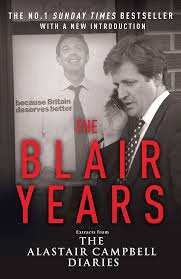
The Blair Years, by Alastair Campbell, 2007

I don’t think there is any question that Alastair Campbell’s obituary when it comes to be written will focus on the events of the last few weeks of this diary. For any readers for whom this is history rather than current affairs, a short summary: Alastair Campbell was Tony Blair’s press spokesman from shortly after Blair became leader of the Labour Party through the first two New Labour governments. He developed a fearsome reputation as a defender of the Government. The verb ‘to spin’ might have existed before Campbell and New Labour, but it came into common currency during those years. To give you some idea of Campbell’s reputation, all you need to know is that the character Malcolm Tucker from The Thick of It was based upon him.

After 9/11 America, led by George W Bush, was determined to depose Saddam Hussein. The premise for this attack was that Iraq possessed weapons of mass destruction (WMDs), or the capability to develop such weapons. Tony Blair was unshakeable in his support for Bush and the issue became a deep dividing line within British politics. To support the case for war a file of intelligence briefings (a dossier) was produced, purporting to demonstrate that Hussein had WMDs. A BBC report claimed that Campbell had interfered with the drafting of the report and ‘sexed’ it up, over-stating the strength of the evidence. Dr David Kelly, a government scientist who had allegedly leaked information on the dossier to the BBC ended up taking his own life. A judicial inquiry into these events, the Hutton inquiry exonerated Campbell but the accusation has stuck, primarily because it seems the sort of thing that Campbell would have done.

Campbell has spent more than twenty years trying to rebuild his reputation, but I suspect he will always be haunted by this accusation. The Blair Years is the first of what is by now a series of eight volumes of his extremely detailed diaries – over 750 pages covering 1994-2003, around a sixth of the total words written contemporaneously. The obvious question is to what extent these diaries have been edited or selected to present a positive view of Campbell and his role in New Labour, and specifically to exonerate him from the WMD accusations? It would be astonishing if not almost impossible to edit down that volume of writing without any element of spin. Choices must have been made, inevitably with the intention of presenting Campbell and Blair in the most positive light. Even if Campbell wasn’t such a notorious exponent of the art of spin, some recasting of events must have happened. I am possibly being naïve but I choose to think that this is a reasonably honest version of events. Campbell saw himself as a leading figure in the Blair administrations, more a chief of staff than a press officer. He was at the heart of the New Labour project, even if on some issues he found his personal views to the left of Blair. An early instance of this is when he tries and fails to persuade Blair not to send his children to a grant-maintained school, which went on to be a bit of a PR disaster for him.

Most of the time there is little effort made to provide context to the events being described – footnotes are few and far between – so the reader either needs to be familiar with the events or spend a fair amount of time flicking back and forth to Wikipedia. The overall effect is of a real-time account of several significant moments in recent British history, such as the death of Princess Diana, the foot and mouth crisis, and the British reaction to 9/11 leading through to the Gulf War. Throughout, Campbell’s portrait of Blair is consistent: he was a reforming Prime Minister often out of step with his party but driven by faith in the rightness of his own views, determined to reform institutions (such as the House of Lords) and with a broad interest in social justice. Campbell himself is by contrast more a traditional party man. The cast of supporting characters is large. John Prescott comes across as a surprisingly likeable ally, while Campbell makes little attempt to disguise his contempt for others such as Clare Short. The effect of some parts of the diaries is to confirm public perception of Labour figures – Peter Mandelson is undoubtedly Machiavellian, Gordon Brown is prone to outbursts of anger, and so on – there aren’t many revelations about politicians secret lives. Perhaps this is because so many other memoirs have been published. What was at the time an insight into what really happened – such as the story of Robin Cook breaking up with his wife on the way to the airport because a tabloid was about to expose his affair (a story sometimes presented as Campbell instructing Cook to divorce his wife) are now well known and all these diaries do is confirm them.

Campbell isn’t over-burdened by humility. Early on he becomes excruciatingly convinced Princess Diana is attracted to him. The Secretary General of NATO is quoted as saying in the context of the conflict in Kosovo “If you can, send me your man Campbell, that would be best“. He becomes good friends with Bill Clinton and George W Bush. I suppose everyone is the hero of their own stories.

While some of the narrative feels like ancient history, other sections bear strikingly similarities to the political situation today – a reforming Labour Government with a large majority after a long period of Conservative rule; a hostile media; cynical anti-politics agenda being pursued by the right-wing; Europe as always a divisive issue. Even electoral reform and changes to the House of Lords are back on the agenda. So these diaries should probably be studied by the new Labour Government. If they were to do so what lessons would they derive?

First, the Conservatives must not be under-estimated. They will be back, and the time to cement Labour’s position as the party of Government is now, not in five years time. The next Conservative Prime Minister may not yet be an MP (Cameron was not an MP when Blair was elected; Starmer was not an MP when Cameron was elected) but they aren’t one of Europe’s oldest political parties for nothing.

Second the media will be unrelentingly hostile and the Government needs to decide what it is going to do about that. What we mean by the media has obviously changed since 1997 with the advent of Facebook etc, but the right-wing tabloids are still stubbornly there and will not miss a chance to undermine the Government.

Thirdly major crises seem almost unavoidable. Whether it is the death of Princess Di, foot and mouth disease, the oil delivery drivers strike (first term) or 9/11 and the Gulf War (second term) and the global economic crisis (third term) there are going to be testing times ahead.

Is the portrait of Campbell that emerges from these diaries accurate? For example is his reputation for quite aggressive ferocity justified? I wanted to quote at length a description Campbell gives of a shouting match between himself and Gordon Brown, Chancellor of the Exchequer (page 528) during the 2001 general election campaign. Brown had long been concerned about the negative impact of briefings by Peter Mandelson, who had been sacked twice from Cabinet positions:

“I went over to see GB in his office….and he was banging away at his computer. He had a pile of papers to the right and on the top had written 75 pence and below it, in large black letters, ‘who will silence Mandelson?’ ….

I tried to make a joke of it, but he was having none of it, went on a great tirade, said we were letting him destroy the campaign, undermine him, be ill-disciplined, on and on he went and eventually I lost it, said PM was nothing to do with me and I did not like the implications that I could be held responsible one way or the other for what he was or was not up to. “Well it has to stop” he said. “Telling me it has to stop suggests that in some way I might be responsible, and I fucking resent that….(continues at some length) I was suddenly conscious that I was jabbing my finger at him, and thought it better to leave.”

This is extraordinarily unprofessional conduct, but it seems there were no consequences for Campbell for swearing and shouting at the second most senior member of the Government. The word suddenly is revealing here – if the description can be taken at face value, he seems genuinely not to have realised he was shouting and being aggressive towards Brown for most of the exchange. If he treated the Chancellor of the Exchequer like this, what was he like with junior members of staff and journalists? Of course we don’t need to ask because there are multiple accounts of his behaviour. So yes, he was aggressive and either didn’t know or care that people were often genuinely scared of him.

Just one other thing I noticed: the back cover of the paperback edition includes the following quote from Matthew Parris, the Times columnist and former Conservative MP

“A brilliant, absorbing account….These diaries….will be gasped at, and relied upon, for decades to come. Buy them; they will suck you in”.

I was surprised to read this endorsement when Mr Parris himself appears only once in these diaries (page 308) as “The little shit Parris“.

One wonders what qualifications were hidden by the ellipses?

The Blair Years, by Alastair Campbell, 2007

Aside