
Invisible Man, by Ralph Ellison, 1952
Invisible Man appears on many lists of the best novels of the twentieth century. It is a powerful and often disturbing account which challenges many of the conventional ideas of the form and structure of the novel.
It opens with the narrator, an unnamed black man, living in an underground room lit by hundreds of electric lights powered by electricity stolen from the city’s grid. He tells his story in flashback, attempting to explain why he feels socially and sometimes literally invisible.
“I am an invisible man. No, I am not a spook like those who haunted Edgar Allan Poe; nor am I one of your Hollywood-movie ectoplasms. I am a man of substance, of flesh and bone, fiber and liquids — and I might even be said to possess a mind. I am invisible, understand, simply because people refuse to see me. Like the bodiless heads you see sometimes in circus sideshows, it is as though I have been surrounded by mirrors of hard, distorting glass. When they approach me they see only my surroundings, themselves, or figments of their imagination — indeed, everything and anything except me.”
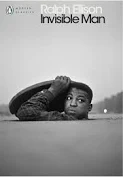
Born in the American South, he lives in a highly segregated society, in which black people live in fear and subjugation. He intends to escape the poverty which defines black lives in this community and wins a scholarship to an all-black college. Integrated education in the South at this time was unheard of. He works to support himself by taking a chauffeuring job. One day, while chauffeuring Mr. Norton, a trustee of the college, he makes a series of disastrous decisions. Norton, a white man, is curious about the lives of local black people. The narrator takes him to the old slave-quarters near the college campus. The fact that there even are old slave quarters still standing shows that slavery is still part of people’s lives, despite it formally ending almost a century beforehand. Here Mr Norton meets Jim Trueblood, a notorious local figure who has got both his wife and his daughter pregnant ‘in his sleep’. This is an uncomfortable portrait of black poverty in which people live little better than slaves and ignore social conventions regarding incest. Norton is appalled and asks to be taken somewhere for a stiff drink. Inexplicably the narrator takes him to a local brothel, where a riot breaks out caused by a surreal day-outing of patients from a nearby mental hospital. (There is an echo of this scene in One Flew Over the Cuckoos Nest, where the patients are taken out for the day, with similarly disastrous consequences).
The narrator is summarily expelled from college. He sees it as an unfair punishment but his principal is appalled that he has exposed the dark side of black people’s lives behind the civilised facade of the campus. The narrator travels to New York and finds work in a paint factory. More chaos ensues – he is a magnet for trouble and has no control over his life. He unwittingly causes an explosion at the factory, is hospitalised and given electric shock treatment. He escapes the hospital and stumbles into the next, decisive phase of his life. Happening across the eviction of an elderly black couple he makes an impassioned speech in their support, accidentally inciting the crowd to attack the bailiffs and triggering yet another riot. His oratorical skills are recognised by a group known as “the Brotherhood” which appears to be a black nationalist movement. He signs up and quickly becomes one of the group’s keynote speakers. Internal politics eventually turns this sour, and he becomes disillusioned with the group. Its message of gradual change and co-operation with whites is challenged from the left by more radical voices, led by a figure known as Ras the Exhorter. The novel reaches its climax with the narrator getting caught up in a race riot in Harlem. He narrowly escapes being lynched by supporters of Ras the Exhorter who perceive him as a traitor to his race.
Invisible Man is vivid, impressionistic, and unconventional. Superficially it follows a traditional narrative structure but the narrator’s adventures and mishaps are chaotic and often appear random. It charts a very specific time in Black American history at the birth of the Civil Rights movement, when many of the debates about how best to combat segregation and oppression were at their fiercest. It’s not a comfortable read but it is an important, unique book.

