
Please, Mister Postman is the sequel to Johnson’s This Boy, the highly praised account of his childhood in the slums of 1950s West London. This Boy (2013) won the Royal Society of Literature Ondaatje Prize (2014) and the Orwell Prize. Please Mr Postman was possibly an attempt to cash in on the unexpected success of the first volume of his memoirs – certainly it appeared very quickly thereafter. It covers what he obviously saw as the second phase of his life, from the early start of his first marriage, aged 18, to its end (the marriage that is, not his life) in his mid-30s.
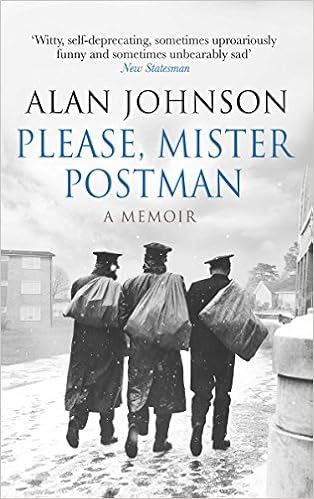
Reading Please, Mr Postman (the title is obviously a reference to Johnson’s occupation, but also a clever nod to the music of the time, which provides a backdrop to all his work and leisure) you get very few hints that Johnson was going to go on and become a Labour MP and eventually Home Secretary. His involvement with the local Labour Party is limited – his focus is more on a slow but steadily increasing commitment to the Postman’s Union, which was to become the UCW (Union of Communication Workers). This was good old-fashioned 1970’s closed shop trade unionism, where if someone broke a strike they were ostracised by their workmates indefinitely. I now know far more about the detail of postal work and the agreements of the time between management and unions governing all aspects of working life than I ever thought I would need. Johnson is rightly proud of his working class roots, but there is little to suggest that he has the political appetite or ability for Westminster. The political events of the day are mentioned, but mainly in passing as a backdrop to the more pressing detail of the latest change to postal delivery processes or the management of his sorting office.
While he devotes many pages to the detail of these issues and to anecdotes about his family, neighbours, friends and colleagues, all the time I got the impression that the real Alan Johnson was hiding in plain sight. We really get to know little about Johnson the man. At the end of the book he describes a distressing conversation with his wife when they agree to separate and divorce. This comes out of the blue – prior tot his there is no suggestion their marriage was in trouble, or the large amounts of time he was spending away on union business was causing them problems. The incident is used to close the book and bring down the curtain on this phase of his life, but is dealt with hurriedly in a few paragraphs – his discomfort at even sharing this level of detail is obvious.
For a brief period Johnson was a significant figure in the Labour Party. Ed Miliband appointed him as Shadow Chancellor of the Exchequer, a post he stood down from when his unsuitability and lack of appetite for the role became unavoidable. He came within a whisker of being elected Deputy Leader of the party, and was spoken of more than once as a candidate for the top job itself, although he quickly graduated to the role of senior statesman . All this is almost possible to imagine when reading about his inability at DIY, local elections in the postal workers union, or his nervousness when speaking at CWU conference. As with most memoirs he paints himself as usually being on the right side of most moments of history but at the same time is very understated and self-deprecatory.
Johnson’s authenticity, his working class roots and trade union activism were always his defining qualities. He makes the most of them here, although this is not a miserabilist memoir. Warned on arriving in Slough that the Britwell estate he was moving into was dangerous, Johnson and family instead experienced it as a welcoming community. His family grows as the seventies progress, and while they are never prosperous things slowly get a little easier, and one or two upgrades occur along the way – he moves from a borrowed bike, to a moped, a Post Office van, and finally a family car. His gratitude for the experience of social housing was obviously formative but it doesn’t prevent him from supporting the Thatcherite policy of selling council houses. Nevertheless his background is a world away from the affluent middle-class life of many New Labour MPs, and it gave him an authenticity when talking about welfare or housing that for others was purely theoretical. Little wonder he stood out – in 2010 a parliamentary report found that the number of former manual workers serving as MPs had fallen from 16% in 1979 to just 4% in 2010. Half of Labour’s candidates in marginal seats in the 2015 election were political insiders such as former special advisers or thinktank workers. The Conservatives had only two former manual workers as MPs post-2010; the Liberal Democrats had one. Johnson’s years as a postie were to prove invaluable in defining him as a Labour politician with first-hand experience of the issues he campaigned on.
Johnson is largely out of politics now, and seems happier for it. He stood down from Parliament in 2017, apparently disenchanted with the direction the Labour Party was taking under Jeremy Corbyn. His most recent career move saw him appear on The Masked Singer – I’d guess it will be Strictly next!

