
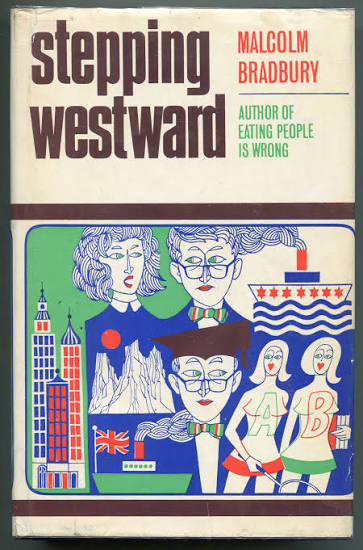
Stepping Westward, by Malcolm Bradbury, 1965
Stepping Westward is an early example of the campus novel, although for some reason Wikipedia does not include it in its list of examples of the genre. Bradbury is still a well-known author, largely on the basis of the television adaptation of The History Man but this, his second novel, has been almost forgotten – it doesn’t have its own entry in Wikipedia, has only one review on Amazon, nine other fairly desultory reviews on Goodreads and is out of print. And yet it is head and shoulders above many other examples of the genre including the novel it obviously had a significant influence on, David Lodge’s Changing Places (1975).
Bradbury took his novel’s title from the Wordsworth poem of the same name, which opens thus:
‘T would be a wildish destiny,
If we, who thus together roam
In a strange land, and far from home,
Were in this place the guests of Chance
And it is this spirit of exploration, even wanderlust, that inspires and infuses the novel. On the Malcolm Bradbury website the author wrote (in an unpublished afterword):
Stepping Westward is my second novel. I wrote it, mostly in the United States, at the beginning of the Sixties, when I and the world were both visibly changing… It was a time when Americanization was passing through Europe like what many of the young in those days still had to take – a dose of salts. Britain was losing an Empire and gaining a washing machine, and America was where, it seemed, everything that was best came from – the best jazz, the best novels, the best ice-cream, the best cars, the best films. In fact America, the America of Arthur Miller and Marilyn Monroe, J.D. Salinger and Dave Brubeck, Jack Kerouac and Allen Ginsberg, Elvis and the Kelvinator, haunted the imaginations of the Fifties young. The old myth of European liberation in the New World never seemed stronger, and adventurous journeys to the new frontier were very much in order. So one day, when my thesis was finished, I put down my Leavis, put on my Levis, and sailed for the United States.
This is the mood that fills this novel, and I hope it seems like a joyous one.
I think it does.
James Walker lives a drab life in Nottingham with three modestly successful novels to his name. Unhappily married and with a young daughter, he takes little joy in life. He doesn’t think much of himself as a husband, father, writer or man. Largely because of lazy reviewers his work has been lumped into the category of ‘angry young man’ novels, even though he had no conception of this when writing them. Out of the blue he is offered and accepts a one-year Creative Writing Fellowship at Benedict Arnold University in the town of Party, located in the undefined West but in the shadow of the Rockies. We see this offer being made from the American perspective and know that he is part of a wider game of campus politics being played by the cynical Bernard Froelich.
Walker sails to America instead of flying, which feels anachronistic even for the 1960s. The journey drags somewhat (for the reader – Walker enjoys himself). We soon learn that Walker has no intention of remaining faithful to his wife – these are the sixties after all – as he pursues one of the American students sharing his journey, a member of an unlikely bagpipe band that has been touring Europe. Once arrived in Party he struggles to navigate the complexities of American campus life and politics. The bumbling Englishman abroad material is hardly original and much of the content here is laboured. Most of the humour derives from cliches about American hostility to the English, American food, and campus politics (including elements of lingering McCarthyism). The crunch comes when his stubborn Britishness leads him to resist signing the university’s mandatory loyalty oath. His speech to the whole university explaining his reasons for this (in a scene very reminiscent of the climax of Kingsley Amis’s Lucky Jim) makes him something of a civil rights celebrity, but also paints a target on his back.
Tempted by the improbably named Julie Snowflake, the young woman he met on the boat over, Walker travels further west during the Christmas break. At first their journey is exciting – he contemplates leaving his wife and marrying Ms Snowflake – but when he fails to act decisively during a mechanical breakdown in Mexico, he realises he is not cut out for this life. He quits his job and sails back home to England and his family.
The novel unquestionably has its issues. The portrayal of campus politics has long lost any interest and seems as dated as the ocean crossing by liner. The sexism in the novel is problematic. Walker seems obsessed with the tight fitting nature of the clothing of every single female student and whenever any woman is introduced he always notices and comments on their ‘sunburnt skin’ or their ‘finely cantilevered bosoms’. Watching students becomes a hobby:
“From their offices the members of the faculty could see the co-eds flouncing past the windows,,,On fine days they wore neat blouses and skirts, tight at the rump, or else cut-off jeans with the Greek letters of their sororities painted in white across their behinds; on wet ones they wore slickers in red and blue and yellow, or, if it was cold, quilted or fur-lined jackets with hoods. ,,, Walker spent a good deal of time peering through the fly-screens on his windows at this campus display.”
In part this is a reflection of the time – the depiction of women and casual sexism reflects the mid-1960s academic and societal landscape. Bradbury’s satirical aspirations, aimed at exposing the hypocrisies of British and American cultures, may have been laudable, but his treatment of female characters often falls into the trap he aims to critique. His fictional academia is a profoundly male-centred world – there are very few female professors or tutors. Women are marginalised as either wives, hostesses, or romantic targets. Julie Snowflake is a modern American young woman, but she serves mainly to act as Walker’s romantic interest. At times she seems his intellectual equal, challenging him, but he never treats her as such. Most other women in the novel are the faculty wives, relegated to supporting roles and judged by how well they “pour tea, manage the donors, and keep their opinions to themselves“. Bradbury is of course critiquing this treatment of women but he does nothing other than portray it – positive female role models that challenge this status quo are hard to find.
The novel ends with a whimper. It fizzles out with most of the plot lines forgotten or abandoned. Walker feels disenchanted with America and when his relationship with Julie stalls he runs away back home. The last time we see him he is climbing onto the liner back to Southampton. In a postscript the university decides to discontinue its Creative Writing fellowship and spend the money more wisely.
Despite all this, I would still encourage anyone interested in the campus novel genre to read Stepping Westward. It is a confident, thoughtful work, a product of its time, no doubt, but it has interesting things to say about the awkward relationship between the UK and America. While Walker is a frustratingly limited anti-hero, the novel deserves a wider audience and to be recognised as an important contribution to the genre.
PS. In preparing this review I looked up some information about Bradbury’s first novel, Eating People is Wrong. Lazily I did not include the words ‘Bradbury’ or ‘novel’ in my search, and the engine’s AI thought I was asking whether cannibalism was legal!

