
Why haven’t I read “Good Omens” before now? That’s not a rhetorical question – tell me why no-one has thrust this book into my hands and said “You love Terry Pratchett and you think Neil Gaiman is pretty good as well, so read this, now”? As you can tell I feel slightly narked at the fact that this wonderful book has not made it onto my reading list until now. 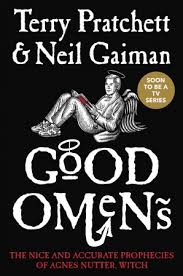
One reason might be that collaborations, especially on novels, have at best a patchy record. Name me a novel written by two people that is as good as any of the novels written by either of the co-authors? That one is a rhetorical question btw. “Good Omens” is the only co-authored novel on the BBC Big Read list of 100 best novels, if you needed any evidence on that point. But something about the way these two worked together, across different continents and time zones, just worked, producing something as good as if not better than their best solo work. It could easily have been written by Douglas Adams, and if you have been paying any attention to anything I have written in the last 5 years or so you will know that there is no higher compliment.
“Good Omens” started life as a Just William parody, and if I were to find a fault with the novel, the extended sections of the prepubescent schoolboys and schoolgirl getting up to no good in an essentially well behaved way are some of the weaker parts of the novel. But that doesn’t really matter, because the cornucopia of ideas and characters that fizz from every page of the rest of the novel more than compensate. Quite how a schoolboy story became a parable about the end of the world I am not sure, but it tells you something about Pratchett and Gaiman’s imaginations. There so much to enjoy here – utterly believable eccentric characters, such as the angel and demon working together to avoid Armageddon, Witchfinder General Shadwell and his assistant Newton Pulsifer, the witch Anathema Device (was/is there any author better at producing fantastic names for his characters than Terry Pratchett was – I give you Cut My Own Throat Dibbler in evidence), a breathless plotline that genuinely leaves it open to doubt whether the world is going to end or not, and on every page some of the best and at the same time wisest jokes you will find in any modern novel.
“It may help to understand human affairs to be clear that most of the great triumphs and tragedies of history are caused, not by people being fundamentally good or fundamentally bad, but by people being fundamentally people.”

