
The Silver Chair was the fourth Narnia novel to be published (and just to reiterate, this should also be the reading order – ignore any other attempts to resequence the novels), and marks the beginning of the decline in the series. But that’s not to say it is without its moments.
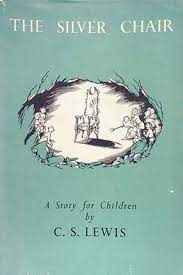
I particularly enjoyed the opening of the novel, flavoured as it was by nostalgia from childhood readings of the series. Eustace Scrubb, fresh from the adventures of The Voyage of the Dawn Treader, and classmate Jill Pole attend the awful ‘Experiment House’. This is a progressive school and Lewis’s conservative views on progressive education are given free rein, including his shock that there should be such a thing as a female headteacher:
“there was an inquiry into the whole thing. And in the inquiry all sorts of things about Experiment House came out, and about ten people got expelled. After that, the Head’s friends saw that the Head was no use as a Head, so they got her made an Inspector to interfere with other Heads. And when they found she wasn’t much good even at that, they got her into Parliament where she lived happily ever after.”
Before this however Experiment House is run by bullies, and while hiding from them Eustace tells Jill about his Narnian adventures. To escape from the bullies, more in hope than in expectation, they try the handle of a door in a wall which has always been previously locked. Magically it opens and leads then not into Narnia but Aslan’s Country, which towers above all other lands. Alsan appears and gives Jill a quest, to find the missing Prince Rillian of Narnia, son of King Caspian. Their quest includes a series of ‘signs’ Jill has to memorise. Things are never made easy for quest followers.
Jill and Eustace travel to Narnia by falling off a cliff, which is only slightly less unlikely than through the back of a wardrobe, blown to safety on a magical wind stream of some kind by Aslan. They arrive and Cair Paravel, and watch as an elderly Prince Caspian (as they later find him to be) sails away. Their first task was to have spoken to Caspian, so they have already failed, as they are to do throughout the story – this is a story about persevering against the odds even when you mess up.
Seventy years have passed since the events of Dawn Treader. Caspian has left Trumpkin the dwarf in charge. Jill and Eustace are given rooms in the castle, but the arrival of a long lost comrade from another world is met with a very muted underwhelmed response. This is mainly because of the uncertainty about the future of the realm – Caspian is old and may not return, and his son Prince Rilian disappeared a decade earlier while searching for the magical serpent that killed his mother.
Jill and Eustace set off on their quest to find the missing prince the following day, led by their guide, Puddleglum. Puddleglum is a gloomy marsh-wiggle, a humanoid figure of Lewis’s invention characterised by a relentless determination to see the dark side of any situation.
And you must always remember there’s one good thing about being trapped down here: it’ll save funeral expenses.
They head north to the giant-lands of Narnia. There they meet the Arthurian ‘Lady of the Green Kirtle’ accompanied by a mute knight in black armour. She directs them to Castle Harfang, the home of the “Gentle Giants”, who ‘would be glad to have them at their Autumn Feast’. Even younger readers will spot the ambiguity in that suggestion, and unsurprisingly the children are intended as the centrepiece, a delicacy, of the celebratory meal. Discovering the giants’ intentions from a cookbook in the kitchen they escape into a cave under the ruined city next to the castle, scene of the latest missed sign. Taken prisoner they are escorted deep into a world ruled by the Lady of the Green Kirtle, and are finally introduced to her attendant, a young man who explains that he is burdened by a curse. Each night he must be tied to a silver chair; if this doesn’t happen he will turn into a serpent.
The ‘mystery’ of the young man’s identity is quickly revealed, and his captors defeated. The trio with their rescued prince return to the surface and there is time for a quick traditional Narnian party, a reunion with the ailing Caspian, before goodbyes and a return to school, where the bullies are given a beating (with the help of a magically restored Caspian) and any loose ends are tied up.
While this was all good a fun in the Narnia tradition, The Silver Chair had many echoes of fan fiction. It uses all the traditional characteristics of the series – the unexpected voyage to Narnia, the quest format, the late intervention of Aslan to help resolve the struggle with a wicked witch, and most importantly of all the character forming experience for the young people involved, the 1950’s version of a gap-year – but there’s a suggestion of Lewis going through the motions, trapped by the conventions of his format. The outcome of the novel is heavily telegraphed very early on and is in no doubt at any point, so when the prince is rescued and the wicked witch dispatched it is anti-climatic (although to be fair the same could be said of the death of the White Witch in The Lion, the Witch and the Wardrobe). The Christian allegory elements of the novel are by this point in the series easily ignored – they are definitely there, with Caspian being revived by a drop of Aslan’s blood for instance – but I never found them intrusive (excepting of course the Last Battle, of which we do not speak). I wonder how children brought up in today’s world of Harry Potter and video games react to the childish joys of these trips to Narnia?


