
King Solomon’s Mines, by H Rider Haggard, 1885
When I was very much younger, so much younger than today, my parents had a lavishly illustrated collector’s edition of ‘King Solomon’s Mines’ in their modest collection of books. The illustrations were vivid and I can remember them to this day. This must have been why I was able to recall a vast amount of detail about the text, brought to mind by those lurid sketches, when I finally returned to reread the novel this week.
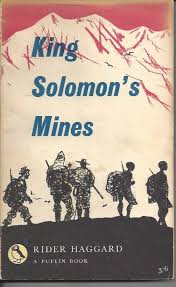
Advertised on publication as “The Most Amazing Book Ever Written”, quite a bold claim, ‘King Solomon’s Mines’ is a classic ‘boy’s own’ adventure story (the dedication is “to all the big and little boys who read it” and describes it as a “story of treasure, war, and wild adventure… I can safely say that there is not a petticoat in the whole history.”). This is a novel that has no pretensions to be anything other than escapist. Published at a time when explorers were still uncovering ancient treasures and when parts of the world were still unexplored by Europeans, (although probably not as many as Haggard suggests) it is easy to see how the adventures of Allen Quatermain and his friends would have captured the public’s imagination in the way it did mine three quarters of a century later.
It is said that Haggard wrote the novel as a result of a bet with his brother, who claimed that he could not write a novel half as good as Robert Louis Stevenson’s ‘Treasure Island’. Whether this is apocryphal or not I have no way of knowing – people tell stories about the origins of their novels because they are asked the question so often. Nevertheless it makes sense – King Solomon’s Mines is essentially a big treasure hunt. Allan Quatermain is employed by Sir Henry Curtis and his friend Captain Good to help find Sir Henry’s long-lost brother, missing in the uncharted African interior. Quatermain suspects this will be a wild goose chase and a highly dangerous one at that, but agrees in return for a share of any treasure they find. They are joined on the quest by various native bearers, porters, and servants, including one, Umbopa, who obviously is more than meets the eye.
After a perilous journey across a deadly desert they travel into a valley, hidden from the outside world by the protective desert and mountains. This is Kukuanaland. A patrol of warriors are about to kill our adventurers, but are so impressed by Captain Good false teeth, monocle, and white legs that they decide to save them. I must admit I groaned at the clichéd nature of these scenes before reminding myself that these are possibly the source of the cliché itself, or one of the earliest such versions at least. Later they prove their divinity as “white men from the stars” by accurately predicting (and claiming personal responsibility for) a lunar eclipse, one such event just happening to be due at just the right time.
King Twala, ruler of Kukuanaland, is a brutal dictator who has come to power by killing his brother. It is soon revealed that Umbopa is actually Ignosi, the rightful king of the Kukuanas. Civil war breaks out with the Englishmen and tribes loyal to Umbopa/Ignosi on one side, and King Twala and his troops on the other. After a lengthy and bloody battle, the rebel alliance triumphs and Twala is beheaded by Sir Henry in a duel. The adventures continue with the search for the lost treasure that has driven them this far. I won’t fill in all the gaps in their adventures but the path to the diamonds is not an easy one.
It is clear that Haggard knew his setting well. There is enough convincing detail to make the scenes realistic, although I did notice that the travellers suffer from ravenous hunger and terrible thirsts after only a few hours of fasting, presumably a way for Haggard to make the passage of time seem longer.
King Solomon’s Mines is credited with creating the “Lost World”, genre. Typically in stories of this period of European exploration in and exploitation of Africa, there is a general assumption that the white man is superior, the natives are brutal, stupid, and easily tricked. Haggard doesn’t deploy these lazy clichés thoughtlessly, although there is barbarism aplenty. While some of his African characters are depicted as monstrous animals, such as ‘The Elephant’, King Twala , others are noble, brave and heroic. The racism is generally muted – Quatermain refuses to use the n-word and says that many Africans are more worthy of the title of “gentleman” than Europeans. The romance between a Kukuana woman, Foulata, and Captain Good is an extremely early and quite touching portrait of an interracial relationship. Quatermain is also opposed to slavery:
“ Now I know your low-class Delagoa Portugee well. There is no greater devil unhung in a general way, battening as he does upon human agony and flesh in the shape of slaves.”
This isn’t an academic analysis, but the commentary on imperialism in late colonial Africa is fascinating. Haggard goes out of his way to present an image of undiscovered territory deep in the interior of the continent, protected by natural barriers. He also sexualises the landscape, most notably with the descriptions of the mountains as “Sheba’s breasts”. Is Haggard recreating an aspect of the continent that by 1885 was almost completely lost?
As a narrator Quatermain is self-effacing, constantly stressing his absence of courage. In the introduction he misleadingly presents himself as a scientist and anthropologist:
“if I had given way to my own impulses, I should have wished to go into the differences, some of which are to my mind very suggestive, between the Zulu and Kukuana dialects. Also a few pages might have been given up profitably to the consideration of the indigenous flora and fauna of Kukuanaland.”.
But this is not going to be a complex narrative about the flora and fauna of darkest Africa:
“The fact of the matter is, I thought… that the best plan would be to tell my story in a plain, straightforward manner…It only remains for me to offer apologies for my blunt way of writing. I can but say in excuse of it that I am more accustomed to handle a rifle than a pen, and cannot make any pretence to the grand literary flights and flourishes which I see in novels—for sometimes I like to read a novel.”
Quatermain is initially a digressive author, giving away at least some of his plot (he tells us that at least two of his party die, and that he has to account for their deaths to a magistrate). This framing introduction, and the editorial footnotes which gently tease the narrator, reassure the reader than whatever the perils our hero comes through in the end.
Finally, I probably didn’t notice the homo-eroticism gaze that Quatermain uses in his descriptions of the other members of his party – but I think it’s there if you read between the lines. Here is our first introduction to the Umbopa:
“Presently a tall, handsome-looking man, somewhere about thirty years of age, and very light-coloured for a Zulu, entered, and lifting his knob-stick by way of salute, squatted himself down in the corner on his haunches, and sat silent.”
Later Quatermain describes the scene when Sir Henry inspects the tattoo which is Umbopa’s evidence that he is the long-lost prince of Kukuanaland:
“Sir Henry told me to ask him to stand up. Umbopa did so, at the same time slipping off the long military great coat which he wore, and revealing himself naked except for the moocha round his centre and a necklace of lions’ claws. Certainly he was a magnificent-looking man; I never saw a finer native. Standing about six foot three high he was broad in proportion, and very shapely. In that light, too, his skin looked scarcely more than dark, except here and there where deep black scars marked old assegai wounds. Sir Henry walked up to him and looked into his proud, handsome face.”
Later still, when preparing for battle, Sir Henry chooses to dress as a native warrior:
“When you are in Kukuanaland, do as the Kukuanas do,” he remarked…round his throat he fastened the leopard-skin cloak of a commanding officer, on his brows he bound the plume of black ostrich feathers worn only by generals of high rank, and about his middle a magnificent moocha of white ox-tails. A pair of sandals, a leglet of goat’s hair, a heavy battle-axe with a rhinoceros-horn handle, a round iron shield covered with white ox-hide, and the regulation number of tollas, or throwing-knives…I am bound to say that I seldom saw a finer sight than Sir Henry Curtis presented in this guise. It showed off his magnificent physique to the greatest advantage, and when Ignosi arrived presently, arrayed in a similar costume, I thought to myself that I had never before seen two such splendid men”.
Possibly for reasons of nostalgia I have a soft spot for King Solomon’s Mines, and I enjoyed revisiting it. It’s an important text in the history of imperial novels about Africa, but also an enjoyable and not particularly offensive adventure story in the Indiana Jones mould.

