
In many of my previous reviews I have struggled to respond to texts that either contain offensive language – that use racially insulting terms, that denigrate gay people or women, or otherwise offend my twenty-first century sensibilities. I usually try to draw a distinction between those texts that use offensive language which was in common usage in the period in which the text was written – Huckleberry Finn, for example, with its widespread use of the n-word – and texts that are more broadly offensive, that perpetuate stereotypes or go out of their way to be insulting to racial or other groups. Sometimes I find offensive novels that have not generally been considered in that category – Perfume being the obvious example, which most reviewers found harmless but which I took great exception to.
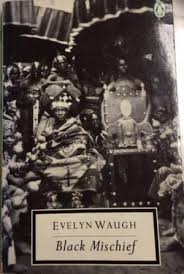
In almost all cases however, I have been able to find redeeming features in the text. The novelist may have been reflecting outdated attitudes towards race, gender or sexuality, but they have nevertheless managed to write something worth reading. But that is mainly because I have been careful not to read those books that should be forgotten and which don’t merit a wider readership today. History has edited these novels from our bookshelves. But this is not always the case with authors who have written otherwise well thought of work, such as Evelyn Waugh’s ‘Black Mischief’. Because ‘Black Mischief‘ is an embarrassingly offensive novel.
The events of ‘Black Mischief‘ take place mainly in the island kingdom of Azania, one of the few independent countries in Africa between the world wars. Waugh’s intention appears overt – he sets out to demonstrate that allowing African peoples to run their own countries is a ludicrous proposition that leads to profound mis-Government, chaos, and conflict. His argument is that Africans simply don’t have the intelligence, judgment or ability to run their own affairs.
Seth, emperor of Azania, inherits his role shortly after graduating from Oxford. He determines to modernise his country, but his ambitions are portrayed as utterly unrealistic – not only does he not understand what modernisation entails, but his efforts are undermined by his people, who have no interest in the modern world, and his officials, who just want to steal anything not nailed down.
Basil Seal, a feckless college friend, journeys to Azania on a whim to escape his debts in London, and is quickly appointed Minister of Modernisation. His sidekick is the Armenian businessman Yokoumian, an equally unpleasant and racist portrait. The small group of Europeans in Azania, diplomats, businessmen and missionaries, do not escape Waugh’s satire – they are all crooks and bored idiots, particularly the British consular staff headed by Sir Samson Courtenay, but there is a venom in the portraits of the Africans in the novel that is missing when the focus turns to the Europeans.
A pageant to celebrate birth control is used as cover for the launch of a coup against Seth, with the French consul planning to install a puppet Government headed by his senile uncle Achon, who promptly dies at his coronation. In the bloodbath that follows the League of Nations steps in and claims the country as a League of Nations Mandate. The natural order with the white man running matters is restored, and Basil returns to London, where his absence has passed largely unnoticed.
Many reviewers claim this novel is a satire. I am not sure that is right – what precisely is it satirising? Certainly not colonialism – Azania is not a colony. Modernisation? Perhaps, but it is hard to see what aspects of modernisation are problematic. Or is it modernisation in Africa? Is Waugh telling the reader that modernising Africa is pointless, because they will just use mis-use whatever modern devices or ideas we ‘give’ them (the wires used in the railway’s construction are used as jewellery, for example). The most striking example of this is the poster drawn up to advertise the benefits of birth control, showing one family wealthy and healthy with one child, and another family with many children where life is hard and poor. These posters are misunderstood by the Africans – silly people unable to understand a simple poster – and they think the single child family is the one that is being presented as the one to avoid.
Life is cheap in Azania – people are killed casually throughout the novel – and cannibalism is widespread. There isn’t a racist stereotype untapped. There isn’t a single positive African character, not even for contrast – they are all either evil, conniving, mercenary, or murderous. Or all four.
Waugh is not a bad writer, but I can’t help thinking that this novel should be allowed to quietly fade away. It’s not funny, the casual and incessant racism is hard to take, and the ending is callously brutal. For the first time ever I was embarrassed to be seen reading this novel (with the front cover shown above) on public transport, which probably says it all.

