
In many of my previous reviews I have struggled to respond to texts that either contain offensive language – that use racially insulting terms, that denigrate gay people or women, or otherwise offend my twenty-first century sensibilities. I usually try to draw a distinction between those texts that use offensive language which was in common usage in the period in which the text was written – Huckleberry Finn, for example, with its widespread use of the n-word – and texts that are more broadly offensive, that perpetuate stereotypes or go out of their way to be insulting to racial or other groups. Sometimes I find offensive novels that have not generally been considered in that category – Perfume being the obvious example, which most reviewers found harmless but which I took great exception to.
In almost all cases however, I have been able to find redeeming features in the text. The novelist may have been reflecting outdated attitudes towards race, gender or sexuality, but they have nevertheless managed to write something worth reading. But that is mainly because I have been careful not to read those books that should be forgotten and which don’t merit a wider readership today. History has edited these novels from our bookshelves. But this is not always the case with authors who have written otherwise well thought of work, such as Evelyn Waugh’s ‘Black Mischief’. Because ‘Black Mischief‘ is an embarrassingly offensive novel.
The events of ‘Black Mischief‘ take place mainly in the island kingdom of Azania, one of the few independent countries in Africa between the world wars. Waugh’s intention appears overt – he sets out to demonstrate that allowing African peoples to run their own countries is a ludicrous proposition that leads to profound mis-Government, chaos, and conflict. His argument is that Africans simply don’t have the intelligence, judgment or ability to run their own affairs.
Seth, emperor of Azania, inherits his role shortly after graduating from Oxford. He determines to modernise his country, but his ambitions are portrayed as utterly unrealistic – not only does he not understand what modernisation entails, but his efforts are undermined by his people, who have no interest in the modern world, and his officials, who just want to steal anything not nailed down.
Basil Seal, a feckless college friend, journeys to Azania on a whim to escape his debts in London, and is quickly appointed Minister of Modernisation. His sidekick is the Armenian businessman Yokoumian, an equally unpleasant and racist portrait. The small group of Europeans in Azania, diplomats, businessmen and missionaries, do not escape Waugh’s satire – they are all crooks and bored idiots, particularly the British consular staff headed by Sir Samson Courtenay, but there is a venom in the portraits of the Africans in the novel that is missing when the focus turns to the Europeans.
A pageant to celebrate birth control is used as cover for the launch of a coup against Seth, with the French consul planning to install a puppet Government headed by his senile uncle Achon, who promptly dies at his coronation. In the bloodbath that follows the League of Nations steps in and claims the country as a League of Nations Mandate. The natural order with the white man running matters is restored, and Basil returns to London, where his absence has passed largely unnoticed.
Many reviewers claim this novel is a satire. I am not sure that is right – what precisely is it satirising? Certainly not colonialism – Azania is not a colony. Modernisation? Perhaps, but it is hard to see what aspects of modernisation are problematic. Or is it modernisation in Africa? Is Waugh telling the reader that modernising Africa is pointless, because they will just use mis-use whatever modern devices or ideas we ‘give’ them (the wires used in the railway’s construction are used as jewellery, for example). The most striking example of this is the poster drawn up to advertise the benefits of birth control, showing one family wealthy and healthy with one child, and another family with many children where life is hard and poor. These posters are misunderstood by the Africans – silly people unable to understand a simple poster – and they think the single child family is the one that is being presented as the one to avoid.
Life is cheap in Azania – people are killed casually throughout the novel – and cannibalism is widespread. There isn’t a racist stereotype untapped. There isn’t a single positive African character, not even for contrast – they are all either evil, conniving, mercenary, or murderous. Or all four.
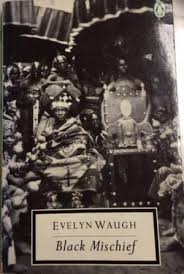
Waugh is not a bad writer, but I can’t help thinking that this novel should be allowed to quietly fade away. It’s not funny, the casual and incessant racism is hard to take, and the ending is callously brutal. For the first time ever I was embarrassed to be seen reading this novel (with the front cover shown above) on public transport, which probably says it all.


It’s so long ago that I read this that I’m afraid I can’t recall my reactions – though I generally have a problem with EW’s casually patrician air about things social and political. Although he can be very funny, I’m not taken in by that public schoolboy veneer of charm or eccentricity – it’s something that’s got the UK into a bit of a mess lately, let alone in those shameful colonial days.
LikeLiked by 1 person
Well said. Not sure it was that funny then, (this book I mean) but now it stinks.
LikeLike
Started reading “Black Mischief” on a recommendation of a friend, I am so glad to read your critique that validates my thoughts, I know now why I put it aside after getting a third of the way through it & I am unlikely to back to it now. Thank you
LikeLike
Oh dear… I haven’t heard of this novel before, and I can see why. I have read a couple of Waugh novels but wasn’t keen, they came across as snobbish (might just have been satirical).
LikeLiked by 1 person
Pingback: Book review: Put Out More Flags, by Evelyn Waugh, 1942 | The Reading Bug
As a Catholic, Waugh would have agreed with the Africans over birth control. Think again, too, about the stupidity of the French & English Legations – Courtney Sampson is a complete idiot! Black Bitch is a faithful & loving wife – Prudence is a bit of a slut etc etc. Seth is a misguided fool not because he’s black but because he’s picked up all sorts of mixed ideas about ‘Progress’.
LikeLiked by 2 people
Fair points, the white folk don’t come out of the novel well either. But that doesn’t make Waugh progressive, if that’s where you were heading?
LikeLiked by 1 person
Far from it. It seems to me that Waugh is dead against the kind of progress being imposed on Azania – not only birth control but Vitamins as food, for instance.
The native gentry come across as much more dynamic & attractive than the Europeans.
Much of the material for this book can be fornd in Waugh’s travel book ‘When the Going Was Good’ – ie the Coronation of Ras Tafari where he just tells it as he sees it.
In any case no reading of BM can leave out Basil Seal and to understand where W. is going with him one must read ‘Put Out More Flags’.
LikeLiked by 2 people
https://readingbug2016.wordpress.com/2020/01/18/book-review-put-out-more-flags-by-evelyn-waugh-1942/
LikeLiked by 1 person
These very interesting comments on Put Out More Flags seem to me to show the same, possibly unconscious, bias that I found in your review of Black Mischief.
If I may pick up a few points from the BM review: as regards Armenians, Waugh says often, in While the Going was Good, that he admires these very much – perhaps in the same sneaking way he feels towards Basil – as ‘men of the world’, they know their way around. But it’s hard to be sure of Waugh –I suspect him of being like Swift – purporting to believe what he says only to lure the unwary reader into a trap. Nb. Gulliver doesn’t speak for Swift. In other words the truth about EW, as a writer, is rarely pure & never simple.
I don’t see your reasons for saying that he ‘ reserves a special venom’ for the Africans. The arrival of the backwoods Earl at Seth’s banquet is splendid – only to be compared to Uncle Theodore’s presence at Lord Copper’s banquet, in Scoop – and the old Azanian gentleman who summons up all his conversational powers to waste them on the odious English vegetarian Dame is every bit as dignified and touching as the decrepit, elderly (& white) tenor whom Guy snubs in the Sword of Honour trilogy.
You refer to casual deaths abounding, but surely Achon’s death is full of pathos, and there can be few deaths in literature as casual as that of Prudence,(unless you remember little Lord Tangent’s in Decline and Fall). If the reader can step over the idea that Waugh favours the kind of ‘modernisation’ shown here the novel becomes much more complex and thought-provoking as well as being actually much more of a laugh.
I don’t believe for a moment that he thinks the arrival of the League of Nations is a good thing. If he thought this then Arthur Potts in D & F would be a hero. He tends to be on the side of folk who just want to be left alone to carry on as they’ve always done: Tony Last, in A Handful of Dust, isn’t very bright but is nicer than the super-moderniser Mrs Beaver & William Boot’s a prize idiot, in Scoop, but a lot more decent than Lord Copper.
Waugh may be patronised, these days as a snob and, far worse, a racist – I’d go no further than to say he can be a bit of an old fogey. Where, for me, he lets himself down is when he goes too far in sentimentalising ‘the noble savage’ ie unspoilt, old fashioned, feudal values, shared, alike by old Mr Crouchback, the family at Boot Magna as well as the country gentry of Azania,
A few thoughts on what you say about Put Out More Flags: Novelists are often advised to write about what they know so it’s not surprising if Waugh’s characters are ‘as usual wealthy & upper class’ (would you say the same of Jane Austen – or Sophocles?). His treatment of class is, in fact, highly nuanced: see Decline & Fall, especially (Sports Day at Llanabba and the list of Bollinger Club alumni). We’re not expected to admire his characters for their social position, any more than we should draw conclusions about ‘class hatred’ in Waugh’s portrayal of Doris & siblings – who aren’t like this because they’re ‘working class’ but because the plot requires them to be repulsive evacuees. In any case Basil & the awesome Connolly kids soon become conspirators,which tells us more about their similarities as they find out how to exploit each other. I can’t but feel that you go too far in saying Doris ‘notices’ a hint of incest in the relationship of Barbara & Basil, implying that Waugh agrees with Doris.
For me this is too hasty: Barbara has been obsessed with Basil for a lifetime, but she is portrayed at the beginning of the book as only one of a trio of women similarly obsessed. We are not shown anything to suggest incest – only the kind of upper class nursery carry- on that a child of Doris’s background wouldn’t understand. The joke is in her interpretation which is one more example of her early & inappropriate sexualisation. I don’t think Waugh’s readers would find anything shocking about incest – Millie in A Handful of Dust has had a baby by her stepfather and is quite matter of fact about it when she tells Tony ‘he couldn’t leave our girls alone’.
Waugh’s first book, Decline and Fall observes prostitution, white slavery, abortion, racial prejudice, castration and homosexuality, including Lesbianism – all presented with great good humour.
One needs a wider context in placing Waugh’s treatment of Ambrose Silk – a more serious & sympathetic character.Aren’t you a bit anachronistic when you praise Waugh for being open-minded? No one was ‘gay’ in 1943, though to the public school boy of Waugh’s class homosexuality was an everyday fact of life – many of one’s friends were like that, you just hoped they didn’t get caught. Waugh’s attitude might be better examined by comparing Ambrose to Anthony Blanch in Brideshead Revisited . Nor should we lose sight of the homosexual elements in the friendship of Sebastian & Charles, and Cara’s view of such friendships ‘of the English’. Even more striking is Sebastian’s devoted service to his gruesome German friend at the end of the book – for which he is ‘canonised’ by Cordelia and the priests at the hospital. Ambrose too had a German lover and there is true pathos in their story. The passage you quote is indeed Ambrose’s own view of his situation – a victim in his own eyes. I would also read it as Waugh’s tribute to ‘aestheticism’ before it was taken over and distorted by cheap ‘comedians’ (nb.’ aestheticism’ is used as a euphemism for homosexuality in When the Going Was Good ). Anthony Blanch may not be a very sympathetic character but he is exotic and a dazzling scene stealer, at his best when young at Oxford. Perhaps Ambrose was recalling a similar Golden Age for himself – did he deserve to be ‘exiled’ in rain-sodden Ireland any more than Tony Last with Mr Todd in Amazonia?
There is a danger in treating Waugh as a ‘realistic’ writer. He is very English – think: PG Wodehouse if you like – only that in Waugh’s hands humour becomes a means of confronting the decline of an entire civilisation – irony rather than satire trying to bring order to an underlying pessimism and sense of tragedy very understandable in a survivor of two world wars. Didn’t he say himself in 1946 something to the effect that satire can only exist in a world where vice pays lip-service to virtue?
LikeLiked by 1 person
Thanks for some thoughtful comments. I might respond at further length if time allows, but in the meantime thanks again. I have a few other reviews of Waugh on my blog if you are interested.
LikeLiked by 1 person
I had hoped to convert you to an unbiased reading of Waugh!
LikeLiked by 1 person
Is such a thing possible? We all have our biases.
LikeLike