Book review

The Hobbit, or There and Back again, by J R R Tolkien 1937

It was a pleasure returning to Tolkien’s ‘The Hobbit’ after a break of several decades (plus the three Peter Jackson films of course). It’s a lovely young person’s novel – the description on the blurb of it being a children’s novel is a little imprecise for my liking, as anyone under the age of approximately 10 may not appreciate the length of the text, or some of the moments of peril and violence. To be honest, I suspect the complete absence of any female characters whatsoever might be off-putting to younger female readers as well. 
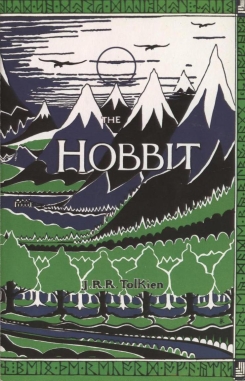
The novel famously opens with a description of the habits and domestic life of Bilbo Baggins, a hobbit with a family line inclined to most un-hobbit like adventuring. Gandalf the wizard (as opposed to all those other Gandalfs you know) uses Bilbo’s comfortable little home to host a gathering of dwarves setting out on a long-planned quest to recover their family treasure and home from the dragon, Smaug. On Gandalf’s recommendation, Bilbo is recruited as the expedition’s burglar. And so the quest begins the long journey east, past peckish trolls, to the last Homely House in Rivendell, which Tolkien does a wonderful job of making sound so alluring, across and into the Misty Mountains, where  Bilbo finds a certain ring, through Mirkwood, and on to the Lonely Mountain, their final destination.

It is an epic journey, full of wonderful adventures. Tolkien packs a lot into a short book. The final resolution is darker than one expects, as the novel grapples with the reality of the quest, its risks and danger, rather than simply using magic or another narrative trick to resolve the travellers’ problems. There is a very serious consideration of the problem of what to do when your dreams come true, how to be brave when your friends go astray, and how to honour your responsibilities to others. If that makes it sound worth it is anything but. 

The quest format is enduringly popular for good reason, and Tolkien writes with considerable economy – the events of the novel occur at a rapid pace, with little of the self indulgent diversions that marred the films. The one obvious exception to this is the fairly awful poetry that Tolkien seems unable to resist. 

The novel builds brilliantly to the climactic Battle of the Five Armies. Here younger readers’ sense of peril will be put to the test, because while the narrator takes care to reassure us of Bilbo’s eventual fate, some of his fellow adventurers are not so lucky. This is a great introduction to fantasy literature for younger readers, and as the genesis story to the much weightier ‘Lord of the Rings’ it is a good starting point for anyone thinking of pitching into the trilogy. Adult readers will enjoy the quest as well – I know I did. 
Standard
Book review

Night Watch, (Discworld 29) by Terry Pratchett, 2002

Night Watch was the 29th novel in Terry Pratchett’s extraordinary life’s work, the Discworld series. nigthwatch

The regular publication of Pratchett’s novels formed part of the background pulse of my life (and I am sure of many others), a predictable and reliable event that one looks forward to, like birthdays or Christmas. Although like all the novels in the series it can be read as a stand alone text, it is not a good entry point for those new to Discworld. This is later Pratchett, more serious, and it assumes a level of knowledge of the characters and their traditions without which  some of the jokes won’t work. An example of this happens when Sam Vimes meets Cut My Own Throat Dibbler. Dibbler is one of the numerous well realised characters who people Discworld and bring it to life. Travelling back in time, Sam meets CMOT when he is just starting out in the pie trade, and accidentally gives him his nickname. This joke doesn’t work if the reader isn’t already familiar with CMOT and his infamous ‘pies with personality.’

‘Night Watch’ is one of the darker novels in the series (although in interviews Pratchett disputed that label). Sam Vimes, commander of the Ankh-Morpork police (the Watch) is pursuing a serial killer, when he is caught in an accidental time warp, and travels back to thirty years earlier when he first joined the Watch. He mentors his younger self, teaching him all the tricks of the trade. The time travelling aspects of the story are handled adeptly, and although as with all time travel stories it won’t stand up to much scrutiny, it is cleverer than most. It is written with love for the characters and the world they live in, not least Sam Vimes the world weary copper, trying to keep the peace and do the job in front of him, struggling with the moral complexities that sometimes presents him with.

Vimes’s time travelling accident happens on the 30th anniversary of the Glorious Revolution of the Twenty-Fifth of May, a small scale over by lunchtime affair in which seven watchmen lost their lives. Each year the battle of Heroes Street is commemorated by those who were there by wearing lilac sprigs in their lapels, and visiting the graves of the fallen. This poignant memory echoes through the novel, as the inevitability of history reasserts itself, despite Sam’s interference with the events of the past. We also meet a much younger Vetinari, an apprentice of the Assassin’s Guild, who goes on to command the City. As a cleverly constructed prequel the novel is really mostly aimed at Discworld fans, rather than new readers. I have huge affection for the whole series, and pretty much everything Pratchett wrote, and his tragic death in 2015 deprived us of one of our great comic writers. But his characters are so vivid and well realised that they live on in our imaginations. In the unlikely event you haven’t discovered Discworld before now, and I know there are huge numbers of fans in the blogging community, then I can’t recommend these novels highly enough. Start at the beginning with ‘The Colour of Magic’, and just enjoy!

Standard