
What makes a novel unreadable? We all have our own breaking points – I may have just have found mine. This post explores the features of ‘The Golden Bowl’ that are making it, for me, almost unreadable.
- Sentence structure
“He found it convenient, oddly, even for his relation with himself—though not unmindful that there might still, as time went on, be others, including a more intimate degree of that one, that would seek, possibly with violence, the larger or the finer issue—which was it?—of the vernacular.“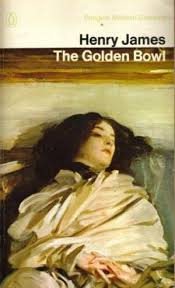
Here’s another example from the same novel:
‘The things, or many of them, that had made Mr. Verver what he was seemed practically to bring a charge of waste against the other things that, with the other people known to the young man, had failed of such a result.”
I am sure it is possible to parse these sentences, particularly with the benefit of the surrounding context, but this level of complexity made reading chapter after chapter exhausting.
2. Paragraphs
What makes some novels harder to read than others is often a matter of personal taste. For me, paragraphs are one such feature. Paragraphs are like decent broadband or clean tap water – something we usually take for granted, but boy we don’t half miss them when they aren’t there. ‘The Golden Bowl’ has some paragraphs, but far fewer than it needs. Reading page after page of text uninterrupted by a paragraph break, indeed uninterrupted by a change of thought or pause for breath, can be tiring and tiresome.
3. Subordinate clauses and qualifiers
Another question of personal taste involves the use of subordinate clauses and qualifiers. There’s nothing wrong with these in the right place, but James seems unable to write a single sentence without, as it were, a subordinate clause. In most cases they serve little purpose, as in the previous sentence. Take it out and the meaning is unchanged. Was this just a habit, a feature of his literary style that he found it hard to shake off, or was something more complex going on? I am usually keen to give authors the benefit of the doubt and assume that they will have noticed when they are doing something that might annoy the reader, and that they have good reason to do so. I assumed on that basis that James was using this style to tell us something about the equivocating, ambivalent character of Prince Amerigo:
“His own estimate, he saw ways, at one time or another of dealing with; but theirs, sooner or later, say what they might, would put him to the practical proof.”
Granted, each of the subordinate clauses here change the sense of the sentence subtly, qualifying the meaning in various ways. But wouldn’t the sense be just as clear written as:
“He saw ways of dealing with his own estimate, but theirs would put him to the practical proof.”
Here’s another example:
“But his actual situation under the head in question positively so little mattered to them that, having by that time lived deep into the sense of his advantage, he had kept no impression of the girl’s rejoinder”
You will either find sentences like this (from Chapter 2) elegant and sophisticated, or clumsy and obscure:
“The spectator of whom they would thus well have been worthy might have read meanings of his own into the intensity of their communion—or indeed, even without meanings, have found his account, aesthetically, in some gratified play of our modern sense of type, so scantly to be distinguished from our modern sense of beauty.”
Undoubtedly writing like this has an impact – in my case the impact was to make me pause and reread the sentence to try to work out what was being said. But this is not a question of characterisation: James adopts this style throughout the novel – it is the only narrative voice.
These aspects of James’s prose have thus far made ‘The Golden Bowl’ one of the hardest novels I have tried to read since starting this blog.
That’s the case for the prosecution. The defence is that modernist novels aren’t supposed to be easy reads. In describing a situation or a statement of fact in a roundabout way, so that it takes time for the reader to grasp the meaning of what is being said, and in exploring the unspoken and half-conscious thought processes behind speech, James was inventing the distinguishing characteristics of modernism. Certainly there is much in this novel that ticks these boxes, and it is these more positive features of ‘The Golden Bowl’ that I will return to in my next post.
Finally, for the avoidance of any doubt, I am not giving up on this novel. I may not read it with the care and attention James seems to expect, but that is not the same as not reading it altogether.


I couldn’t get along with The Golden Bowl at all, though I really enjoy early James (e.g. Washington Square). There’s a great anecdote about Edith Wharton and HJ trying to find the King’s Road in Windsor. It really encapsulates his excessive prolixity and is well worth a Google.
Those sentences you quote are atrocious. I suppose there was method in his madness, somewhere, but I can’t find it.
LikeLiked by 1 person
here’s a link to the Wharton/James story
https://www.theguardian.com/books/booksblog/2014/aug/12/edith-wharton-henry-james-a-backward-glance
LikeLike
I’ve heard that some of James’s novels are like this. It may be best to slow down your reading and read something else alongside it for when you want a simpler read. I’ve had to alter my reading techniques for authors such as Proust, Joyce, Borges etc.
LikeLike
Even by slowing my reading pace right down I still struggled with some of those quotes.
LikeLiked by 1 person
Whoa. I’m usually okay with verbose writing, but that is very difficult to read. I’m impressed that you’re not giving up…
LikeLiked by 1 person
To be fair to James, the problem is mine, not his. This post was more by way of confession than complaint.
LikeLike
Pingback: One Lovely Blog Award! – Wonderful Words 101
Reading Bug, I really don’t think it’s you. By interrupting full thoughts with asides, sometimes more than one, or even more than two, make it extremely difficult to grasp. It becomes work. And I found that he seems to write many pages about one trivial thing and that goes on and on. I think The Golden Bowl could be edited down to a hundred pages if you took out all the junk. Also, who thinks and talks like that? Did Europeans and Americans REALLY nit pick each thought??
LikeLiked by 1 person
Thank you – glad to know it’s not just me (and Rebecca West!). I can tell you one thing, I am not going back to Henry James – life’s too short.
LikeLike
I am trying to read The Golden Bowl now. I am a lifelong devoted reader almost 70 years old, but have never read anything so cryptic as this novel. I just read The Turn of the Screw and found it reasonably enjoyable. Many people find W. Faulkner hard to read, but he’s a breeze compared to James.
LikeLike
Reading The Golden Bowl keeps giving me a bad headache each time I pick it up!It is much too long,too cryptic and I dislike each and every character.Half way through I have decided life is much too short to continue this very hard work
LikeLike
As a retired Dutch teacher of English I wondered if, after struggling through ‘The Golden Bowl, there were more people who found the book unreadable. After all, the author is highly acclaimed, so was it my fault?
To my joy and relief, it was not. I am now halfway through ‘What Maisy knew’, which I find more palatable.
I can’t help thinking that James’s reputation is at least partly based on his difficult writing. The phenomenon is quite similar to the notorious French philosophical writers, who seem to delight in being obscure.
LikeLiked by 1 person
Jaap – thank you for your comment. I have read somewhere that James’s writing gets more and more complex over the course of his life. I certainly didn’t have this difficulty issue with some of his other works. I think you are right to question whether the author is the problem or is it the reader – but in this case it seems a widely accepted view that it is the author that is the problem!
LikeLike