20th century Literature, Book review, Brideshead Revisited, Evelyn Waugh

Brideshead Revisited by Evelyn Waugh, 1946

Why do I write this blog? Thinking about it there are four principal reasons, with one bonus justification.

  1. To keep a record of what I read. Simple as that – just to look back and see what I have read over 12-24 months is interesting, as my appetite for classic fiction wanes and is replaced by recent history, for example.
2.    To keep a note of what happens in the novels I read. I appreciate that probably sounds a bit daft at first, but if you think about it, how many times have you picked up a book and wondered whether you had read it or not? Writing down what happens helps fixed the main events of a story in my memory. Of course, re-reading books and rediscovering them can be great fun, but I find it frustrating not being able to remember what happens in a book even though I know I have read it.
3.    To make me a careful reader. This follows on very much from the above – if I know I am going to have to write something about a novel, I will read it more carefully than otherwise. I will even make marginal notes and highlight sections if I am being really conscientious. When I do this of course it means I am more likely to remember the detail of the book, but writing it down reinforces this.
4.    To have something interesting and original to say about the novel/book.
(The bonus reason is that I occasionally use this blog to write about something other than my reading. It’s harmless, and gives me somewhere to work out my thoughts, or maybe just show off a bit, even if just to myself.)
So when I finished Evelyn Waugh’s 1946 novel “Brideshead Revisited” and found I didn’t really have anything new or insightful to say about the novel, I was disappointed. Looking back on the list above however, I realised there are nevertheless plenty of reasons to blog about the novel, even if it won’t be as amusing or clever as I would have hoped – it still ticks three of the four boxes.
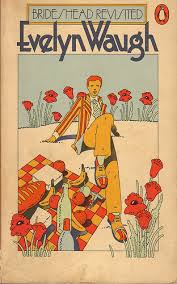
“Brideshead Revisited” is narrated by Charles Ryder, an upper middle class officer who is billeted in the grounds of an English country house at an indeterminate point in the second world war. He is startled to realise he knows the house well, having visited as a guest many times. The body of the novel is a series of reminiscences starting with Charles’s time at Oxford in the early 20’s, when he meets Sebastian Flyte, the younger son of the Brideshead family. The fact he is a younger son, and therefore unlikely to inherit the family title or house, is significant – he dedicates himself to a life of excess, ending as an alcoholic wreck. The surname Flyte is also telling – Sebastian is quintessentially flighty, a decadent aesthete interested in only what pleases him. The bond between Ryder and Flyte is strong and instantaneous, and their lives run in parallel until Sebastian’s alcoholism finally pulls them apart.
The sexual nature of their friendship is fairly explicit – bearing in mind that gay relationships were illegal in the UK before 1968, and only decriminalised in very specific circumstances thereafter. They have an openly gay friend – Antoine Blanche – who is accepted by them without judgment or any hint of censure. Waugh is as clear as possible on this point, dropping multiple hints. To give one example, Charles’s cousin, Jasper, visits him early on during his time at Oxford, and warns him “Beware of the Anglo-Catholics – they’re all sodomites” (28). The Flyte’s are one of England’s leading aristocratic Catholic families.

They grow apart, and Charles becomes an artist. He eventually marries, although his relationship with his wife is distant, and he has no interest in his children. He goes on an expedition into the South American jungle, and is away for two years – when he meets his wife after this absence their lack of affectionate is palpable. On the stormy Atlantic crossing home he begins an affair with Sebastian’s sister, Julia, but she ultimately rejects him in favour of her Catholic faith. In a book-ending chapter back at Brideshead, Ryder reveals he too has embraced Catholicism.
This is a complex novel with many themes. The loss of Edwardian England, preserved in part in Brideshead and Oxford, but torn apart by the devastation of the Great War. Waugh’s 1959 introduction to the novel talks about it being about the imminent loss of the great English country house, but that seems a minor theme to a 21st century reader. Catholicism, the Second World War, love, homosexuality – it makes it seem a worthy novel, and eventually it is, but the early scenes in Oxford in particular are extraordinarily evocative:
“Oxford, in those days, was still a city of aquatint. In her spacious and quiet streets men walked and spoke as they had done in Newman’s day; her autumnal mists, her grey springtime, and the rare glory of her summer days – such as that day – when the chestnut was in flower and the bells rang out high and clear over her gables and cupolas, exhaled the soft airs of centuries of youth. It was this cloistral hush which gave our laughter its resonance, and carried it still, joyously, over the intervening clamour.”
Standard
20th century Literature, Book review, Martin Amis, The Information

The Information, by Martin Amis, 1995

Martin Amis wrote the “at pains to be offensive” “Lionel Asbo”. So why on earth would I read “The Information”? My excuses are, to be honest, slim. I originally read this novel when it was first published, in 1995. I had been impressed by the griminess of “London Fields”, and thought Amis was a writer worth persisting with. He was paid an astonishing £500,000 advance for this novel, which may also have had a part to play in my original purchase decision. Coming across it on my bookshelves two decades later, I could remember nothing about it, even when prompted by the blurb. So I restarted, and once going refused to give up, even though the whole exercise was in some respects a long, drawn out insult.

The premise of the novel is simple. An unsuccessful contemporary writer, Richard Tull, has a friend, Gwyn Barry, who has by some inexplicable stroke of fortune become a highly successful novelist. Both men are intensely unpleasant individuals, two sides of the same coin, with only book sales differentiating them. While Tull’s books are unreadably, painfully bad, Barry’s are bland and inoffensive, yet sell by the million. Readers, it is implied, are all idiots, writing books is pointless, all modern books are rubbish, and the publishing industry is full of crooks, thieves and scoundrels.
In response to the failure of his literary career, Tull plans a complex and rambling scheme to punish Barry for his success. This scheme never quite comes to fruition and fizzles out when at each turn Barry has yet another outrageous stroke of luck to avert the threat of the day. As this happens so often, there is little or no interest in whether the next threat will pan out – we know it won’t.
This is another deeply misogynistic book. There are no even partly convincing female characters – they are simply wives and girlfriends, defined by their relationships with the male protagonists. They are sexually used by the men without having any apparent say in the matter – for example at one point Barry has sex with his research assistant, does her the gracious favour of coming quickly so as not to inconvenience her overly, and then moves to his wife’s bed to brag about it. Amis is not celebrating this behaviour of course – my point is that the women are passive in their acceptance of this abuse. Real women wouldn’t stand for this behaviour for a second.
I am not going to go on at any more length about the failures of this book – I have spent too long on this already. If you enjoy Amis you might like this, but there are many less incestuous, less disappearing up its own self referential fundament, less simply unpleasant books about the London literary scene out there.
But. The thing is, despite all this, Amis can write. At its best his writing is something to savour. Take this:
“He awoke at six, as usual. He needed no alarm clock. He was already comprehensively alarmed.”
Or this
“Cities at night, I feel, contain men who cry in their sleep and then say Nothing. It’s nothing. Just sad dreams. Or something like that…Swing low in your weep ship, with your tear scans and sob probes, and you would mark them. Women–and they can be wives, lovers, gaunt muses, fat nurses, obsessions, devourers, exes, nemeses–will wake and turn to these men and ask, with female need-to-know, “What is it?” And the men will say, “Nothing. No it isn’t anything really. Just sad dreams.”
 “there in the night their bed had the towelly smell of marriage.”
There is something on every page that is interesting, not just in the use of language, imagery, etc., but in the author’s ear for how people speak and think. One example of this is his fascination with idiom. One character consistently makes mistakes with her idiom, and a whole section of what passes for a plot revolves around her confusion between the phrase “Gwyn can’t write for toffee” with what she meant to say, which was that he wouldn’t write for peanuts – different foodstuff, utterly different meaning.
“Demi’s linguistic quirk is essentially and definingly female. It just is. Drawing in breath to denounce this proposition, women will often come out with something like “Up you” or “Ballshit”. For I am referring to Demi’s use of the conflated or mangled catchphrase – Demi’s speech bargains: she wanted two for the price of one. The result was expressive, and you usually knew what she meant given the context… So Demi said “vicious snowball” and “quicksand wit” and up gum street”; she said “worried stiff” and “beyond contempt” (though not beneath belief”); she said “on its death legs” and “hubbub of activity” and “what’s with it with her” (257)….” And so on at length.
Another example is the way he captures a character’s fractured internal monologue, in this case thinking about an article being written about him:
“Although Barry was no. A keen. While no jock or gym rat, Barry responded to the heightened life of fierce competition. He loved games and sports….with his old sparring. …As a novelist Tull was no. Unfavoured by the muses, Tull was nevertheless.” (404)
Finally, is it just me or is it hard to forget that Martin is his father’s son? Sometimes you can hear the grumpy old man being channelled, especially here where the reference to the waking-up still drunk scene in “Lucky Jim” must surely be deliberate:
“Looking the mirror now, on the morning of his fortieth birthday, Richard felt that no one deserved the face he had. No one in the history of the planet. There was nothing on the planet it was that bad to do. What happened? What have you done, man? His hair, scattered over his crown in assorted folds and clumps, looked as though it had just concluded a course of prolonged (and futile) chemotherapy. Then the eyes, each of them perched on its little blood-rimmed beergut…..His teeth were all chipped pottery and pre-war jet-glue.” (46)
Kingsley pretty much gave up bothering to try to write convincing female characters, or indeed anyone other than grumpy old men – is Martin heading that way?
Standard
Book review, First World War, History, The Live and Let Live system, Tony Ashworth, Trench Warfare 1914-1918

Trench Warfare 1914-1918 – The Live and Live System, by Tony Ashworth

I do read some interesting books don’t I? This is one of the Pan Military History series, originally published in 1980 (that date is important by the way, and I will come back to it) and was a bit dry to be honest. It’s more of a reference book than a page-turner. Which was a pity, because the author has identified something really interesting about military conflict, and the First World War in particular, and that is the tendency of combatants to impose some control on their environment, even in the midst of the bloodiest, nastiest conflict imaginable, by refusing to kill their enemies. Ashworth calls this the live and let live system, whereby troops in the trenches would come to informal understandings with those facing them that they would leave one another alone in certain circumstances, at particular times, days, and for particular purposes. This understanding found its most vivid expression in the extraordinary Christmas truces of 1914, when trench warfare was still a relatively new experience, and when the bloody battles of Ypres, Passchendaele, the Somme etc. had entrenched (if you will forgive the pun) bitterness against the enemy.

For me, this was a bit of a light bulb moment. I knew of course that soldiers in the trenches were not constantly fighting, and that there was evidence from other conflicts, touched on at the end of this book, that a surprisingly large proportion of soldiers would avoid killing one another when they could. But the nature of trench warfare, when troops were in close proximity – certainly in hearing range in many cases – to their enemy for long periods of time – meant that they would slowly begin to recognise their opponents as people rather than abstract entities. Once that happen – these are people that eat, sing, hate the rain, etc., like us – then killing them becomes harder. Peace kept breaking out despite all the efforts of the war machine to stop it. In 1917 there were extensive mutinies in the French army across the whole of their front – mutinies which the Germans opposing them at the time were blithely unaware of. As the author points out, this was no doubt because these fronts were largely applying the live and let live principle at the time – if you don’t attack me I won’t attack you.
The context of the war is important here, and it is something Ashworth doesn’t really mention. The belief that a continental war was coming had been around for decades, fuelling spending on the Royal Navy for example, but in many scenarios the Germans, with our shared Royal family, were on the same side as the UK. France was to many our traditional enemy; we had never fought the Germans in a war, whereas we had hardly stopped fighting the French over centuries. So there was no inherent hostility towards the Germans. The media tried to stoke it up of course, and atrocity stories played a part, but the evidence presented in this book suggests that many soldiers in the trenches were quite happy to consider not killing Germans if the reciprocal could be ensured. When higher commands ordered activity, Ashworth argues and demonstrates that firing to miss was common-place.
I have mentioned one omission from this study, the context of the war, but there are a couple of other factors which are not given any focus. I think the conflict in the trenches was – to an extent – seasonal. The weather dictated the extent and nature of the conflict, and this is supported by the casualty figures I have seen elsewhere. Ashworth identifies many different features which meant “live and let live” was more or less likely to occur, but doesn’t mention these practical considerations of weather and season. A minor point I suppose.
I also mentioned earlier that this book was published in 1980, 35 years ago. The relevance of this is that the author was able to interview and correspond with survivors of the Great War, an opportunity that would not exist today. I wonder if he realised at the time how precious this opportunity was. Diaries, letters and journal can tell us a lot, but I don’t think they could ever be a substitute for the oral history of survivors.
Standard
20th century Literature, Book review, Hard-Boiled Wonderland and the End of the World, Haruki Murakami, literature in translation

Hard-Boiled Wonderland and the End of the World, by Haruki Murakami

Translated from the Japanese by Alfred Birnbaum

In my notes on “The Shadow of the Wind” I was harsh, some might say brutally so, towards the translator. So I wanted to open this review by tipping my hat to Alfred Birnbaum. This must have been a fantastically difficult novel to translate. I’ll come to why later but I wanted to start by saying this was one of the strangest books I have read in a very long time. It is set in Japan, and that is one of the very few definite things I can say about it. It is constructed of two parallel storylines, and while it is reasonably clear they are connected early on – otherwise they wouldn’t be in the same book would they? – it takes a long time for the connection to become apparent. Murakami slowly reveals the links – thinking about a novel he has just read about a prisoner, the narrator in one storyline meditates on
the image of a world within walls. I could picture it, with no effort at all. A very high wall, a very large gate. Dead quiet. Me inside. “ (164)
Which is a description of the setting of the parallel narrative. The conclusion suggested here is that the second story is a dream of the narrator of the first story. I resisted the temptation of this interpretation for a long time, (although it turned out to be right), because while fantastical, dreamlike things happen in story B, story A is almost as bizarre.
Story A follows a data analyst with special powers. The author spends a lot of time trying to explain the nature of these powers and the circumstances in which they were acquired, but the effort was wasted on me. Gibberish is gibberish whether written at length or not. Here’s an example
“Whatever we do t’your cognitive circuits, we must never sever that channel. The reason bein’ that your surface consciousness – your first circuit – developed on nurture from your subconscious – that is, from your second circuit. That channel’s the roots of your tree. Without it your brain wouldn’t function. But the question here is that with the electrical discharge from the meltdown of Junction B, the channel’s been dealt an abnormal shock. And your brain’s so surprised, it’s started up emergency adjustment procedures. “ (283)
(As an aside, why the scientist speaking here has this strange accent is one of the many things that went over my head). The narrator has a magnetic attraction to women, who cast aside their clothes and implore him to sleep with them at every opportunity, which is irritating. The nearest style this all approximates to is magical realism. Supernatural things such as unicorns, and subterranean, murloc-like beasts called INKlings appear, and sound can be turned on and off. This is not a naturalistic world, although it is recognisable.
On the other hand, Story B is more dream-like, and follows a similar character (yes, the same person, as we find out sooner or later) who goes to a walled city, has his shadow surgically removed (although it survives the procedure) and spends his time “dream-reading” – trying to interpret mystically readings generated by skulls in a library. As you do.
Eventually the narrative settles down, and a storyline emerges. Despite myself, towards the end of the novel I found myself caring for the romance between the narrator and his librarian girlfriend, a love so compelling that it can cross the boundary between the narratives.
There are so many unusual things about this novel that it is hard to select one, but if forced I would point to the chapters where the author suddenly begins a crude pastiche of American noir detective novels (Chandler, Hammett, etc) – at one point a character stores an object at a baggage check counter, then posts the claim ticket to himself – precisely what Marlowe does in “Farewell my Lovely” (I think).The characters (at this point) all crack wise, even when being smacked around, facing death with smart alec comments, and talking about “spilling the beans”, “rubbing people out”, and “getting sweet”.
This was such a mash-up of genres that I was left utterly bewildered. Which is probably a first. Murakami is hugely popular, and his new novels (this dates back to1985, and includes references to the Police and Duran Duran) are something of an event. If this is representative of his work, I might wait a while before trying another.
I mentioned earlier the credit due to the translator. The different styles of Idiom used are handled well, as is the challenge to make the nonsensical technical explanations, have a veneer of sense. Murakami’s prose can be dense – here’s an example of the translation challenge:
 “This is very important…because to believe something, whatever it might be, is the doing of the mind. Do you follow me? When you say you believe, you allow the possibility of disappointment. And from disappointment or betrayal, there may come despair. Such is the way of the mind”. (351).
Indeed, and as is well know, fear can turn to hate, etc.
I did a quick once-over with the shaver, splashed water on my face, combed my hair. My puss was puffy like cheap cheesecake.” (128/9). A good simile, although the last time anyone used the term “puss” to mean face was around 1945.
Authors often anticipate critical reactions to their work, and include them as a way of fending them off. Murakami does just this towards the end of this novel, when he has a character say “The Wizard of Oz had to be more plausible” (341) If plausibility is what you want this is probably the wrong place to start.
 
Standard
20th century Literature, Book review, http://schemas.google.com/blogger/2008/kind#post, Italo Calvino, The Path to the Spiders' nest

The Path to the Spiders’ nest by Italo Calvino

Another Eton mess. Sorry, cheap joke. This short novel by Calvino, his first, was written in 1946, almost immediately after the end of the Italian partisan war. It follows a young (adolescent?) boy, Pin, who gets involved almost by accident in the partisan campaign. Pin is wise beyond his years in some respects, an orphan (we presume, although this is not confirmed) brought up by his prostitute sister, but innocent and naïve in other ways, always searching for companionship and love. This edition of the novel includes an introduction, written later in the 1960’s, in which Calvino apologises for the story’s failings, including its “neo-realism”, and its sentimental ending.

Most of the action of the novel is shown through Pin’s eyes. He has a limited understanding of what he sees, and it is the gap between his relative innocence and the world going on with its business around him, that offers some the amusement of the novel. Don’t get me wrong – this is not a novel of compic misunderstandings. While Pin is an innocent abroad, trying to survive among short-fused partisans living in the hills above the unnamed city, he is also very “street-wise”. At the same time he is also short-sighted – he steals a German soldier’s gun without giving any consideration to the likely consequences, for himself or his sister.

Although Pin carries most of the narrative focus of the novel, there is one chapter where the point of view switches to one of the partisan fighters – this chapter, and the switch in particular, jars and disrupts the overall flow of the narrative, simply to give a brief lecture on the politics of resistance. The novel also includes some heavy handed symbolism. A pet hawk has its neck wrung, which I wrongly thought might foretell Pin’s eventual demise. The hawk is a more flexible metaphor for innocence and liberty, killed in the bloody war it gets caught up in (you can see why I thought this might have meant Pin, who also carries a lot of symbolic weight on his young shoulders.) 

The introduction to the novel is in some ways more interesting than the novel itself. Calvino directly addresses the reader, and is very frank about the novel’s genesis and its weaknesses. He avoids the obvious explanation/excuse – he was a young writer just setting out to learnt his craft – and gives a series of false starts, interrupting himself and restarting each time with “This was my first novel…” Through this iterative process he comes to an acceptance that this novel is a very minor part of Italy’s literature of the war. He points out some interesting parallels – for example with Treasure Island. Treasure Island is a very simple children’s novel, with memorable but two-dimensional characters (with, arguably, the exception of the charismatic but evil Long John Silver) and has a young boy as its narrator, caught up in an adventure out of his control. So is this novel also a children’s story? And does that explain why it appears on the Eton list? Probably. Roald Dahl’s autobiographical “Boy” is often taught in state schools for the same reason – tell a child a tale about another child having adventures, and it will capture their attention in a way that other stories by the same author may not. This is one of the secrets behind the success of Harry Potter of course. It confirms my suspicion that the Eton list is not an aspirational piece of showing off, but more in the way of a light, unadventurous summer reading list that a bright 16 year old could probably run through in a couple of months.


And as for this novel? Well it won’t occupy you for long, and its weaknesses are capably pointed out by the author himself (although I would recommend you read the preface after the novel). It is an interesting tale of the partisan war in Italy, but other than that it is little more than a curiosity.
Standard
21st century literature, Book review, Carlos Ruix Zafon, literature in translation, The Shadow of the Wind

The Shadow of the Wind by Carlos Ruix Zafon, translated from the Spanish by Lucia Graves

This is one of the novels included in the Eton headmaster’s list I wrote about earlier this month.

Let’s start with the nonsensical title, which sets the tone for the rest of the novel. The wind does not have a shadow. Perhaps I am being overly literal, or perhaps that is the point – the title being a euphemism for something that doesn’t exist. The title is also the name of the novel that is the subject matter of the story, a novel that is elusive and hard to pin down, like its author. So the title is, if I am being kind, an ironic, tongue in cheek, self-referential joke.


The same summary could be applied to the rest of the novel. It is written in high gothic style, reminiscent of the early 19thcentury gothic, grand guiginol novel. When one of the characters tells one of the many tales within a tale that make up this novel, another character responses that “It had all the makings of a lurid melodrama. “(239). When I read that I felt like responding as another character did when yet another diversionary tale is being spun ““The abridged version…for goodness sake!” (253). There are scenes set in crypts, with mysterious, ghostly apparitions, sinister, spectral figures lurking in the gloom, and so on. (See chapter 34 for the height of this style). The principal plot follows a young man who comes across a novel (the eponymous Shadow of the Wind) by a mysterious writer, Julian Carax. The young man tries to track Carax down, following various clues, and passes through a maze of clues until finally, at the novel’s climax, Carax’s true identify is revealed.


It’s hard to take this melodrama seriously. It seems more in European taste (for example, The Name of the Rose” which is an obvious influence) but is very old-fashioned. The tendency for characters to monologue about their exotic past reminded me at points of the un-improvable scene in Austin Powers, where Dr Evil reminisces about his childhood.


“The details of my life are quite inconsequential… very well, where do I begin? My father was a relentlessly self-improving boulangerie owner from Belgium with low grade narcolepsy and a penchant for buggery. My mother was a fifteen year old French prostitute named Chloe with webbed feet. My father would womanize, he would drink. He would make outrageous claims like he invented the question mark. Sometimes he would accuse chestnuts of being lazy. The sort of general malaise that only the genius possess and the insane lament. My childhood was typical. Summers in Rangoon, luge lessons. In the spring we’d make meat helmets. When I was insolent I was placed in a burlap bag and beaten with reeds- pretty standard really. At the age of twelve I received my first scribe. At the age of fourteen a Zoroastrian named Vilma ritualistically shaved my testicles. There really is nothing like a shorn scrotum… it’s breath-taking- I highly suggest you try it.”


Compare this with:


“This dream was the first of many and they began with that mysterious fever, which some blamed on the sting of a huge red scorpion that appeared in the house one day and was never seen again, and others on the evil designs of a mad nun who crept into houses at night to poison children, and who, years later, was to be garrotted reciting the Lord’s Prayer backwards with her eyes popping out of their sockets, while a red cloud spread over the town, discharging a storm of dead cockroaches” (268)


If you like this sort of thing, then obviously this is the sort of thing you will like. But is it well done? Are the characters convincing? Is the narrative compelling? Is this suitable reading for a well-read 16 year-old Etonian?


Well not really, no. The text is repetitive and over-written. There is little to admire in the writing by way of style, although I appreciate that could be in part a question of translation. The plot is ridiculous and predictable, and characters behave as they do without apparent motivation or sense. Women are reduced to cyphers – there isn’t a well developed female character in the book, and those that do appear are all generic and passive. Why this appeared on the Etonian reading list is more of a mystery than that unwound in this novel.


Redeeming features? Well the background was interesting. Post-Civil War Spain, where the fascists remain in control and the Secret Police can still make people disappear, where everyone has lost a family member or friend, was realistically drawn. But that’s largely it. This novel has huge numbers of five star reviews on Amazon, so I am obviously missing something.

This edition, published for the 10th anniversary of the book’s original publication, contains at the end some “Book Club reading notes”. I doubt if the book was originally written for this market, but there is a childishness, a paradoxical lack of complexity in the characterisation and plot (which for all its detail and length is actually fairly straightforward; all is revealed in a very linear way with the minimum amount of effort from the investigators, and carefully laid out in well preserved diaries and notes when required) which makes this suitable book club material, as well as justifying its inclusion in the Eton “What every 16 year old boy should have read” list.

Standard
Book review, History, Hugh Trevor Roper, Second World War, The Last Days of Adolf Hitler

The Last Days of Adolf Hitler by Hugh Trevor Roper

Probably the last thing the world needs is another book about the Nazis, but I bought this (second hand) at the same time as the Bullock biography, read it, and it seems daft not to review it for risk of repetition. It does overlap with the later chapters of the Bullock book to some extent, and indeed is cited in it, but is quite distinct in other respects.

This book was originally commissioned as an investigation into (you guessed it) the last days of Adolf, specifically to address the rumours that he had escaped Berlin and was lurking somewhere in South America. The absence of a body, and the Russian refusal to clarify some of the confusion around his last days, fuelled this speculation. Trevor Roper puts this all neatly to bed, and while conspiracy theories linger to this day, unsurprisingly, they have never had the potency one might expect given Hitler’s status as the ultimate bogey-man.

To pad things out a little, the book opens with a summary of Hitler’s court, describing the principal characters and the bizarre wider cast of astrologers, masseurs, vegetarian chefs and the like. This is reasonably standard stuff, but where this book really takes off is in the almost minute by minute account of the last days of the Third Reich. I couldn’t avoid speculating how the British Government might have ended had things gone badly in 1941. Hitler’s choices once again seem hard to fathom. if he wanted to fight to the bitter end, why not leave Berlin, join some of the surviving German forces, which remained considerable, and fight on? Instead he holed up in a city destined to be taken by the Russians, and then killed himself rather than being captured.

As a reference work this is second to none. As a read it is well-written and relatively short. If you want to know about Hitler’s last days there are probably more up to date accounts available, as well as plenty of documentaries and the like, but nevertheless I am quite happy to have added this to my collection.

Standard
21st century literature, Book review

Supplementary: A bit more about “A Spot of Bother”

The primary character in Mark Haddon’s “A Spot of Bother”, Douglas Hall, is 57. Much of the “humour” of the novel derives from his unhinged behaviour as he suffers from a nervous breakdown/depressive episode. I wrote yesterday about how this is in poor taste, as is the humour wrung from people’s shock horror reaction to a gay couple kissing. The novel is less than ten years old, but it had more of a 70’s sitcom feel to it in these passages. But what I wanted to write about in a bit more detail here is the portrayal of Douglas. Haddon tells us he is 57, but then writes him at least ten years older. He is retired, which of course is eminently possible at 57, but he has pretty much given up on life. He potters around, building a shed, watching videos and taking an interest in bird spotting. He finds the modern world confusing and challenging, and when he has sex with his wife it takes them both by surprise.

57 isn’t old.

Why does this matter? Because when the central character is unrealistic, hard to like but also hard to believe in, the whole book suffers. Without a convincing portrayal in this role the rest of the characters struggle. Some are better than others – the daughter Katie for example is well drawn, and the wife, Jean, with her badly kept secret affair was also believeable. But given the caricature that is Douglas and Jean’s son Jamie, I wasn’t convinced Haddon had ever met a gay man.

Of course, having written the above I then checked the Internet (does it age me that I still capitalise Internet?  Of course it does) expecting to find out that Haddon was gay, but it appears not. Interestingly I found some confirmation of my observations about reviewers – so for example the Sydney Morning Herald said “while the characterisation can’t be faulted, A Spot of Bother fails to fulfil its early promise. What initially shapes up as a disquietingly soft stab in the human heart turns obvious and formulaic. Haddon’s examination of the contours of love is forensic in its insight but a sentimental undertow proves too alluring to resist” and the Guardian said “it never tries to be much more than good jokes or funny situations….readers could be forgiven for wanting – and expecting – more.” Selectively quoting reviewers to support your position is cheating, and I rarely do it, but there was something about the half hearted quotes on the cover that led me to suspect my feelings were shared.

In his earlier career Haddon wrote exclusively for children. The migration from that to adult novels obviously isn’t easy, and some of the weaknesses of this novel could be seen as deriving from the habits of writing for children – the cheap laughs, the weakly drawn characters, the tendency towards slapstick. So perhaps rather than seeing this as a follow up novel to “A Curious Incident” it is better thought of as a transition novel from writing for kids to writing for adults?

Standard
21st century literature, A Spot of Bother, Book review, Mark Haddon

A Spot of Bother by Mark Haddon

This was Haddon’s second novel, published in 2006 after his hugely successful “A Curious Incident”. I have reviewed his third novel, “The Red House” on this blog previously, and was optimistic that this would be equally readable. Largely it was – the very short chapters and frequent changes of narrative perspective meant the pages passed quickly, and I finished the near 500 pages in a couple of days. This would normally an indication that the novel was well written and enjoyable, but I finished this with a vague feeling that something wasn’t quite right. What could it be?

Well, to start with, there’s that awful title, a cheesy pun (the principal character has a spot which he thinks is cancerous, and which triggers a series depressive episode) reminiscent of a Norman Wisdom film or episode of Some Mothers (“Betty, I’m having a spot of bother”). The author avoids putting much effort into giving the characters a back story, which is sketched in very faintly, simply by making occasional reference to “that time the dog got run over in Rhyl” or “the time we crashed the mini in Copenhagen” (made up examples, but you get the idea). I flicked through the book at random and picked out these examples (not made up this time) and realised that Haddon uses this technique a lot more than I thought:
“several years ago when he had fallen from a stepladder, broken his elbow on the rockery, and passed out, a sensation which he remembered as being not unpleasant (a view from the Tamar bridge in Plymouth had featured prominently for some reason)” (page 1
“He had not felt like this since John Zinewski’s Fireball had capsized several years ago and he had found himself trapped underwater with his ankle knotted in a loop of rope.” (2)
“Betty’s brother, the one who died in that horrible factory accident, had made a hat out of a napkin.” (52)
“”Got pulled over by police on the M5 once…wingwalking on a Volvo roofrack”” (66)
“Coming home from university… spilling that paint over the cat, losing her passport in Malta.” (233)
And so relentlessly on. All families have disaster stories, enhanced over time, which cumulatively build the family history. They are important. But a novelist needs surely to make more of them than this. At first I thought we would get round to visiting these incidents and finding in them the key to the principal characters various neuroses – there has to be a reason why a bit of eczema causes George to have a full-blown nervous breakdown – but it never happens. I don’t mind doing a bit of work to fill in gaps left by an author, but this was too much – the characters were cut-outs who behaved as they did for no apparent reason, take it or leave it.
There is an attempt at farce here, reminiscent of Tom Sharpe. People mix anti-depressants and alcohol with inevitable results, dog poo is trodden in, a toddler’s toy is tripped over, a gay couple kiss and outrage the religious aunt and uncle, and so on. The wedding, which is the drawn-out climax of the novel ends in a fight, sex, and tears, as we always knew it would.
Being charitable, I prefer to think of this novel as a dry run for the much more controlled “Red House”.
PS: like most contemporary novels the cover and back cover are covered in quotes from reviewers. You get the sense that my luke-warm response was shared – the Guardian described the book as “readable” and “brisk”, the Telegraph “entertaining” and the Sunday Times “crisp, light” (like a white wine?). Damned with faint praise.
 
 
Standard
21st century literature, Book review, David Nicholls, Us

Book review: Us, by David Nicholls

David Nicholls’s previous two novels, “Starter for Ten” and “One Day” have both been made into moderately successful films, so I don’t think it is being overly cynical to conclude that the setting for this novel – a series of European capitals and art galleries – was at least in part influenced by the author’s anticipation of sealing another film deal. Once you open with that cynicism, it is hard to stop. But I think you should. OK, the chapters are all extremely short, designed I suspect for the attention deficient, but the principal character, Douglas, who is also our narrator, is not an endearing character. He is a bore, and a bit of a bully. He is inattentive towards his wife, and positively negligent of his 17 year old son. He knows he has traded up in marrying his artistic wife, and never overcomes that expectation that sooner or later she is going to realise it too.

And so it comes to pass, when shortly before their son leaves for university, and it is suggested, for good, his wife announces apropos of nothing, that she wants to leave him. In a desperate, if photogenic, attempt to save his marriage he takes her on the tour mentioned above, although for reasons hard to imagine he thinks it is a good idea to take their son as well. The tour goes badly from the off, and never recovers.

I thought I knew how this novel would end, long before it did, and I was wrong. Nicholls avoids the cliched happy ending, and quite possibly forfeits the film deal I cynically accused him of engineering earlier. (Although if it does translate to film then they will probably rewrite the ending.)

This is pretty undemanding stuff, not quite chick-lit (or whatever the male equivalent is) but not many steps up either. Nicholls writes quite slowly, so I won’t have to make the decision as to whether to bother with his next novel for a while yet, but if I had to make it today I’d look for something a bit more challenging.

Standard