A little. For every book that falls into this category – very well known, but very little read – reading the novel, in this case for the first time, in other cases for the first time for decades – is a very interesting experience. What characters and scenes have entered the cultural lexicon, and which missed the cut? In Alice an extraordinary proportion of the scenes have made it. Reading the novel was like revisiting familiar childhood scenes. There were very few chapters or scenes that were not well known, and that had survived the transition from book to popular knowledge largely intact – the Mad Hatter and the March Hare are exactly as random and bizarre as you think they are going to be, the Cheshire Cat and the Caterpillar are slightly creepy, and the Mock Turtle sadly irritating.
The Internet will tell you that Alice is a satirical portrayal of Victorian England, with disguised portrayals of political and other prominent, and that the nonsense comments of the characters either are coded commentary on the events of the day, or simply a portrait of the topsy-turvy nature of society – “We are all mad here”. Critics have been able to divine critiques on the Monarchy, colonialism, evolution, politics both left and right and many others in Alice – how fruitful these attempts at decoding the text have been is debateable. Alice is a wonderful children’s book, where the dream-like transitions from one bizarre situation to another, capture perfectly a child’s flexible perspective on the world. I suspect it is that aspect of the novel, rather than its “hidden” meanings, that have made it so popular, and why the characters have been so resilient, when other Victorian children’s literature – The Water Babies for example – have faded from the popular imagination.
Category Archives: Book review
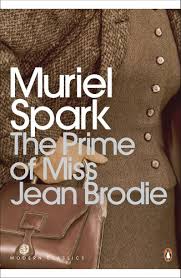
The Prime of Miss Jean Brodie – Muriel Spark, 1961
Read in a Penguin edition
Following on from The Maltese Falcon, this is another novel arguably better known for its film adaptation than the original novel. The film was a success, in its own terms, but of necessity made some significant changes to the novel, in structure if not in spirit.
Miss Jean Brodie teaches at a small private girl’s school in 1930’s Edinburgh. She believes herself to be in her prime of life, and the novel focusses on her relationship with her “set” – a small group of girls who she adopts as her favourites, and who she dedicates herself to moulding in her own image. This experiment largely fails. While she has a significant impact on the girls’ lives, they all outgrow her and go their own separate ways, remembering her with little more than wry fondness.
Described as an experimental novel when first published at the start of the 60’s, the main innovation Spark uses justifying this label, and elevating this from a traditional school days tale, is her use of a fractured time scheme. Instead of a chronological approach to story telling, in which the events of the story are presented in the order in which they happened, the events of the novel leap forward and back in time, as if presented through the recollections of one of the participants. The reader therefore knows what happens to the principal characters – often the main focus of interest of many novels – early on, and is free to focus on other issues. This approach to presenting the events of the novel is a fragmented order is less innovative now of course, but at the time was considered daring. It leads to an interesting case of “negative foreshadowing”, a term I just made up, where a character’s ultimate fate is described, followed by an incident which in a traditional novel would be described as foreshadowing. (A good example of this in its traditional context is the scene in “Of Mice and men” where a character is pressurised into putting down his old, sick dog).
For a very short novel Spark manages to include a large number of themes and ideas in “The Prime”. The religious issues of 1930’s Scotland, and their impact on the girl’s emerging sexuality features heavily. Equally, the social divisions of the time are also central to the background of the narrative. Education, and the ability of a teacher to influence the attitudes and perspective of their students, and not least politics are also consistently featured. The girl’s vivid imagination is portrayed very effectively – they imagine themselves as heroines of stories inspired by Miss Brodie, and as they get older these stories inevitably get more explicit, while retaining an innocence suitable to 1930’s Presbyterian Scotland:
But the novel is not didactic – this is background, not much more, and the primary interest is in character. The success of this is evidenced by the fact that as well as translating to the cinema, “The Prime” has also been performed successfully as a stage play, and was made into a television series. The portrayal of the central characters in the film was sufficiently vivid to have stayed with me for a long time, so much so that reading the novel felt in many ways like a re-read.
Comment: Spade and Marlowe
There’s no denying the huge influence Hammett had on Philip Chandler’s work. Chandler acknowledges this in “The Art of Murder” when he wrote:
Another difference between Spade and Marlowe is that Marlowe is significantly more pious. He is a man of high principle. Marlowe will sleep with the women he encounters in his adventures, but he won’t allow them to use their sexuality to influence him – in “The Big Sleep” for example he throws the dangerous but highly attractive Carmen Sternwood out of his apartment when she climbs uninvited into his bed. Spade has fewer scruples – he sleeps with Brigid even though he knows she is using him.
Another strong echo of Chandler is the scene where Spade confronts the young man, who we later find is working for the Fat Man:
“The boy spoke two words, the first a short guttural verb, the second “you”.
“People lose teeth talking like that.” Spade’s voice was still amiable, though his face had become wooden.” (457)
The one thing Chandler does above all others which elevates Marlowe is giving him a voice – by using a first person, interior monologue narration, we are given an insight into Marlowe’s thoughts and feelings in a way we only peep into those of Spade’s. It is this above all else that allows us to empathise with Marlowe, to walk in his steps, even if he hides some key facts and conclusions from the reader, to keep us guessing. With Spade we only see and hear what the omniscient narrator allows us to see. This leads to explanatory scenes, where the characters’ dialogue is primarily there to help the reader “catch-up”. Marlowe is the more rounded creation, and Chandler’s narratives are the more complex and interesting, but the debt he and many other detective fiction authors owe to Hammett is unambiguous and significant.
Supplementary: The Maltese Falcon (2) – A Different Approach
This is extraordinary writing. Hammett uses these small movements, even down to the width of her pupils, to tell us so much about what is going on. Brigid has widened her eyes as part of her seduction technique. She narrows them to glance at Spade, who is studiously ignoring her performance. The fingertip to the mouth is a classic sexual invitation, mimicking fellatio. When this doesn’t work she moves to smoothing her dress, drawing her attention down to her legs and groin. She is an expert temptress, using her sexuality to get what she wants. Later, after they share a supper of sausage, (little subtlety there!), “Spade’s arms went around her, holding her to him, muscles bulging his blue sleeve, a hand cradling her head, its fingers half lost among red hair, a hand moving groping fingers over her slim back. His eyes burned yellowy” (453). She has won – or has she? (Incidentally, I am not sure about the word “yellowy”).
“No, you know I didn’t” (455)
He knows she didn’t have the gun under her pillow, because her pillow didn’t stay in place all night, suggesting that their sex was reasonably active. Pretty racy stuff for 1920’s American literature?
I’m going to write separately about the parallels between The Maltese Falcon and the writing of Raymond Chandler, but for now, while Hammett can’t hold a candle to Chandler when it comes to crafting a phrase, few can, I should acknowledge that there are still some treasures here. For example he describes Brigid’s eyes as “cobalt-blue prayers”, which I thought was extraordinary. There is also the description of the Fat Man, which was one of the best descriptions of obesity I can remember reading:
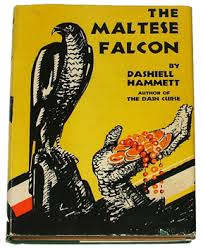
The Maltese Falcon, Dashiel Hammett, 1929
Read in Picador edition as part of “The Four Great Novels”
Dashiel Hammett’s “The Maltese Falcon” (1929) is a devastating critique of the American Dream. Often seen as a straightforward detective novel, a closer contextual reading reveals a damning indictment of American capitalism and society.
At the heart of the novel is the quest for the Maltese Falcon, an elusive golden statute encrusted with highly precious stones. The falcon is never seen, never found, always slipping through the hands of the pursuers and melting away, like the proverbial pot of gold at the end of the rainbow. There is little evidence it actually exists, but the treasure hunters seek it obsessively, and great financial and physical cost to themselves. What is this if not the perfect metaphor for the American Dream, the promise of wealth and happiness that so many Americans pursed (and pursue) but can never quite attain? When the gang think they have at one point found the statue, it turns out to be a fake, lead instead of gold. Hammett is surely saying that the American Dream, like the falcon, is a myth and a fake.
In Hammett’s prohibition-era America, society is unjust and intolerant. The police in Hammett’s novel are incompetent and corrupt, agents of a corrupt and unjust society. At one point Spade tells Iva, Archer’s widow, in relation to talking to the police “Maybe it’d be best to say “no” right across the board”. This was Hammett’s response (in effect) when question by the McCarthy investigation into communism in the arts in America in the 1950’s (to be precise, he pleaded his 5th Amendment rights to all questions”) a stance which eventually landed him in jail. The novel ends with Spade turning his lover into the police, and turning his back on love, another rejection of the romantic illusion of middle class life.
Scoop – Evelyn Waugh – 1938
Read in a Penguin Classics edition
The plot is simplicity itself. By a confusion over names, William Boot, the Daily Beast’s rural affairs correspondent, is sent to cover a conflict in Ishmaelia, a North African country where gold has just been discovered, and where the European powers are struggling, through proxies, for control. War has yet to be declared – it never really is – and the journalists have little to do except follow one another around. Boot stumbles upon the real story by accident, and returns to acclaim, only for the case of mistaken identity to be repeated, leaving him in the countryside seclusion her prefers.
“The British Public has no interest in a war which drags on indecisively. A few sharp victories, some conspicuous acts of personal bravery on the Patriot side, and a colourful entry into the capital. That is the Best Policy for the war.”
Elsewhere a fellow journalist explains in anecdote the power of the press, and why it should not be ignored:
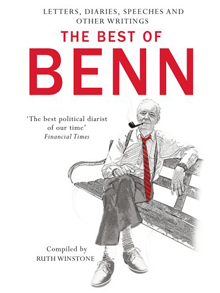
The Best of Benn – Tony Benn, edited by Ruth Winstone
Go Set a Watchman by Harper Lee
“Go Set a Watchman” (and what a great title by the way) was an early, rejected draft of the story that was to eventually become “To Kill a Mockingbird” (or “that Mockingjay book” as overheard in Waterstones recently. In Watchman, 26 year-old Scout returns from New York to spend time with her family in Maycomb, Alabama. The contrast between urban, progressive New York, and the backward, sister marrying deep South, is the source of much of the dramatic tension of the novel. Scout discovers by chance that her father and family are involved in a racist movement to ensure the black community remains in its place. This movement has sinister, violent undertones. The N word is used freely by its supporters. Scout passinately confronts her father, who refuses to apologise, but tells her she is wrong. Her uncle, a doctor, repeats this message, and when she gets upset violently hits her. This calms her down in the book’s most upsetting scenes. The novel ends with the suggestion that Scout has come to terms with her family’s racism, and may even stay in Maycomb.
Much of the reaction to the novel, and speculation as to its long delayed appearance, centres on the alleged transformation of the character of Atticus Finch, from noble defender of the oppressed black peoples of Maycomb, to a racist Klan supporter. Watchman’s hero is far more human than the paragon of TKAM. This confused response is wrong on two counts. Firstly, as Watchman makes very clear, the Atticus Finch of the second novel is the same man as in the first. There has been no major transformation, no becoming racist due to a traumatic incident or gradual embitterment. Yes, the times have changed, and the circumstances with them, but Atticus was and is a decent racist. How can the brave defender of a wrongly accused black man be a racist? Simply this – he believes in the rule of law, believes black people have a right to a fair trial, but he doesn’t believe they have the right to much more than that. Certainly not equal rights, equal education, the right to have proper democractic representation. Worst still, while Scout is appalled by Atticus’s association with disgusting racists preaching race war, she still has racist views herself. She agrees with Atticus for example when he explains that co-education threatens the Southern way of life. She challenges effectively the idea that mixed relationships will lead to mongrelization of the white race – are black men so irresistible to white women that they have to be legally restrained from marrying them? – but believes the consitution should not compel people to share their schools if they don’t want to.
Realistically, this is probably as progressive you would get for white people in the 1950’s, and even then Scout’s liberalism can be traced not just to her father’s decency, but her “corruption” by New York progressivism.
Why is the Finches’s racism so apparent in Watchman, but not Mockingbird? I believe the main difference is the context. In 1930’s Southern USA, the civil rights movement didn’t really exist. (This is not my specialist subject to say the least, but I think that’s right). In the 1950’s the NAACP was on the march, organising, and challenging the institutional barriers which left most black people as simply released slaves, with few if any political rights. Watchman prefigures the battles to come over civil rights, and shows us how threatened and scared some white communities were. Not everyone in the South who opposed civil rights were monsters, even if their behaviour and language was monstrous.
This book provides us with a different way of looking at Mockingbird, and is worth reading for that reason alone. Lee shows some skill in her handling of the portraits of the Maycomb community, capturing a sense of time and place. The characters emerge strongly, recognisable and consistent with their later (but also earlier) incarnations in Mockingbird. Whether Lee’s editor, who encouraged her to shelve this book and re-create the novel based on the flashback, was right or wrong is a meaningless question – we now have both books, and if Mockingbird is slightly diminished in the eyes of some readers, there’s little that can be done about this now. I suspect Mockingbird is resilient enough to emerge form this unscathed, with Watchman becoming a footnote in future GCSE and A Level reference books. Which would be a pity, because I also suspect Watchman is the more accurate, less romantic portrayal of the two.
Mud, Blood, and Poppycock by Gordon Corrigan
I am going to assume that Gordon Corrigan is a nice man. In this 2003 Cassell edition of Mud, Blood, and Poppycock he shares with us that he is married and a church-goer, so this is a reasonable assumption. I genuinely do not want to spend ages telling you why this book is terrible – it’s not a particularly good use of your time or mine. I know I have said this before, but it is not really the purpose of this blog to self censor and only write nice, glowing reviews of wonderful books. So in the unlikely event that this spoils a nice person’s day then I am genuinely sorry, but this was one of the weakest, worst written history books I have read in a very long time.
The technique here is simple and very badly done.
Step 1 – make a general observation, unsupported by any reference or evidence whatsoever, about the popular perception of the Great War – for example that the trenches were full of very large rats.
Step 2 – claim with little or no evidence to the contrary that they weren’t
Step 3 – claim that there may in fact have been some true in the popular perception after all – but argue that the rabbits were larger in the French trenches, that the Tommies enjoyed the company of the rats, and who minds the odd rat anyway other than lefty pinkoes?
I am not aware of anyone every suggesting that soldiers marched all the way from the Channel Ports to the front line. Nor apparently is Corrigan, because this perception is not evidenced in any way. Nevertheless, having set up this straw man, he points out that trains, motor vehicles, mules and horses were all in abundance in 1914 Belgium. Point made, straw man demolished. Yet a sense of honesty compels him to admit only a few lines later that “The pre-war army was …well accustomed to marching. The reservists were not so lucky. Reservists sitting by the side of the road, boots off, and feet bleeding were a common sight (75). Again, no authority is provided, but it is hardly surprising if the common perception of soldiers having to march an unreasonably long way grew up if this was a common sight on the roadsides of Northern France and Belgium.
There is an opportunity here for some serious historical investigation to be done. The Army stands accused of not looking after its solders very well, of making them march long distances in uncomfortable footwear, and of not providing enough motor and equine transport. So is that true? What does the evidence say? What did other armies do with regard to moving their troops about, in the circumstances where transport was limited and the need to move troops around urgent? Was transport taken seriously as a military discipline? I don’t know, but neither, apparently, does the author.
Finally, Corrigan is at pains to let the reader know he is a retired soldier. If the numerous reminders of this are not sufficient, he uses playground language – “wedding tackle”, “willy”, and “dirty water” – at times in a way that is utterly inappropriate in a serious work of historical inquiry. But perhaps that is the point.
Supplementary: Brideshead Revisited (2) – on the description of marital and extra-marital sex
There are some interesting descriptions of sex in Brideshead. Waugh avoids any explicit reference to gay sex, but he is slightly more comfortable with marital affairs, taking a quick peek into the bedroom. When Charles returns from his two-year long trip to South America, his reaction to meeting his wife could not be more off-hand if he tried. “There was also a daughter now, she remarked” (218) – noted in the same tone as if she had had the spare bedroom redecorated. When they are at last alone, the scene is described thus:
“She talked in this way while she undressed, with an effort to appear at ease,; then she sat at the dressing table, ran a comb through her hair, and with her bare back towards me, looking at herself in the glass, said “Shall I put my face to bed?”
It was a familiar phrase, one that I did not like; she meant, should she remove her make-up, cover herself with grease, and put her hair in a net.
“No” I said, “not at once”.
Then she knew what was wanted. She had neat, hygienic ways for that too, but there were both relief and triumph in her smile of welcome; later we parted and lay in our twin beds a yard or two distant, smoking”.
Waugh packs a huge amount of information in this brief scene of clinical, hygienic marital sex. When his wife offers herself – obliquely, but quite clearly – to her returning husband after two years apart, she can’t even look at him. She seems to disgust him somewhat – “cover herself with grease”- and his acceptance of her offer is equally half hearted – “not at once”. her relief and triumph derives from his acceptance of her offer. It is later implied that she has been unfaithful in his absence, and that he is aware of this – her relief derives from a mistaken belief that her infidelity has gone unreported, or is forgiven. This is a marriage where little needs to be said – later, when Charles decides to go to see Julia, his mistress, rather than his newly arrived daughter, signalling effectively the end of the marriage, all she says is “I wish it hadn’t got to happen quite this way” (256)
Sex with his mistress on the other hand is more tempestuous, with the storm raging on the Atlantic acting as a usual metaphor:
“As we made our halting, laborious way forward…we were alternately jostled together, then strained, nearly sundered, arms and fingers interlocked as I held the rail and Julia clung to me, thrust together again, drawn apart, then in a plunge deeper than the rest, I found myself flung across her, pressing her against the rail, warding myself off her with the arms that held her prisoner on either side” (248)
This plunging and swooping goes on for some time. When the actual, non-metaphorical sex happens a little later, the language Waugh uses is quite extraordinary:
“Julia led me below. It was no time of the sweets of luxury; they would come, in their season, with the swallow and the lime flowers. Now in the rough water there was a formality to be observed, no more. It was as though a deed of conveyance of her narrow loins had been drawn and sealed. I was making my first entry as the freeholder of a property I would enjoy and develop at leisure”. (248)
So not only is this first sexual exchange portrayed in legalistic, commercial terms, but more precisely as a transaction relating to property. Julia eventually inherits Brideshead House, and if they had married Charles would have shared in this inheritance. (Incidentally I wonder if the reference to the “swallow” an accidental punning reference to oral sex? If that’s not too far for you, then this surely is: the mention of lime flowers could be an oblique reference to the fact that lime trees are hermaphroditic, with both male and female parts, suggesting Charles’s tastes are not solely confined to women, as by now we are almost certainly aware.
Portraying sex in novels in the first half of the twentieth century was a challenge – writers were pushing at the boundaries of what public taste and censors would allow, and of course sometimes – Lady Chatterley, Ulysses, The Well of Loneliness, etc – crossing the line. Waugh seems to me to be ambivalent in his references to heterosexual sex – it is treated almost as a necessary evil, but is far from comfortable compared to his treatment of the relationships between men.