21st century literature, Book review, Booker Prizewinner, Hilary Mantel, Wolf Hall

Wolf Hall by Hilary Mantel 2009

Wolf Hall won the Booker prize in 2009, and its sequel, Bringing up the Bodies, is the Bookies’ favourite for the 2012 prize. If it weren’t for this accolade I very much doubt if I would have read it, not being an historical fiction fan, and I certainly would not have persisted to the end of the 650 pages.
This is very much the “anti-Booker” – instead of the usual slim volume of sensitively crafted, flawed memories, this is a detailed recreation of the life of Thomas Cromwell. As always the best and first question to ask is “Why?” – which Mantel helpfully answers in a short Q&A published at the end of this Fourth Estate paperback edition. Mantel found Cromwell a mysterious figure, and decided to give him a voice. This she does very well – his portrait is well rounded and convincing. He comes over as a sympathetic figure, caught up in turbulent times, trying his best to follow his conscience whilst at the same time to survive and prosper.

Mantel draws heavily from the historical record, which is of course legitimate – Shakespeare did very much the same – and we get a detailed insight into the key characters from this crucial period in English history. There is, as you will have guessed, a faily big “but” coming. In fact, several. Where to begin?

First, everything takes such a long time to happen, and while we wait for Henry to divorce Katherine and marry Anne Boleyn the material used to fill the gaps is not interesting enough to carry the reader along – I confess I took a two week break half way through reading this, and only returned out of a sense of duty or stubborness.

Second, the author’s much criticised use of the male singular personal pronoun is deeply irritating. Usually, but not always, “he” is used to refer to Cromwell. The idea no doubt is to pull the reader closer into identifying with him, but it generates huge confusion virtually on every page, which is compounded by large blocks of dialogue and the use of the present tense. You can usually work out in the end who is being referred to, and devices to make the reader pause and think are often no bad thing, but here the main impact is one of irritation.

This confusion is made worse by the huge cast of characters, many with the same name, who are often lightly sketched. I gave up bothering to try to work out who was who, who was related by birth or marriage to who, and so on – the investment of effort and time wasn’t proportionate to the reward.

Finally, the title is simply a teaser for the second book in the series, (I am assuming it is a series – there are a lot of wives to go), Wolf Hall being the home of the Seymours. It is an evocative metaphor for the dog eat dog world Henry created amongst his court, but it is a bit of a cheat.

In the end, do we care enough about the central character to justify the 650 pages? I didn’t I’m afraid, and unless you are a big historical fiction fan (think Philippa Gregory or Alison Weir) I would not recommend this.

Standard
20th century Literature, Amsterdam, Booker Prizewinner, Ian McEwan

Amsterdam by Ian McEwan

Read in 1999 Vintage edition
The important thing to remember about this novel, winner of the 1998 Booker prize, is that it is pre-Atonement, pre-On Chesil Beach, even pre-Saturday.  In other words it is not the work of a mature writer at the height of his powers – which I know is not much of an excuse, but it was the best I could come up with. In fact after a few hours of puzzlement – what the heck was he thinking of? – I think I came to understand what McEwan was trying to do here, and I was willing to forgive him.
The plot is flimsy. Molly Lane has died in her forties of an unspecified dementia, (false note struck straight away – everyone would have wanted to know what her illness was, and would have talked about it) and her past lovers assemble to mourn her. The cast includes:
·         George, her present husband, who maliciously prevented people from visiting her, and used her illness as a means of imposing the control on her he was never able to exercise when she was well.
·         Vernon, editor of a mildly left wing broadsheet, who is struggling to take it down market, running stories about conjoined twins instead of chess tournaments
·         Clive, a composer who has been commissioned to write a millennial symphony (we are in the late 1990s). Clive is revealed as a casual plagiarist;
·         Garmody, the Foreign Secretary, who has a range of unpleasant right-wing views. He is a Portillo-like figure (that is the nasty Portillo of the mid 1990’s not the avuncular figure he has become).
Clive and Vernon, long standing friends, casually make a pact to kill one another should either of them become ill in the way Molly did. George finds pictures of Garmody amongst Molly’s possessions that show him cross-dressing.  He sells them to Vernon, who uses them to boost circulation, but falls out with Clive as a result. Meanwhile Clive, on a walking break in the Lake District, sees a woman being attacked, but does not intervene because he wants to work on his composition.
Vernon is sacked, Clive can’t finish his composition, and in a rage they decide to kill one another, which they do while in Amsterdam, using the country’s relaxed laws on euthanasia. The front cover of this edition shows two gentlemen in frock coats and top hats duelling in a wood or forest, with one or two others watching on as seconds, a not so subtle reference to this mutual destruction.
Each character tells their section of the story in the first person, so we don’t see them in their full awfulness immediately – they have little or no insight into their own behaviour. For example when Clive sees the woman attacked he views the incident as little more than a domestic argument, when to the reader it is chillingly, obviously, more than that: “She made a sudden pleading whimpering sound, and Clive knew exactly what he had to do.” (88) He walks away.
McEwan assembles a cast of grotesques, and hurries to dole out suitable outcomes to them all. The implausibility of the ending really needs no elaboration from me, and he came in for a huge amount of criticism – the worst of which was to compare it to the kind of contrivance used by Jeffrey Archer. To a point this is justified – the ending is ridiculous and unbelievable. But I have a theory as to what McEwan was aiming for. It is a mistake to read this as social realism, a psychological study, or a thriller. This was intended as social satire, however clumsily it is executed. In fact the novel I am most strongly reminded of is Evelyn Waugh’s The Loved Ones, which is deliciously dark, and ends, like this, with sudden death. But while Waugh carries it off, McEwan undoubtedly doesn’t. Principally this is due to simple care with the various elements of the plot. Satire is such a difficult art that a near miss – as I believe Amsterdam is – is nevertheless a profound miss. If evidence of this were needed, I think it is significant that while the characters and events of Waugh’s 1930s novel have stayed clearly with me for more than 20 years, I could remember nothing of this novel from a 1999 reading until I read the book this week. McEwan’s themes – the intrusions of the press, injunctions, euthanasia, etc – are still very relevant, so I was surprised at how dated the novel felt.
Standard
21st century literature, Book review, Booker Prizewinner, John Banville, The Sea

The Sea – John Banville


Read in a Picador 2006 edition. Winner of the 2005 Booker prize.
A generic Booker prize winner is emerging from my reading of recent weeks. The short novel is narrated by an older character looking back on a formative incident from their youth – an incident that is not revealed until well into the novel. This incident has profoundly affected the later life of the main characters, but like the sun cannot be looked at directly, and has to be revealed slowly and through hints and subtle references. Other than this climactic event there is little plot development, and all the characters are seen through the prism of this incident. The typical 21st century Booker favourite is heavy on atmosphere and imagery, but light on some of the more traditional components of the novel such as story.
The Sea could almost have been written as a “How to win the Booker prize” exercise, ticking so many of these boxes. This does it a disservice however, because within the generic Booker candidate is a much stronger novel struggling to get out.
The plot is easily summarised: Max Morden, (a pun on “maximum modern”?) recently widowed, having lost his wife after a long illness, goes to drink himself quietly into oblivion in a seaside boarding house from his youth, where, many years earlier, “something happened” – the traditional formative experience. Max narrates the novel in a stream of consciousness which flits from one time period to another. Slowly the childhood summer where he met the Grace family is unfolded. While clearly distressed at the loss of his wife, the narrator is still able to craft elaborate metaphorical descriptions of the Grace family and their seaside summer.
In what way does this childhood experience make the man, as we are led to conclude? Why does being witness to a traumatic childhood experience, combining sex and death (and while this is a spoiler, apologies, the real surprise would have been if his childhood had not been marked by an experience combining sex and death, wouldn’t it?) make Max the man he becomes? Does it affect his ability to form adult relationships, make a career, or otherwise live his life? Apparently not – there is no real hint that his average career and average life has been affected by the incidents of this extraordinarily long summer.
The fallibility of memory is often a strong theme of these novels, but is played straight here. Max misremembers, adjusts his focus, admits to fallibility, but on other occasions when the authorial voice is stronger has a stroner grasp of time and place. While he recognises these memories may be fallible or flawed, this doesn’t detain him long – nothing comes of the gap between memory and reality.
The reviews quoted on the cover and back of this novel focus heavily on Banville’s use of language. He has a particular flair for imagery which while not directly associated with the thing being described, does have the effect of making the reader pause and reflect. At times this tips over into plain over-writing, such as when a farmyard is described thus – “Big shallow muslin-draped pans of milk lost in their own silence” (53). This doesn’t really mean anything, but has the effect, if you are like me, take another pass at the sentence. Most of the time though the imagery works well; seabirds dive like “torn scraps of rag” (64), a waiter approaches “tentative as a fox cub” (65); a car engine cools “still clicking its tongue to itself in fussy complaint” (79). I particularly liked the narrator’s description of lying in bed next to his wife like “toppled statues of ourselves” (99)
Banville (or is it Morden?) tiptoes on the border with nonsense so frequently that is not surprising that occasionally he oversteps – such as when “being alone with Myles was like being in a room which someone had just violently left” (83); or when Chloe’s teeth are described as having “a faint tinge to the enamel of her incisors that was green indeed, but a delicate damp grey-green, like the damp light under trees after rain, or the dull-apple shade of the underside of leaves reflected in still water” (138).
I have a sneaking suspicion that this is actually a great novel – or more specifically that Banville has the potential to write a great novel. The writing here is allusive, (I got lots of echoes of Eliot which I haven’t traced yet) complex, very clever, and improves with time – rereading for this blog very shortly after the first reading was a surprisingly pleasant experience, not having to worry about the distracting nonsense of the big reveal, and being able to just enjoy the writing instead. Absolutely this is a flawed novel, but would it be too patronising of me to say it shows great promise?
Standard
21st century literature, Booker Prizewinner

Supplementary: The Sense of an Ending (2) – Julian Barnes

I wanted to add a few comments to my notes on Julian Barnes’s “A Sense of an Ending”. I have spotted what I think is a significant flaw at the heart of the novel, although to be fair it is one that is not apparent on a casual read. 

The novel’s primary theme is the imperfection of memory, which the narrator describes more eloquently as “some approximate memories which time has deformed into certainty” (page 4), and “that certainty produced at the point where the imprefections of memory meet the inadequacies of documentation” (page 17). To illustrate this the letter Tony writes to Adrian and Veronica is exhibit A. In Tony’s memory this letter is unremarkable:

“as far as I remember,I told him pretty much what I thought of their joint moral scruples. I also advised him to be prudent” (page 42) 

– all fairly restrained, dignified stuff. The actual letter is far more robust, and is positioned by the narrator as being the cause of all the subsequent problems in their various relationships.

But this doesn’t work, because when Tony describes his recollection of the letter he is already aware of what he wrote, he has seen the original – unless we are being invited to understand that the narration of part one is divided from part two by the reading of Mrs Page’s will.

While possible that is unconvincing – why would Tony record the events of part one unless to provide background to part two? So he already knows his language was harsher than he describes it in his softened page 42 version. This is important to the understanding of Barnes’s central theme, that memory is fallible, but that documentary evidence can often teach us how flawed our memory is. Here the documentary evidence is to hand, but Tony still presents us with the pre-documentary version.

I appreciate that I need to set this out more clearly, but for now I think my central point is that the points Barnes are discussing are not fully thought through.

Standard
21st century literature, Booker Prizewinner

The Sense of an Ending – Julian Barnes, 2011

Read in a Vintage books edition 2012.

Plot outline – Part 1

The narrator of the novel, Tony Webster, looking back over 40 years to his youth, tells us about his group of friends at school in the 1960s. The tight knit group is joined by a slightly detached fourth member, Adrian. Adrian sees the world from a different perspective from the others, but is clearly very bright, and goes on to Cambridge. Tony goes to Bristol, another friend to Sussex, and the fourth goes into his father’s business (Barnes having fun there with the subtle gradations of university attainment and status.) Just before they leave school another boy commits suicide, ostensibly because he has got his girlfriend pregnant. This is a portent of things to come, a rather clunking clue in fact. There are along the way some irritating “if this were a novel” comments from the narrator, drawing our attention to the artificiality of the construct, just in case we weren’t aware that we are reading a book rather than watching real life unfold.

At university Tony has a relationship with a girl, Veronica, including an awkward weekend stay at her parents’ house. He later introduces her to his former school-friends; shortly afterwards they separate, and shortly after that she and Adrian get involved. Hearing from them about the relationship, Tony writes a spiteful letter cursing them. In the end it appears to have been a literal curse, because Adrian commits suicide. At the time we are told this was an existential act of someone unable to see the point of life, but it doesn’t take much to detect that it might be more complicated than that.

Part 2

Forty years flash past, and we are brought to the present. As this is a routine and predictable discursion on the fallibility of memory, we know that the way Tony remembers things is unlikely to be an accurate recollection of the past (even Tony knows and acknowledges this). It comes as no surprise therefore when these events are given a new focus. This is precipitated by the death of Veronica’s mother, who bequeaths Tony £500 “blood money” (Veronica’s description) and Adrian’s diary. We are left to guess how she came into possession of this document, but Veronica has requisitioned it and refuses to honour her mother’s will.

Tony pesters Veronica for the diary, which leads to several abrupt, uncomfortable meetings. She persistently tells T he “doesn’t get it” – there is clearly some dark secret from their youth that has yet to emerge. She takes him to meet a disabled person who we are led to believe is her child. Finally, in the last scenes from the novel it is suggested that the disabled person is Veronica’s brother, the product of a late pregnancy of her mother’s (am I the only one offended by the simple leap that equates late pregnancy with an undefined disability?) It is also suggested, but never made explicit, that the child’s father was Adrian, and that Tony’s spiteful letter had been the catalyst of this affair, which in turn had led to Adrian’s suicide and Veronica’s embitterment.

Although Barnes is trying hard to be modern here – having a flawed narrator retelling tales of their past through the perspective of the present, and then having to re-evaluate that initial view because of an unexpected catalyst – is in many ways very traditional.

Does it work as a novel? Well the Booker judges obviously though so, for what that is worth. But the book is not without its problems. First of these is Veronica. Her behaviour is irrational. Even if we fill in some of the gaps of the story in line with Barnes’ s hints and assume that Tony’s letter to Adrian was the catalyst for an affair with veronica’s mother, and subsequently Adrian’s suicide, this still asks us to accept that:

a)       Veronica believes that Tony’s letter was the sole reason for the affair and suicide, and that none of the principal actors bore virtually any responsibility for their behaviour. She maintains a relationship with Sarah, her mother, until her death in old age, despite the suggestion that she (Sarah) had stolen her boyfriend from her, borne him a child, and provoked his suicide.

b)       She would bottle up her anger and resentment for forty years without saying anything to Tony

c)       When finally her mother dies and the diary comes to light she is willing to show Tony the consequences of his actions, but not simply tell him. If he doesn’t “get it” telling him he doesn’t get it seems a pretty stupid waste of time.

None of this is in any way psychologically convincing. It just doesn’t ring true. Barnes tries to disguise this by showing us events solely from Tony’s point of view, which works for a while, but not after some reflection on the puzzles he sets us at the end of the novel.

Some other observations:

·          The novel opens with a series of vivid images, almost all of which relate to water in one way or another, including steam, the Severn Bore, and bodily fluids being washed down a basin. What is the significance of this symbolism – is water being used to represent memory, or time? 

·          There are some strong connections between this novel and Amis’s On Chesil Beach – a relatively banal incident in the early but unliberated 1960’s looked back on in older age and seen in a different light.

·          The novel is to my mind about a third too long – the meetings between Veronica and Tony where she seethes with anger about his betrayal could easily be collapsed into a single, much more powerful meeting. This would have made it a long short story rather than a novella, and disqualified it for the Booker – is Barnes really that cynical?

Standard
21st century literature, Anne Enright, Book review, Booker Prizewinner, The Gathering

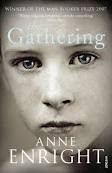
The Gathering by Anne Enright, 2007

Read in the Vintage 2008 edition shown

The decision of the 2007 Booker prize judges to give this book the nod over On Chesil Beach must rank as one of the all-time puzzling decisions of a prize panel. Because this was lame. The novel’s central premise is very traditional – a family member has committed suicide, and the clan gathers to mourn their loss and review his life. This is shown us by Veronica Hegarty, the book’s narrator, sister of the suicide, Liam. We are told early on that Liam’s death can be traced back to an event in his childhood. The traditional dark secret revolves around her grandmother, Ada – I was irresistibly reminded of another Ada, great-aunt Ada Doom, who saw something nasty in the woodshed, and has never been the same since.

The reveal – that Liam was sexually assaulted by a friend of the grandmother. (he was staying with his grandmother as his mother went through yet another pregnancy) is underwhelming. The line between this assualt and his eventual suicide decades later is never drawn – in fact Liam is a very lightly sketched character, and we understand little about his life and why he took it. The disclosure of this incident from the past is not the turning point we are led to expect – it is not revealed to the wider family, and nothing comes from it.

Stylistically the prose is wooden and at times comically so. When the narrator has sex with her husband she describes lying there “quartered like a chicken”. The narrator says of the young undertaker “You could unpeel him and he would still be true” (75) which is not just a whacky metaphor but gibberish isn’t it? Whether this disjointed narrative is supposed to reflect the distressed psyche of the narrator is besides the point – it is still clumsyily written.
The central character is unsympathetic and the fact that her mother often is unable remember is unsurprising.
Novels where nothing happens, and the events just consist of unstructured memory – and the point that Veronica’s memory is flawed, and is constantly being reconstructed is laboured to death here – flowing back and forth across the events of the past – are getting tired. I am really crying out for a novel where something happens and the characters are believable and interesting. Not much to ask for is it?

P.S. As with The Accidental, negative reviews on Amazon outweigh the positive – and I genuinely don’t believe this is just Booker bashing.

Standard
21st century literature, Booker Prizewinner

The Inheritance of Loss – Kiran Desai

Read in a 2007 Penguin edition.
Kiran Desai’s novel is in many ways a very traditional exploration of modern India, but a dramatic contrast to White Tiger. The book is set in the 1980s in the shadows of the Himalayas, and follows the affairs of a small prosperous household – a retired judge, his cook, and his teenage granddaughter.
This is not a plot-driven book. From the time of the opening chapters to the novel’s conclusion only a small amount of time has passed, and there has been little incident. Most of the narrative is devoted to following the characters’ back stories – how the judge went to university in England, how his granddaughter’s parents died in Russia, and so on. Most of this is extraordinarily predictable – everything plays out just as we expect, with little happening and minor dramas being created out of minor events such as the loss of a dog. The more dramatic events of the time are shown but appear largely incidental. In any event the time structure of the narrative has already shown us that no-one central to the story will be affected.
Although the setting allows for some exploration of the politics of northern India, and in particular the struggle for independence of the Gurkhas, this largely feels like window dressing for the centre of the novel, the lives of the main characters and the cast of eccentrics that circles them. The book really only comes to life when it jumps across to follow the cook’s son struggling to make a life for himself in New York.  I wasn’t surprised to subsequently read that this is the author’s current home.
This has all been done before, and better, most obviously by Rushdie. The contrast with White Tiger though is interesting. Here the portrayal of India remains convincingly honest; the police are corrupt, there is crushing poverty, which robs people of their dignity, tourists are crass and insensitive – but at the same time the country has its beauty and the people have their charm, even when you have to struggle to find it. The book is well written, and the descriptive prose is very well done. For me this was not enough, and while this novel was head and shoulders above White Tiger, it nevertheless disappointed. Incidentally I found the title pompous and patronising – yes everyone has experienced loss of some kind of another, and it has had an affect on their situation and personality, and yes there is an obvious read across to India itself, but the same could be said of just about anyone and any country.
Standard
21st century literature, Booker Prizewinner

The White Tiger – Aravind Adiga

The White Tiger won the 2008 Booker Prize.

This first novel is written in the form of a letter to the Premier of China as an introduction to modern India. The author is not a fan – of modern India, that is, not China. India is a rich source of material for contemporary novelists, (for example, the Inheritance of Loss) and seems to be favoured by Booker judges. The novel charts the life of the narrator as a chauffeur to a prosperous family, and portrays the country as sordid, brutal, and above all bitterly corrupt.

If written by a Western author this account could be easily have been seen as racist. The author’s closeness to the country he describes probably deflects that criticism. Nevertheless there are virtually no redeeming features of the country – the bravery of people who fought for India’s independence is mocked, the beauty of the countryside goes unmentioned, and no-one acts through anything other than cowardice or self interest. The Indian Tourist Board will not be recommending this book in a hurry! It is an indictment of the country India has become in the years since independence, and is horribly unbalanced compared to say Slumdog Millionaire, which shines a light on the underbelly of India but equally shows the beauty of the country and its people.

The plot is very simple. The narrator murders his boss, and runs away with his money, showing a small amount of compassion by taking his nephew with him, despite knowing that the rest of his family is almost certain to be slaughtered in retaliation. Using the stolen money he bribes his way into a position of influence, and gloats over those he has left behind. We are told this fairly on in the book, so I am not including any spoilers. Years later he records his crimes in letters to the Chinese Premier, a plot device that makes little sense incidentally. The central character is deeply unpleasant; as well as being an unrepentant murderer, he is also bigoted towards gays, black people, and women. of course I am not suggesting the author shares these views, but they are presented without adequate challenge. Just because bad views are expressed by a bad person doesn’t make them any more palatable.

By coincidence I am also reading “Crime and Punishment” at the moment, and although the comparison is probably unfair, Dostoyevsky does something Adiga does not (or cannot), which is given us an insight into the mind of a killer. While the portrait of Raskolnikov shows us the internal struggles a killer goes through, in White Tiger the killing is shown as a simple commercial transaction, with little or no horror, nor psychological consequences – extraordinarily I have even seen one reviewer describe the murder as “brave”. Killing someone in cold blood and leaving your family and friends to live or die with the consequences isn’t brave. It’s not even as if the main character was living an impoverished life on the streets – he was doing fairly well as a chauffeur. I appreciate the author isn’t saying “Life in India is so bad murder becomes acceptable” – what he is surely is presenting us with is a world where morality has disappeared, so much so that a murderer sees little wrong with their crime, because they see similar acts of immorality being rewarded all around them. This is “Crime” with no “Punishment”.

All in all a strange Booker choice, subverting many of our expectations about what novels about modern India should be, but with very few redeeming features.

Standard