
Capital, by John Lanchester, 2012
I’ve written quite a bit in the past about different categories of novel – most recently Newgate novels for example, nineteenth century stories about prisoners awaiting trial in Newgate. or the earlier Silver Fork novels about rich Regency people doing rich Regency people things. The problem is – where do you stop? Where do you stop creating ever finer more detailed sub-categories of novel? This problem occurred to me when reading John Lanchester’s 2023 novel Capital.
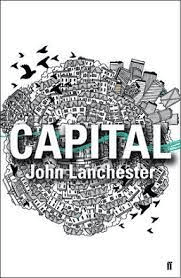
As well as obviously being about London and its inhabitants, Capital is more specifically a credit crunch novel, a literary response to the financial crash of 2008. It was published in 2012 which makes it a a relatively early response to the crash, when the full impacts of austerity had yet to be played out. In Capital people are still manically developing their houses with basements and loft extensions, even if the early seeds of doubt about the wisdom of this reckless spending are being sown; later post-Brexit crash novels (or are they a separate category?) see that this reckless spending is not without consequence. The worst that happens to a banker made redundant part way through Capital is that he has to sack his nanny and retire to the country with his money, confident that he will bounce back. Where am I going with this point? I suppose I am arguing that instead of simply being an ambitious survey of life in modern-day London, Capital is a more immediate response to political and economic circumstances that might not have the durability and longevity the author was obviously aiming for. It’s also a novel that addresses that very specific problem of gentrification, without having much to say about the issue other than vaguely suggesting it is not a good thing.
Capital follows the inhabitants of a south London street, Pepys Road, over the course of a year. The choice of name is obviously not coincidental – Pepys was a great chronicler of London-life, and it seems Lanchester aspires to do the same. Pepys Road is undergoing dramatic changes as London society responds to a influx of new residents from around the globe. As we are introduced to a series of immigrants – a Polish builder, a Hungarian nanny, a Senegalese footballer and a Zimbabwean traffic warden – one wonders whether these are much more than stereotypes? Their stories are juxtaposed with those of earlier residents, now undergoing their own diaspora as they are forced out of Pepys Road.
“Having a house in Pepys Road was like being in a casino in which you were guaranteed to be a winner. If you already lived there, you were rich. If you wanted to move there, you had to be rich. It was the first time in history this had ever been true”.
Another of the multiple threads of the novel follows stockbroker Roger Yount. Roger and family live a life of excess fuelled by the multi-million salaries and bonuses common in the City pre-Crash. Roger is an entitled and slightly thick public-school boy relying on nepotism to get along in a business he admits he does not really understand. His wife Arabella is a bit of a monster, spending her days shopping for designer nonsense and having long boozy lunches with girlfriends while her children are cared for by a series of nannies. We care little for Roger and Arabella, equally stereotypes in their own way, and celebrate their downfall as Roger first gets a disappointing five figure bonus, and is then sacked and has to rethink his life
Most of the storylines peter out – they have endings of sorts but I was insufficiently engaged with the characters to worry overly if they go on to live long and happy lives. Ends are tied up but with a conspicuous sense of ends being tied up so that the novel could finish rather than narratives being successfully concluded. A good example of this is the young African footballer who comes to the UK to play, suffers as career-ending injury, and goes back home with riches beyond imagination and still able to play football locally – a happy ending of sorts but hard to see where it fits in the overall narrative, other than being just another story of the residents of Pepys Road.
At over 600 pages this was harder work than it ought to have been. The years immediately after the Crash in which this novel is set seem a lifetime ago. If I had read Capital when it was first published it would have had an immediacy that it now lacks given how much has happened since then – it’s almost enough to make me nostalgic for 2012!
 The Reading Bug