Antony Beevor, Berlin, Book review, History, Second World War

Berlin by Antony Beevor, 2002

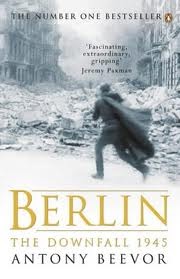
Berlin – The Downfall 1945 Antony Beevor, Penguin, 2002


You might get the impression from some of my recent posts that all I do is read German history, but it is fair to say that these entries are not entirely representative of my reading habits. Before I get to the book itself, a little gripe – this book’s cover includes the strap line “The Number One Bestseller”. It is amazing how often that line is used – I think it is largely devalued now. No doubt if challenged the publisher could justify it by selecting a very limited period of time, or category, or location. Number one in the non-fiction category on December 11th 2004 in Latvia doesn’t really count.


I am being overly cynical however, because this book is a highly authoritative account of the fall of Berlin. As you might expect, the horror is unrelenting, and while I now know more about this terrible period of history than I could possibly want, I confess the detail has not stuck – there is a long parade of generals with similar sounding names, battles across unknown terrain, without any clear overall picture of the progress of the war – there is simply too much detail for the non-academic reader.
What has stayed with me (as I usually find) are the images. History says that the fall of the Third Reich was a long but inevitable process. Where you start the beginning of the end from is a matter of choice – the Battle of Britain, Pearl Harbour (my choice, because after the USA joined the war there was really only one way it was going to end) D-Day or the end of the Battle of the Bulge, it all pointed to defeat for Germany at the end of the war. A negotiated peace was theoretically possible but the Nazis would never have let it happen. So the crushing of Berlin, principally by the Russians, was always going to be brutal. Despite this, it seems many Berliners tried to continue normal life right up to the end , rather than getting the hell out of there. They did not see the end as inevitable. The ability to deceive oneself despite all the appalling evidence to the contrary is quite chilling. Of course there were also many Berliners who could see what was coming but could do nothing about it.
 
When it was published I remember the book being controversial because of its focus on the systematic rape of German girls and women by the Red Army. While these accounts are hard to stomach, the context justifies their inclusion, and Beevor makes it clear that he is not taking sides or using this abuse as a justification for anti-Soviet propaganda, a pretty pointless exercise in any event. German atrocities are not the focus of this book but are referenced as part explanation for the brutalities of the Red Army.
 

This is “popular” history, that is history for the mass market, with half an eye on a TV series, but few concessions have been made to accessibility. It’s not an easy read, for many reasons, and even students of the period could probably find better, more digestible accounts. It is also one of those history texts that provide little in the way of food for thought. Compared to say When Money Dies, which can provide much to think about in the context of today’s society, all this book tells us is that when wars come to a bloody end there is an incalculable price to pay, which I think we knew.
Standard
History

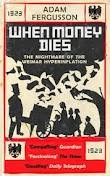
When Money Dies – Adam Fergusson

When Money Dies – the Nightmare of the Weimar Hyper-inflation
(First published in the 1970’s, although I read the 2010 version pictured here.)
First off, what a great title for a book. But the obvious question I need to address in the first instance is once again, “Why?” Although I studied Economics at A level in the (early) 1980’s my interest in the topic, faint though it was even at the time, has not been maintained.  I could pretend that I found the debate around how to control inflation in the face of spiralling public expenditure and falling revenue a particularly pertinent one given the financial times we find ourselves in in 2012. And I suppose that would be true, although with hindsight the behaviour of the German political establishment seems baffling – if we just print enough money it – all our economic woes – will all go away.  George Osborne doesn’t strike me as much of a reader, but he would love this book with its messages of controlling expenditure, maximising revenue, sacking lots of unnecessary public sector workers, etc.  However the parallels between Weimar Germany and 21st century UK can be overplayed – we aren’t being occupied by the French army for instance.
I could also argue that the rise of Hitler is inextricably linked with the series of crises in the German economy, and that would be closer to the truth, because in reality I read this book because I wanted to stay one step of my sons who was studying the rise of the Nazis in GCSE History. But as he will never read this far my secret is safe!
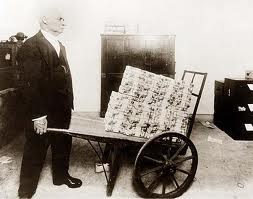
Incidentally, the QI theory of history – that everything we were ever taught in school is wrong – doesn’t really apply here. People really did have money worth less than the paper it was printed on, although whether the wheelbarrow stories are true is another matter. What I found interesting was how Germans managed to survive this period – for example rural Germans were much less affected than those in the cities, having access to their own food sources.
I can’t hand on heart recommend this (unless you are Danny Alexander or Ed Balls I suppose) because there are histories of the Weimar that tell the story with more “economy” (see what I did there?) and more context. I’ll write about one of these, by Richard J Evans, when I finally finish it!
(PS After I wrote this I saw this book recommended by an economist writing in the weekend newspapers!)
Standard
History

The Greatest Day in History – Nicholas Best

The Greatest Day in History – the 11th Hour of the 11th day of the 11th Month – How the Great War Really Ended by Nicholas Best (Phoenix 2008)
I am probably being pedantic here, but I see a bit of a contradiction between this book’s title and its sub-title: either the book is about the 11th November 1918 – the day – or the 11th hour of that day, or about how the war really ended, which is infinitely more complex than just the analysis of one hour or day.
Pedantry aside, what the author has done here is actually very interesting – he has gathered together a series or memoirs and recollection of the end of the First World War, and woven them together. Sensibly he hasn’t been dogmatic about the time span, and where the narrative requires it he has gone outside the 24 hour constraints.
The book is a curious mixture of these memoirs with some genuine historical analysis, charting hour by hour how the Germans came to sign the Armistice. Armistice not of course surrender, a detail which matter significantly for the later course of European history. The Nazi version of events, whereby the undefeated German army was betrayed by the politicians, is comprehensively demolished through this detail. The last hours of the Kaiser before the abdication is also minutely described. Other scenes are more impressionistic – what various famous or to be famous people were doing at the time of the Armistice.
Many scenes from this book stayed with me, including the account of how, when the news that an armistice and ceasefire was imminent, some troops rushed to the front so they could claim they had “seen action”, not wanting to miss the last chance to have a go at the “Boche”. Some men died minutes before 11, and of course some fighting went on after 11.
I was a little surprised that this approach worked – that a deep dive into one day could tell so much about broader European historical themes such as the end of the second Reich and the Austro-Hungarian empire, instead of a traditional, broad narrative sweep across the years. The use of so much raw material, especially the diaries and letters, gives the account an immediacy and urgency – you can share the elation, the relief, and the bitterness as the war ends.
For anyone who wants to read about the Great War but doesn’t want to lose the personal stories of those involved, this is highly recommended.
Standard