
The New York Times called Barbara Kingsolver’s Demon Copperhead ‘a close retelling of Charles Dickens’s “David Copperfield,”’, concluding that this was ‘either a baffling choice or an ingenious manoeuvre’. That’s the question I am struggling with: why use Charles Dickens’s David Copperfield as the outline structure for your novel? Was this in some undefined way a form of ‘cheating’, a tribute to Dickens, or simply a case of an author using the well-established technique of borrowing a structure to provided an outline for the events of the novel?
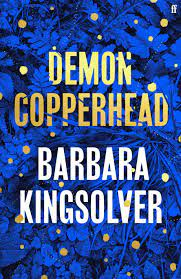
First I need to overcome the vague sense of unease that using someone else’s plot outline is against the ‘rules’ of novel writing. Of course there are no such rules, and while plagiarism is something else entirely, this is nowhere near that level of imitation. Authors have used the plots from other authors from the year dot – Shakespeare’s plots are virtually all borrowed from earlier (or even contemporaneous) texts, and the practice continues to the present day, Ian McEwan’s Nutshell being a very successful adaptation of Hamlet for example. But while borrowing someone’s plot structure and characters may not be against any rules, the author still needs to have a reason for doing this, some original approach that respects the source text but does something new with it – if not that that’s still just copying! There’s a further complication here in that Copperfield is a very personal novel in which Dickens drew upon elements of his own personal life story. David is Charles in some respects, in the way Demon certainly is not Barbara! So does Demon Copperhead does something new with the material of David Copperfield while respecting the original text? I think it does, although I have some reservations, which I will come to.
“You know, sometimes you hear about these miracles, where a car gets completely mangled in a wreck. But then the driver walks out of it alive? I’m saying you are that driver.”
Kingsolver’s hero and endearingly honest narrator is Damon Fields, known as Demon and nicknamed Copperhead for his red hair. Demon is the living definition of trailer-trash, born to a drug-using teenage single mother in Virginia. Lee County is in the heart of the Appalachians, a community of largely white folk who are the butt of all American jokes about rednecks and hillbillies. Wikipedia says this of the stereotyping of Appalachian people:
“Appalachian individuals are perceived largely to be impoverished, white, rural, lazy, and rough around the edges. Appalachians are also stereotyped to be hillbillies. NPR describes the stereotypical portrayal of Appalachians as “children in sepia-toned clothes with dirt-smeared faces. Weathered, sunken-eyed women on trailer steps chain-smoking Camels. Teenagers clad in Carhartt and Mossy Oak loitering outside long-shuttered businesses.” Other common Appalachian stereotypes include inbreeding, poor dental hygiene, and wearing no shoes.”
Kingsolver clearly finds this stereotype offensive and empathises with Demon and his community, but she does little to challenge the oversimplified portrait – the novel is full of people who fit this description! Not everyone is an ill-educated redneck, of course, but there are more than enough. Demon is from a sub-category of this community – he identifies as a Melungeon, a dark-skinned ethnic group specific to this region and descended from Europeans, Native Americans, and sub-Saharan Africans originally brought to America as indentured servants and slaves. His life is blighted by poverty and discrimination. His early childhood follows the template of the source novel quite closely: an ineffectual mother, a long-dead father and a violent stepfather. When his mother dies of an overdose, he is taken into the ‘care’ of the authorities who do an appalling job of looking after him, putting him into foster homes where he suffers neglect and abuse in equal measure. Finally he tracks down his grandmother who helps him find a home with Coach Winfield and his daughter Agnes. He becomes a successful American football player until he suffers a career ending injury. This injury is the catalyst for the next phase in Demon’s life as he struggles with a crippling opioid addiction. Almost all his peers succumb to the same addiction and several of their lives are destroyed by this new plague. Kingsolver writes powerfully about the impact of this drug and the responsibility of the pharmaceutical companies for engineering the crisis, seeing the issue from the perspective of those involved and affected rather than sitting in judgment from outside the issue:
“What’s an oxy, I’d asked. That November it was still a shiny new thing. OxyContin, God’s gift for the laid-off deep-hole man with his back and neck bones grinding like bags of gravel. For the bent-over lady pulling double shifts at Dollar General with her shot knees and ADHD grandkids to raise by herself. For every football player with some of this or that torn up, and the whole world riding on his getting back in the game. This was our deliverance. The tree was shaken and yes, we did eat of the apple.“
In most of his novels Dickens championed ideas of social justice. He led specific campaigns against child labour, baby farming, money lending and the various other ills that blighted Victorian England. Kingsolver uses the same basic narrative and setting of the source text to address more recent social issues in the United States – the appallingly underfunded social care system, the failing education system, racism and of course the opioid epidemic. In this respect the ‘borrowed’ narrative is effective, although it could be argued that a novel about these issues and in this place and time didn’t really needed the overlay of a Dickensian narrative.
I mentioned earlier I had some reservations about the author’s reimagining of the source material. One issue is in the portrait of the modern-day Micawbers, Kingsolver’s McCobbs family. Micawber may be a weak and ineffectual man, but he is also kind-hearted. The McCobbs on the other hand are just plain unpleasant. Steerforth is a much more nuanced character than his Kingsolver equivalent, the sporting bully Fast Forward. There’s a wider issue with the Dickensian origins of the novel – sometimes it becomes a distraction. I found myself trying to recognise scenes, characters and parallels with the source material rather than focussing on the novel itself. This isn’t a big issue – because I don’t know Copperfield that well I was able to just read Copperhead on its own terms, as an American novel about an orphan who struggles to find a safe home in the world.
I am still not sure the Copperfield parallels were entirely necessary. With or without them this is a powerful story about an American underclass that so far as I know has not previously had a champion. The novel ends on a positive note for Demon and his relationship with Agnes, which suggests the author is also positive for the rednecks, hillbillies and trailer trash she vividly humanises, rescuing them from the ignominy of being the butt of the endless incest and poor dental hygiene jokes.
”
 The Reading Bug