Book review

The Amazing Maurice and his Educated Rodents (Discworld 28) by Sir Terry Pratchett, 2001

My lock-down guilty pleasures Discworld series reread continues with another novel I have not read before.

Let me explain. I discussed at length in my previous post the fact that The Last Hero and Maurice were not originally considered part of the Discworld series of novels. The change, from them being Discworld stories to becoming part of the series happened around 2009 or thereabouts. The Amazing Maurice has even weaker claims to be part of the series than Hero – apart from the setting (Uberwald, although it really could be anywhere vaguely middle-European), a mention of the Unseen University, and a brief appearance by Death and the Death of Rats, this is very much a stand-alone novel. So although I religiously bought each Discworld novel as they were published, from as early as The Colour of Magic, I missed some of the Discworld stories, including, obviously, this one.

The Amazing Maurice is marketed as a children’s or younger reader’s novel. I don’t want to argue with that because what makes a children’s novel is a matter of authorial and publisher’s judgment that I am not in a position to question, But there are dark elements to the story that I will come back to later which could easily upset a younger audience.

The Amazing Maurice is a cat who has acquired the ability to talk. He did this by eating a rat who had the same ability, having lived on a rubbish dump outside the Unseen University, where lots of background magic had accumulated. Maurice works with a troupe of talking rats with the same powers, and their human, Keith, a piper. They travel around from town to town embezzling communities by a minor variation on the Pied Piper scam – the rats make a nuisance of themselves, and then for a modest fee Keith pipes them out of town. We join them as they arrive at a town in Uberwald called Bad Blintz. This, they promise themselves, is going to be their last heist before retirement, the set up line for so many unsuccessful adventures (and bad movies). Maurice is the brains of the operation, keeping the fairly gormless Keith out of trouble as best he can.

Bad Blintz turns out to be a troubled place. Rats have already impoverished the town, and while food continues to disappear there don’t seem to be many surviving rats left. Keith meets the mayor’s daughter Malicia who is obsessed with story-telling, and has a thin grasp on the difference between reality and fiction. For example, when she is searching the town’s rat-catchers’ hut for clues she keeps leaning casually on walls hoping false walls will open. The fact that they do find a hidden trapdoor, leading to a network of cellars full of stolen food and caged rats, naturally encourages this fantasy. Malicia learns about Maurice and the rats ability to talk but is unfazed by it – it’s the sort of things that happens in stories.

At the heart of the novel is the quest to work out what is happening in Bad Blintz – where all the food is going, and what has happened to the rats? In the course of that quest we are introduced to many of the rats in the ‘clan’ – their aging leader Hamnpork, Dangerous Beans a spiritual rat, his assistant Peaches, and Darktan, the trap expert, to name a few. In the nightmarish cellars of the town they meet and confront the sinister Rat King, Spider, who is able to control rats, cats and even humans with the powers of his mind.

Some of the scenes with the rats, caged and cannibalistic, are vivid and scary, and I can only imagine how a pre-teen reader would react to them. There are also some character deaths, not all of which are temporary, and while the happy-ever-after ending is well constructed and satisfactory, the scares and genuine sense of threat along the way contribute to that sense of darkness I mentioned earlier. Pratchett has learned from Roald Dahl and others that stories for children can be nasty.

Pratchett was a wonderfully thoughtful writer, always with something interesting and original to say about the big issues of life, so I should not have been surprised to read such insight and compassion in a children’s story about talking rats. Along with the ability to speak the rats (and Maurice) have developed consciousness, and dare I say it souls. They develop concepts such as the self, an awareness of evil, and debate moral issues such as whether to eat non-talking rats, and what happens to them after they die. The rats are not overly anthropomorphised, certainly not sentimentally. They still widdle on everything, can’t wear clothes because they get in the way, and take their names from the sides of tin cans. In case we miss the point the contrast is emphasised by the snippets from a children’s story which the rats carry around in a manner akin to a holy book. This gave Maurice and the rats a depth of character that you just don’t expect in a story about talking animals, and for a brief moment my lifelong aversion to rats was abated.

Storytelling is an important theme in the novel. Malicia think life is just a story, the kind in which there is always a happy ending. Speaking of endings, I think Maurice has one of the most satisfying and effective endings in the series. The rats work out a purpose in life, which isn’t to run away and live on an island, but to use the power of narrative force to shape their destinies;

“If you don’t turn your life into a story, you just become a part of someone else’s story.”
“And what if your story doesn’t work?”
“You keep changing it until you find one that does.”

The Amazing Maurice and his Educated Rodents

Maurice is an important link in the Discworld chain because it kept the franchise alive and fresh, introducing a whole new group of readers to Discworld, who would of course go on to read the ‘main’ series. It was awarded the Carnegie Prize in 2002. This was Pratchett’s first major award, and in acceptance he gave this wonderful quote reflecting on his ambivalent about the fantasy genre:

Stick in one lousy dragon and they call you a fantasy writer’

Standard
Book review

The Last Hero (Discworld 27), by Sir Terry Pratchett, 2001

I haven’t yet worked out why this matters to me, but for some reason it does. If you look up a list of Discworld novels on the internet today it will tell you there are 41, starting with The Colour of Magic and ending with The Shepherd’s Crown. There are many other Discworld books, from guides to the streets of Ankh-Morpork to Nanny Ogg’s recipe book.

The-last-hero.jpg

But it was not always thus. The list of Discworld novels used to run Thief of Time (26); Night Watch (27 – now 29), omitting The Last Hero (now 27) and The Amazing Maurice and his Educated Rodents (now 28), both of which at the time were firmly non-canonical “other” Discworld stories. By ‘the list of Discworld novels’ I am mainly referring to the list as published in each new instalment of the series. I have a first edition of Night Watch for example, which shows this order, and categorised The Amazing Maurice as a Discworld story. I can perfectly understand why, for marketing purposes, Pratchett’s publisher would want to differentiate the novels written for younger readers – essentially the Tiffany Aching books – although I am not convinced that the differences between the younger reader novels and the mainstream Discworld novels are all that significant. Over time this distinction might fade, and they will just be considered part of the golden thread of the series. The Sir Terry website maintained by his publishers lists the Tiffany Aching books both in the main series of novels and in the younger reader section (along with the carpet People, Truckers, Dodger etc) in classic having their cake and eat it fashion.

The only real difference between the Last Hero and (say) Thief of Time i.e. a conventional Discworld novel is that The Last Hero is illustrated. It’s not a comic book – there are no speech bubbles – but there are illustrations on every page, and it was always conceived as such. It could be published without the illustrations as a Discworld novella, but that would be ripping the heart out of the novel (or whatever it is) because the illustrations, by Paul Kidby add significantly to the text. Kidby was at this point (2001) just taking over as the principal Discworld illustrator from Josh Kirby who was to die the year The Last Hero was published.

The plot is a very conventional Discworld adventure. Cohen the Barbarian sets off with his Silver Horde to return fire to the home of the Gods, Cori Celesti. A message is received by Lord Vetenari, Patrician of Ankh-Morpork, warning him that if their quest succeeds, the world will end. He assembles an unlikely team to stop them –  Leonard of Quirm, Captain Carrot, and the world’s worst wizard, the irrepressible Rincewind, backed up by the wizards of the Unseen University. They travel into space and round/under the world in a contraption invented by Leonard, in scenes that combine multiple references to the Apollo missions with echoes of Jules Verne and Dan Dare thrown in, arriving just in time to save the day, inevitably. It’s great fun, and a wonderfully fresh addition to the series. I thought I had read all the Discworld novels already, but because of the issues I mentioned in the opening of this post (at far too great a length!) I had missed this one. It was a wonderful to discover another chapter in the Discworld story.

Standard
Book review

The Thief of Time (Discworld 26) by Terry Pratchett, 2001

In Thief of Time Terry Pratchett gives his by now bulging bag of Discworld characters, settings and scenarios a good shake, and comes up with an entertaining story about the end of the world. There are some distinct echoes of Good Omens along the way, but that’s not necessarily a bad thing.

The Auditors of Reality, who as we know from Hogfather want to end the world, finding humanity unnecessarily messy, are back. The Auditors had the potential to be fairly sinister, dementor-like figures, in their floaty grey hooded-cowls, but their susceptibility to explode when tasting chocolate is a bit of a weakness. They don’t seem to have learnt much from their previous encounter with Death and his grand-daughter, Susan Sto-Helit, who set out to stop their latest attempt. The Auditors’ dastardly plan this time is to hire a clockmaker Jeremy Clockson (yes, this is the standard of the jokes. If you don’t like them then don’t read the book, it’s quite simple really) to build a perfect glass clock. There is at this point what David Tennant’s incarnation of Dr Who called some “timey-wimey” stuff. We are asked to accept that a clock that can measure time perfectly will stop the universe. There are quite lengthy attempts to explain why this might be the case, and these have a sufficient veneer of plausibility to hold the rest of the plot together.

Another reappearing character is sweeper Lu-Tze of the History Monks. Lu-Tze first appeared in Small Gods but here the character is expanded significantly, as is the role and history of the History Monks themselves. Lu-Tze is the only known master of “déjà fu” a martial art in which the hands move in time as well as space. This leaves one’s opponent with ‘the feeling you’ve been kicked in the head this way before‘. Lu-Tze usually relies on the principle that no-one notices a sweeper, which allows him to go anywhere in the monastery, together with ‘Rule One’. Rule One states “Do not act incautiously when confronting little bald wrinkly smiling men”.

Pratchett spotted that as Westerners often draw inspiration from spiritual figures from the East, so seekers of enlightenment from the East may well look for insights into philosophy from the West. The Discworld version of this concept is Lu-Tze’s following of ‘The Way of Mrs. Cosmopilite’, drawn from the everyday sayings of Mrs Marietta Cosmopilite, his landlady when he lodged in Ankh-Morpork. For is it not written that ‘a penny saved is a penny earned’, ‘do you think I’m made of money’, ‘don’t make me come in there’, and ‘because’ and other pearls of wisdom.

To help him track down the doomsday clock, Lu-Tze takes a bright young apprentice, Lobsang Ludd. Lobsang is a relatively new recruit to the History Monks, having previously been raised by the Ankh-Morpork Thieves’ Guild. Lu-Tze quickly learns that Lobsang is (of course) no ordinary apprentice, having powers to manipulate time way ahead of anyone of comparable experience or age. Lu-Tze and Lobsang set out to find the maker of the glass clock, and in part to make repairs for the last time such a clock was made, which caused huge problems with the history of Discworld before breaking. Motifs from road-trip and master and apprentice stories are used as well as a slightly out of place reference to James Bond – they are equipped with special devices by a quartermaster called Qu!

Susan is against her better judgment called in to help Death. This involves her leaving her day job as a teacher (the scenes of Susan teaching her class Geography by magically transporting them to the country concerned are wonderful). She questions Nanny Ogg, given a guest appearance as the world’s best midwife, who eventually reveals she once helped Time herself have twins. As two young men in the novel, Lobsang and Jeremy, have already demonstrated a special relationship with Time, joining the dots by this point isn’t too difficult.

Thief of Time is also a Death novel. As well as commissioning Susan’s help, Death organises a reunion of the Four Horsemen of the Apocalypse, who are joined by the Fifth Horseman, Ronnie Soak, a personification of Chaos and now living in quiet retirement as the world’s most efficient milkman.

This is perhaps not Pratchett at his peak, but not far off. The jokes are, as always, wonderfully terrible, and the pop-culture references come thick and fast. The plot hangs together – just – and while there is little suspense we keep reading because we want to know how it is all resolved. There is even just a hint of romance for Susan, which is nice.

Standard
Book review

The Fifth Elephant (Discworld 24), by Terry Pratchett, 1999

My lock down indulgence reread of the Discworld series continues with another novel featuring the great moral philosopher Duke, Commander and Blackboard Monitor Sam Vimes.

One aspect of Pratchett’s work which is under-appreciated in my opinion is his ability to craft detective stories. Because The Fifth Elephant is, among several other things, detective fiction. The Stone of Scone, an ancient dwarven artefact, is stolen from the Ankh-Morpork Dwarf Bread Museum. Which is suspicious, because the original Scone of Stone, under close guard far away in a mine in Uberwald, is central to the forthcoming coronation of new  Low King of the Dwarves. To further complicate matters the Patrician, Lord Vetenari, has decided to send Sam Vimes as his ambassador to the coronation, suggesting that while there he may wish to negotiate with the Low King on a trade agreement with Ankh-Morpork. Uberwald is rich in underground fat deposits, as a result of the untimely arrival of the titular fifth elephant of legend. Or as Sam puts it:

“Let me see if I’ve got this right,’ …. ‘Überwald is like this big suet pudding that everyone’s suddenly noticed, and now with this coronation as an excuse we’ve all got to rush there with knife, fork and spoon to shovel as much on our plates as possible?’

Überwald, the setting in part of the previous novel in the series (Carpe Jugulum), is a complex kingdom home to dwarves, werewolves, vampires and trolls. Vimes wanders into this maelstrom of political in-fighting rather unprepared. Pratchett tiptoes close to commenting on radical Islamism here – a traditionalist faction of dwarves insists on remaining below ground, and refuse to acknowledge the existence of female dwarves. This faction has allied with the werewolves to undermine the new Low King and secure a more radical successor. Vimes is framed for an attempt on the Low King’s life, and with his bodyguard missing and the clacks down (this is the first explanation of the arrival of the clacks, the telegraph system that is the basis of Going Postal (Discworld 33)) things are not looking good for him.

Back in Ankh-Morpork things are also Going Postal. Captain Carrot has resigned to look for his – well, I suppose the right term is girlfriend, but that really doesn’t cover the complexity of the relationship – Corporal Angua. Angua is a werewolf, and daughter of the ruling werewolves back in Uberwald. This leaves Sergeant Fred Colon as acting captain, which doesn’t work out well.

The usual things that make Pratchett’s novels a continuing joy are all to be found here. There’s the clever references that are so easy to miss. One I patted myself on the back for spotting was when Vimes is considering how clumsy and uneducated he feels in the company of Ankh-Morpork aristocracy “What chance had he got against a tie and a crest“, which is a line from the classic punk anthem Eton Rifles by The Jam. Later the werewolf philosophy of “Uberwald for the werewolves” is characterised as “joy through strength”, an inversion of the Nazi slogan, telling us all we need to know about the werewolves. There’s also plenty of the Vimes philosophy we have come to expect and treasure. It’s really hard to pick a favourite quote from a novel as stuffed-full with them as this is, but try:

“All he knew was that you couldn’t hope to try for the big stuff, like world peace and happiness, but you might just about be able to achieve some tiny deed that’d make the world, in a small way, a better place. Like shooting someone.”

I think this is the first novel where we really get to see Vimes and Lady Sybil as a married couple. The maturity of their relationship, full of compromises and kindness, is worth reading the book for alone:

“Sam Vimes could parallel process. Most husbands can. They learn to follow their own line of thought while at the same time listening to what their wives say. And the listening is important, because at any time they could be challenged and must be ready to quote the last sentence in full. A vital additional skill is being able to scan the dialogue for telltale phrases, such as “and they can deliver it tomorrow” or “so I’ve invited them for dinner” or “they can do it in blue, really quite cheaply

This is a great addition to the Watch series which sees a few more squares of the complex jigsaw that is Discworld pieced together, and introduces some new themes such as the coming of the clacks. Looking forward to The Truth (DW 25) already.

Standard
Book review

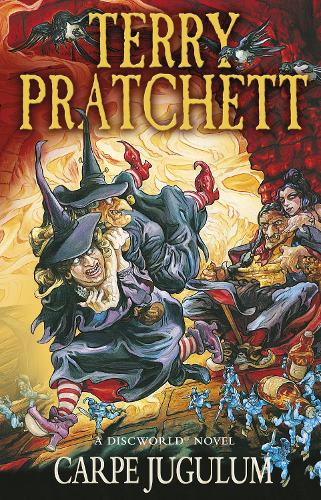
Carpe Jugulum (Discworld 23) by Terry Pratchett, 1998

We have, it has to be admitted, been here before. Lancre, to be specific, the mountain home of Terry Pratchett’s wonderful witches, the awesome Granny Weatherwax, Nanny Ogg, Magrat Garlick, and Agnes Nitt. (And yes, that’s four witches, which is one too many, and a bit of a problem). Magrat, recently married to King Verence, has had a daughter, and people from far and wide have been invited to the christening. Unfortunately for all concerned, in an attempt to be progressive Verence has invited guests from Uberwald, a neighbouring kingdom inhabited by vampires. The vampires, once invited into the castle, begin to take over and snack on the locals. The witches are not standing for this of course, and battle begins.

Carpe Jugulum - Discworld Novels (Paperback)

If you have been paying attention, and why would you, bells will start ringing at this point. Isn’t this pretty much exactly the plot of Lords and Ladies (Discworld 14) published some six years earlier? Superficially charming but sinister and other-worldly villains are accidentally invited into Lancre, take over, and battle with the witches? Pretty much.

The good news is that all this doesn’t matter in the slightest. Shakespeare recycled plots freely and unapologetically, so why couldn’t Sir Terry? Any time spent with the profound moral philosopher that is Granny Weatherwax, Pratchett’s finest creation, is time well spent, even if we have been here before. And this is a very brave book – not many fantasy writers would go to the dark places that Granny visits when she is called out to a difficult home birth, and is faced with the choice of saving the mother’s life or the child’s. When Mrs Patternoster, the local midwife, suggests the choice of who to save should have been offered to the husband/father, Granny replies:

You don’t like him? You think he’s a bad man? ,,,Then what’s he done to me, that I should hurt him so?”

Granny takes the pain of the decision, both literally and psychologically, on her own shoulders, so that others might not have to. This is such a shockingly brave and moving scene, showing how hard and sometimes lonely the lives of the witches are.

Another fresh feature to this story is the character of Mightily Oats. or more specifically the Quite Reverend Mightily-Praiseworthy-Are-Ye-Who-Exalteth-Om Oats, an Omnian missionary priest called in to officiate at Magrat and Verence’s daughter’s naming ceremony in the absence of the local priest who has been injured in a fall from a donkey. Oats is one of the ordinary-man characters Pratchett writes so well. He is devout in his faith in Om, but questions some of the teachings of his schismatic church. He is determined to do the right thing, even confronting vampires, when his every instinct is to run away. This is Mightily’s coming of age story. He starts the novel as a callow, frightened priest amongst the heathen folk of Lancre, particularly (and rightly) scared of the local witches. By the end of the novel he has earned their grudging respect, and slowly come to terms with his religion.

“Even when he was small there’d been a part of him that thought the temple was a silly boring place, and tried to make him laugh when he was supposed to be listening to sermons. It had grown up with him. It was the Oats that read avidly and always remembered those passages which cast doubt on the literal truth of the Book of Om—and nudged him and said, if this isn’t true, what can you believe?

And the other half of him would say: there must be other kinds of truth.

And he’d reply: other kinds than the kind that is actually true, you mean?

And he’d say: define actually!”

Carpe Jugulum also features the first appearance of the wonderful wee free men, the Nac Mac Feegle. The Feegles are a force of nature, and another fantastic addition to the Discworld universe, who of course were to go on and feature in their own series of novels. Scrivens!

Carpe Jugulum also features an Igor. I am not sure if this is the first appearance of Igor’s in Discworld (I think it might be) who is the servant of the invading vampires, and a part-time plastic surgeon of considerable skill. He is a traditionalist who spends his spare time breeding spiders, making sure the doors creak eerily, and generally trying to keep the old ways alive. Igor’s ancestral home is Dontgonearthe Castle, which tells you as much as you need to know about some of Pratchett’s jokes.

By now Discworld is a richly featured landscape full of much-loved characters with extensive backstories. This makes immersing yourself into a novel like Carpe Jugulum a wonderfully comforting and entertaining experience.

Standard
Book review

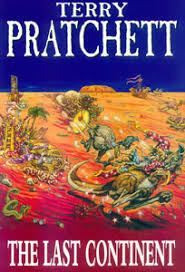
The Last Continent (Discworld 22) by Terry Pratchett, 1998

Discworld novels are often divided into a number of sub-categories – the Watch, Witches, Death, and so on. Of these by far the weakest group are those featuring Rincewind, the world’s worst wizzard, and within that group, I am sorry to say, The Last Continent is the least interesting and entertaining.

The novel can’t really be said to have a plot. It has two, and they are not very well integrated. In one, following shortly after the events of Interesting Times, Rincewind is magicked away to Xxxx, a thinly disguised Discworld version of Australia. He wanders around the outback for the rest of the novel encountering just about every representative feature of Australia you could mention – if it is a cliche about Oz, it’s there. There’s a certain relentlessness about Pratchett’s approach to this, almost as if he had to include every last possible thing he had ever read or heard about the continent. Weak lager, check, Skippy the Bush Kangaroo, check, Waltzing Matilda, Ned Kelly, peach melba and the Sydney Opera House, to name just a very few of the dozens of archetypes packed in. Rincewind is so heavily protected by plot-armour at this stage that the chances of anything interesting happening to him are non-existent – instead everything happens around him, and he passes serenely through unaffected.

The Last Continent - Wikipedia

The parallel plot features the wizards of Unseen University. Their search for someone who can help cure the Librarian, suffering from a form of morphic instability in which he keeps transforming into random objects, leads them to try and track down Rincewind, once the Librarian’s assistant. In the rooms of the Egregious Professor of Cruel and Unusual Geography they find a window in space leading to a tropical island. They pile through but of course get trapped when Mrs Whitlow, the University’s head of Housekeeping and the nearest thing the UU has to a sex-symbol, closes the window leading back to the university.

This is no typical tropical island. Cigarette plants, chocolate coconuts and spoon bushes pass unquestioned, but the arrival of a dinosaur that evolves into a chicken and a boat made from a plant lead even the usually phlegmatic wizards to wonder what is going on. The resident god of evolution turns up. and it gradually becomes apparent that not only have the wizards travelled a long way in space, they have also travelled far back in time, to when the world was being designed and assembled. Their suggestions – for example for sexual reproduction, are enthusiastically adopted by the god and lead to the Discworld as it becomes.

This is a thin foundation for a novel. The Australian cliches pile up irritatingly, and you end up waiting for the next one to turn up (Priscilla, Queen of the Desert, check, duck-billed platypus, check, the Dreaming, check). I felt Pratchett kept throwing new Xxxx items at the book to try and distract the reader from the underlying absence of anything approaching a plot. The fun with creation myths never really takes off – it’s mildly diverting, nothing more. Pratchett published two novels a year most years for almost twenty years, so a dud was always a possibility, but they are still a disappointment when they crop up, as they inevitably must. It’s not that I actively disliked The Last Continent, just that I didn’t love it. Some, perhaps much of that is down to Rincewind – he’s just not that entertaining a character, and he doesn’t have any relationship (except, I suppose, with the Luggage) to help carry the burden.

The Last Continent does however contain one of Pratchett’s greatest, if most cynical, quotes:

“We put all our politicians in prison as soon as they’re elected. Don’t you?”

“Why?”

“It saves time.”

Orbital by Samantha Harvey 2023

Orbital by Samantha Harvey 2023 Rotating about the Earth in their spacecraft, they are so together, and so alone, that even their thoughts, their internal mythologies, at times convene. Sometimes they dream the same, dreams of fractals and blue spheres and familiar faces engulfed in dark, and of the bright energetic black of space that…

How Not to be a Political Wife by Sarah Vine, 2025

How Not to be a Political Wife by Sarah Vine, 2025 This book’s clumsy title sets the tone for what is, one can be pretty confident, going to be quite a bumpy ride. The book is categorised as a memoir, but more accurately it is a confessional of staggeringly indiscrete proportions, quite calculatedly burning lots…

Every Man for Himself, by Beryl Bainbridge, 2002

Every Man for Himself by Beryl Bainbridge, 2002 Half past four on the afternoon of 8th April 1912 – the weather was mild and hyacinths bloomed in window boxes – a stranger chose to die in my arms. “Please,” I said, as he pitched forward and clutched me round the waist. We both fell to…

Standard
Book review

‘Give a man a fire and he’s warm for a day, but set fire to him and he’s warm for the rest of his life.’

Jingo combines two of Sir Terry’s favourite topics – social commentary, in this case on

Jingo: (Discworld Novel 21) (Discworld Novels): Amazon.co.uk ...

The Corgi paperback cover – note how the weathervane symbols point Hubwards, Rimwards, Turnwise and Widdershins

nationalism, and the men, women and other species of the Ankh-Morpork City Watch. It is silly to have favourites in these things, but if forced to choose I would probably have to opt for the Watch as my preferred set of books within the overall series.

Pratchett’s inspired idea here in order to explore the dangerous attraction of nationalism is that one day an island, Leshp, emerges from under the Circle Sea halfway between Ankh-Morpork and Klatch. Both countries see the island as a important strategical location, and lay claim to ownership of the territory. Chaos, almost inevitably, ensues. What complicates matters is that a Klatchian prince, Khufurah is visiting Ankh-Morpork to receive an honorary degree from the Unseen University. The timing is either an opportunity for some diplomatic discussions about the future of Leshp, or for mischief! Guess which is the more likely to occur? Someone – but this isn’t really a detective novel – tries to assassinate the Prince, and Sir Samuel Vimes, Commander of the City Watch, investigates. Is someone trying to provoke war between Ankh-Morpork and Klatch, or does the attempted assassination arise from an internal Klatchian power struggle?

Vimes, assisted by Captain Carrot and Corporal Angua, the Watch’s only werewolf, makes good progress, but relations between Ankh-Morpork and Klatch deteriorate even more quickly, and war is soon declared. Pratchett writes powerfully how petty nationalism (jingosim) can take hold and drive a country to war, and how poisonous an inflated sense of superiority can be. The ‘enemy’ is seen as weak and cowardly, likely to run away from the proud armies of Ankh-Morpork. Vetinari, Patrician of Ankh-Morpork, unexpectedly stands down, unable to prevent the rush to war but unprepared to sanction it, leaving the dangerous Lord Rust to take over. Rust mobilises the city’s nobility to create their own private regiments, an opportunity which Vimes, now dismissed as Watch Commander, decides to follow. 

From this point the novel divides into a series of parallel plot lines, all converging on the ominously inevitable battle in the deserts of Klatch. Vimes and his newly formed regiment pursue ’71-Hour Ahmed’, a suspect in the attempted assassination, back to Klatch, Nobby and Sergeant Colon travel with Vetinari and his mad-genius inventor, Leonard of Quirm, in Leonard’s “Going-Under-the-Water-Safely Device” to investigate Leshp, where they find out the island is only temporary, and will re-submerge in a matter of days. From here they push on to Klatch, assuming slightly farcical disguises in order to travel incognito. Will they be able to prevent war between the over-confident forces of Ankh-Morpork and the Klatchian desert tribes?

I have mentioned this novel revolves around a discussion of the dangers of nationalism. Please don’t assumes this means the novel is in any way worthy or preachy. The political points are made with a light touch, although there’s no ambiguity in Pratchett’s perspective. The seductive lure of nationalism is exposed, such as here where the Ankh-Morpork leaders discuss the rush to occupy Leshp:

‘Why are our people going out there?’ said Mr Boggis of the Thieves’ Guild.
‘Because they are showing a brisk pioneering spirit and seeking wealth and . . . additional wealth in a new land,’ said Lord Vetinari.
‘What’s in it for the Klatchians?’ said Lord Downey.
‘Oh, they’ve gone out there because they are a bunch of unprincipled opportunists always ready to grab something for nothing,’ said Lord Vetinari.

I am sure I have said this many times before, but I don’t think anyone reads Pratchett for the plots. The joy is in the language – at one point he describes “little crunchy brown bits” (in the context of Sybil’s cooking) as “the food group of the gods” which is just perfect, isn’t it? Elsewhere there is a touching demonstration of the ‘Trousers of Time’ theory first explained in Guards, Guards, where Vimes is able to hear how his life might have played out if he had made different decisions at a key point in the novel. STP’s genius shines through in many other ways, but one I don’t think I have mentioned before is his use of names. I love how he plays with the names of the various Watch stations in Ankh-Morpork for example – Pseudopolis Yard, Treacle Mine Road, Cable Street, and possibly my favourite, Dolly Sisters, each one just simply fun in their own right, irrespective of the wit and intelligence behind the names themselves.

If, 21 novels in, I haven’t won you round to the idea that your life would be richer with a little Discworld in it, I probably am not going to do so, but forgive me for not giving up. Jingo is possibly a shade too long and some of the jokes are laboured – Nobby dressing up as a profoundly unattractive Klatchian women was a bit ‘Carry-On’ at times – but every visit to Discworld is a pleasure, and this was no exception.


Jingo (Discworld 21) by Terry Pratchett, 1997

Aside
Book review

Hogfather (Discworld 20) by Terry Pratchett, 1996

In any long running series, especially where the author produces books with the regularity that Terry Pratchett achieved, one looks out for repetition – recycled material, sometimes ironically self-referential, sometimes disguised. So when I tell you that Hogfather features Death leaving his day job and assuming the role of the missing, presumed dead Hogfather, the Father Christmas of Discworld, it will ring some bells. Didn’t that happen before, in Reaper Man and before that in Mort? (It did). To be fair, that’s a minor quibble, because as I am sure I have said before, with Pratchett it is never about the plot.

Here, Death is not taking a holiday, but covering for the Hogfather, who despite being the titled character makes only the briefest of appearances. Death is driven to do this on the basis that the Hogfather is responsible for the sun rising each morning, and for this to happen children have to believe in him. It’s not as awkward and contrived as it sounds.

Having failed to force Death to retire in Reaper Man, the grim Auditors of Reality, “celestial bureaucrats”, hire an assassin from the Assassin’s Guild to kill the Hogfather, symbol of all that is creative and joyful in the Discworld. A particularly psychopathic assassin, Mr. Teatime, is assigned the job.

“Mister Teatime had a truly brilliant mind, but it was brilliant like a fractured mirror, all marvellous facets and rainbows but, ultimately, also something that was broken.”

He recruits a gang of Ankh-Morpork’s more unpleasant thugs (and that’s saying something) to capture the Tooth Fairy’s kingdom, steal all the collected teeth, and use them to control the children of Discworld, commanding them to no longer believe in the Hogfather. Again, still not awkward, contrived, or even twee. Honestly. Pratchett gets away with this because the narrative doesn’t give us this summary – the reader is left to work most of this out themselves, and the immediacy of the action – we are just shown what is happening in the moment – is realistically portrayed. There’s a darker element to the novel as well – when Mr Teatime kills people they stay killed.

Death, becoming aware (somehow) of the Hogfather’s absence, decides to fill in for him. Along the way he visits his granddaughter, Susan Sto Helit, tricking her into investigating the Hogfather’s disappearance. This is not the first time Susan has been called upon to help Death, although at least this time she is not collecting souls for him. She tracks a missing tooth fairy to the Hogfather’s Castle of Bones, on the way meeting Bilious, the “Oh God” of hangovers (one of Pratchett’s better throw away jokes). I am not going to spoil for you what happens there, but I bet you can work it out!

As well as spending time with Death and his assistants the Death of Rats and the ever-hopeful raven, exploring the Hogswatchnight traditions of Discworld and gently satirising the commercialism of Christmas along the way, we also follow the wizards of the Unseen University as they get ready for their great midnight feast, at the same time try to understand why new minor magical creatures keep popping into existence, such as the hair-loss fairy:

“No sense in being bashful about goin’ bald,” said Ridcully evenly. “Anyway, you know what they say about bald men, Dean.”

“Yes, they say, ‘Look at him, he’s got no hair,’” said the Lecturer in Recent Runes.

Susan and the Oh God try to work out what has happened to the missing tooth fairy, and why Death is substituting for the Hogfather, while Mr Teatime and his gang ransack the Tower of Bones. It’s all handled flawlessly by Pratchett, and the reader happily suspends disbelief for the duration, not least because all the characters themselves are constantly telling one another how unlikely everything is.

The Discworld version of Christmas is inevitably a much earthier version of our own Dickensian yuletide. The Hogfather’s sleigh is pulled by four fearsome wild boars, Gouger, Rooter, Tusker and Snouter. But even in Discworld traditions are being slowly sanitised. In earlier times the Hogfather gave households pork products, and naughty children a bag of bloody bones; now all the Hogfather brings is soldiers, dolls and noisy toys for that 4.30 am start.

Pratchett as ever is a great moral philosopher, with Death as his most articulate spokesperson:

“All right,” said Susan. “I’m not stupid. You’re saying humans need… fantasies to make life bearable.”

REALLY? AS IF IT WAS SOME KIND OF PINK PILL? NO. HUMANS NEED FANTASY TO BE HUMAN. TO BE THE PLACE WHERE THE FALLING ANGEL MEETS THE RISING APE.

How’s that for poetry – “where the falling angel meets the rising ape”? I rarely feel the need to justify reading what some people (entirely wrongly) consider children’s books, but here Pratchett provides the answer himself in one elegant, poetic and profound phrase.


Standard
Book review

Feet of Clay (Discworld 19) by Terry Pratchett, 1996

This is Pratchett at the peak of his powers. Feet of Clay, often overlooked in any discussion of the best of Discworld, is sublime. it is a well constructed crime novel, but also a profound meditation on identity. It is also one of the City Watch series of the novels, and thus one of my favourites.

One of the less understood races of Ankh-Morpork are the golems. Usually treated as animate machines, they are awakened from their slumber and set off in search of the meaning of their existence. With the help of a priest and a baker they create a king golem, placing in his head instructions that go far beyond the simple mechanical phrases normally used. This experiment with creation goes badly wrong, which is how the Watch becomes involved. In a parallel plot sinister figures arrange for Lord Vetenari to be poisoned and replaced by a more malleable figure. Fortunately the Watch has a newly appointed forensics expert on the case, Constable Cheery Littlebottom.

Pratchett is often cited as a serious commentator on social issues (the Vimes Boots theory for instance) but in Feet of Clay he reaches Dickensian heights of commentary and analysis. On social housing for example he states:

“While it was regarded as pretty good evidence of criminality to be living in a slum, for some reason owning a whole street of them merely got you invited to the very best social occasions.

Sam Vimes is usually the calm centre of common sense in Discworld. Here he articulates openly republican ideas, and I can’t help but believe that this reflects Pratchett’s thinking as well:

“Royalty was like dandelions. No matter how many heads you chopped off, the roots were still there underground, waiting to spring up again. It seemed to be a chronic disease. It was as if even the most intelligent person had this little blank spot in their heads where someone had written: “Kings. What a good idea”. Whoever had created humanity had left in a major design flaw. It was its tendency to bend at the knees.”

I also like the sound of Vimes’s ancestor, kingkiller Stoneface Vimes, who tells us through the pages of his journal:

“In the Fyres of Struggle let us bake New Men, who will Notte heed the Old Lies”. 

We could do now with some New Men who can see through the old lies.

You would not expect to read a thoughtful discussion of what makes us human in the pages of a comic fantasy novel almost 20 books into a series, but that’s precisely what Pratchett offers here. There are no easy or glib answers, but some serious questions. The golems do the heavy lifting both literally and metaphorically, bearing the weight of these questions. They are treated as machines, but they can think and reason, and when they start to take their own lives in response to the wave of murders across the city we gain an insight into their developing sense of self-awareness. They are unable to live with the guilt of their shared responsibility for the deaths.

Sexuality is another area where Pratchett bravely is unafraid to tread. The sexual relationship between a human and a werewolf has already been accepted by the Watch, but an openly female dwarf seems at first a step too far. Cheery Littlebottom ground-breakingly confronts the sexual mores of her race and her profession but embracing her sexuality. Wearing lipstick and a skirt is a revolutionary step in dwarven culture. Is Pratchett here signalling support for the LGBTQ+ community, or is he having just a bit of fun with bearded ladies? Discworld preaches acceptance of difference and diversity, nowhere more so than in the Watch. Vimes even accepts a golem onto the payroll in a final and bold statement of understanding.

It would be a mistake if I gave the impression that this novel takes itself in any way seriously. It doesn’t, even while discussing serious issues with the respect they deserve. Like all great works of literature Feet of Clay works on many different levels – the discussion about identity and sexuality is there if you look for it, but so are the dad jokes about Nobby and Colon, the well-constructed murder mystery, the police procedural, and the character study. I would never choose a favourite Pratchett, but if I did, this would undoubtedly be on the shortlist. I suspect I have said that about most of the other 18 or more Pratchett novels I have reviewed thus far, and will say again more than once before The Shepherd’s Crown comes round again.

Standard
Book review

Maskerade (Discworld 18) by Terry Pratchett, 1995

Regular readers of this blog (should there are any) will notice a pattern emerging in which I alternate between a classic/serious novel and the next book in the Discworld series. Today is a Discworld day, more specifically the wonderful Maskerade. And the good news is that this is one of the best, featuring the extraordinary witches of Lancre.Mask

The plot is a simple parody of the Phantom of the Opera. Agnes Nitt, destined to become a country witch leaves sleepy Lancre to seek fame and fortune at the Ankh-Morpork opera house. (It is perhaps surprising that a city as violent and lawless as Ankh-Morpork has its own opera house, but Discworld is anything but predictable). At the same time the wonderful Granny Weatherwax finds out that the equally wonderful Nanny Ogg has written a popular cookbook – but has not received any royalties from the publisher. They set out for Ankh-Morpork on a mission to collect what Nanny is owed, with an understanding that they will probably pop in and visit Agnes along the way, and if she agrees to join their coven in a firmly junior position that would all work out fine as well (“You needed at least three witches for a coven. Two witches was just an argument.”). There is nothing as definite as a plan here. 

The stage is set for what is a surprisingly tightly written mystery story – although I had read the book before I couldn’t easily work out whodunnit – as well as a wonderfully comic novel. While Pratchett always has a serious point in the back of his mind, here the seriousness never gets in the way of the fun – for example the scene where the senior witches stay in Madame Palm’s house for ladies of negotiable affection, and manage somehow to make it even more disreputable, is glorious!

Maskerade is fantastic. It features two of my favourite characters in the whole of fiction, Nanny Ogg here finally stepping out from the shadow of Esme Weatherwax with her own special brand of magic (in essence, being nice and talking to people), and of course Esme herself. The witches have been on a road trip before, (Witches Abroad) but here they can play uninhibitedly in Ankh-Morpork. Pratchett clearly had a huge amount of affection for these characters – they are immensely endearing and believable. (Re-reading what I have written there I can’t help notice the abundance of superlatives, but it’s a fair reflection of how I feel about the novel.)

Nanny Ogg is a complete nihilist –  her philosophy of life is summarised as “do what seemed like a good idea at the time, and do it as hard as possible.” She gets some great lines, such as:

“Can you identify yourself?
-Certainly. I’d know me anywhere.”
Is it me or is there a hint of the Marx brothers in that joke? This is after all a night at the opera?
There is no reverence whatsoever for the seriousness of the setting:
Well, basically there are two sorts of opera,”
said Nanny, who also had the true witch’s ability to be confidently expert on the basis of no experience whatsoever.
“There’s your heavy opera, where basically people sing foreign and it goes like “Oh oh oh, I am dyin’, oh I am dyin’, oh oh oh, that’s what I’m doin'”, and there’s your light opera, where they sing in foreign and it basically goes “Beer! Beer! Beer! Beer! I like to drink lots of beer!”, although sometimes they drink champagne instead. That’s basically all of opera, reely.”
The quality of the jokes, is as ever, both terrible and wonderful at the same time – such as here when describing Nanny Ogg’s cookbook
“What about this one? Maids of honour?”
“Weeelll, they starts out as maids of honour…but they ends up tarts.”

:

Standard