Book review

Interesting Times, (Discworld 17) by Terry Pratchett, 1994

Interesting Times, as well as being 17th in the Discworld series, is also the fifth novel to feature the world’s worst wizard, (or should that be wizzard?), Rincewind. So, cards on the table time – despite the enormous respect I have for all things Discworld, Rincewind is one of my least favourite characters. My heart sank a little when I read that this was another Rincewind novel (the fifth). I think there’s a good reason why after making several valiant attempts to resurrect him, Pratchett eventually allowed Rincewind to quietly fade into the background of Discworld.

‘May you live in interesting times’ is commonly thought to be an old curse (don’t we live in them right now?) usually attributed to the Chinese, although wrongly so according to my extensive research (Wikipedia). The phrase provides the inspiration for this adventure in which Rincewind travels to the Agatean Empire, the mysterious continent from which Twoflower, the naive but very rich tourist in The Colour of Magic and The Light Fantastic, came. 

After Pratchett’s traditional framing introduction, the novel opens with the Patrician of Ankh-Morpork receiving a demand from the Agatean Empire to send them a great wizzard. The spelling mistake triggers the idea of sending them Rincewind. Of course this immediately leads to a series of disasters and mishaps from which he always emerges through sheer dumb luck.

The villain of Interesting Times is Lord Hong, a Machiavellian character who has read Twoflower’s book, What I did on my holiday which has inspired vague ambitions to conquer distant Ankh-Morpork. Pratchett’s record on villains is patchy, and Lord Hong doesn’t linger long in the memory – he is a bit of a cardboard-cutout psychopath. Cohen the Barbarian also makes a reappearance, accompanied by a Silver Horde of aging barbarian berserkers. Together with a new “Red Army” of young idealists and Rincewind’s trademark failures at magic, they capture the imperial palace, and with it the Empire. Lord Hong rallies the Empire’s armies, and the scene is set for an epic battle – six aging barbarians and an ex-teacher against 70,000 trained soldiers. What could possibly go wrong?

There are several fairly serious issues with Interesting Times. First, the jokes aren’t that funny. There’s always a high groan quotient in the Discworld novels, but the problem here is repetition. The Silver Horde are old, but really good at fighting. People who under-estimate them usually don’t live to regret it. If that joke is repeated once it is repeated a dozen or more times. Rincewind is a rubbish wizard and a coward, who will run away from danger at any opportunity, but is also a great survivor. Again, point made and repeated over and over again. The word intercourse is funny. Maybe once, but that’s enough.

And then there’s the rape ‘jokes’. The Silver Horde are barbarians, and rape women. Now they are old this is probably not going to happen, but it won’t stop them trying. I know the 1990’s were different times, but it was not funny then, and is certainly not funny now. Terry Pratchett was usually fairly progressive in his values (take for instance the ideas about religion in Small Gods), but this is a horrible mis-step. Am I being pious to find the opening scene – in which castaway Rincewind encounters several buxom Amazons who beg him to help them repopulate their race after a strange and highly specific plague has mysteriously wiped out all their menfolk – both boringly unoriginal and offensive? While I am being offended I may as well throw in the fact that much of the novel is culturally insensitive to the point of racism – Chinese/Asian people are portrayed as inherently funny – they speak strangely, eat weird food, misunderstand things, and are generally different to the citizens of old Ankh-Morpork.

About three quarters of the way through Interesting Times I was thoroughly fed-up – disappointed and un-entertained. And then something strange happened – I started to be engaged. I think I can pinpoint precisely the moment this happened – when it dawns on the Silver Horde that they may not win their battle (even though they quickly recover and offer surrender terms to the army) and begin to come to terms with their mortality – sooner or later all heroes die. There is a poignant scene where Cohen lists all his barbarian horde friends, and is told disbelievingly one by one that they have died, or worse retired into respectability. Old men don’t fear death, but they don’t welcome it either, especially not old heroes who have spent their life avoiding it. Pratchett doubles-down at this point by revealing the tragic back story to Twoflower’s loss of his wife, which is handled with dignity. Pratchett always was at his best when writing about Death.

So Interesting Times isn’t bad, but it hasn’t aged well, and could probably have been about half as long and not suffered. Rincewind fans will enjoy it, but there are few of the great quotable quotes that you can trip over elsewhere in the series. It’s not as thought-provoking or as funny as most other novels in the series, and Rincewind is as un-engaging as ever. Thank goodness the next novel in the series, Maskerade, sees the return of the wonderful witches!
Standard
Book review

The Discworld Companion by Terry Pratchett and Stephen Briggs, 1994

By a wonderful act of synchronicity, I stumbled across this £1 charity bookstore treasure very shortly after completing Soul Music. This edition of the Companion (later editions being called the New Discworld Companion, followed by The Turtles Moves..The Discworld Companion…So Far) was published in 1994, ending with the publication of – and therefore fully describing the known Discworld up to – Soul Music.

This is much more than a guide to the Pratchett universe, although it is a very comprehensive one at that, obviously only comprehensive up to 1994 that is. This partiality is in itself is fascinating, as this snapshot of the DW universe reveal that at this point it is surprisingly complete – certainly all the main features you would expect – the Watch, Vetinari, the Witches, Death, a fully developed concept of how magic works, and so on – are all there, fully formed. In one sense the final 25 or so books were about filling in the detail and backstory rather than reinventing DW, and the genesis of several of the later novels are clearly present here. Examples of this include the references to the mysterious world of XXXX, later explored in the Last Continent (Discworld 22) or the writer William de Worde and the fact that moving type has not yet been fully embraced in Ankh-Morpork. de Worde’s entry in the Companion ends with the this sentence:

“It could well be that the future holds great things for young Mr de Worde…”

You really couldn’t ask for a clearer indication that Sir Terry had The Truth, the DW novel about the introduction of printing, planned out in his head, even though it wasn’t to eventually appear until 2000 as DW 25.

The Companion also has lots of canonical additional content found nowhere else – there is a very comprehensive description of the history, working and traditions of the Unseen University for example, in which Unseen Academicals is hinted at in the description of the DW version of football:

“UU records suggest that students from the University have no participated recently, but street football with various rules is still an Ankh-Morpork tradition”.

The sections on magic, DW units of measurement/standards, and Morporkian law, equally all give plenty of background to the DW universe only hinted at in the novels.

At the end of the Companion, after the A-Z section, is some fascinating additional content. In a chapter apparently written by Stephen Briggs, there is what I feel is one of the best summaries of the reasons why the novels are so loved:

“There is a certain quiet optimism (in the books). If there is a struggle, the good win – but not easily, and at some cost. There is a strong dislike of coercion of people, either by other people or gods or some concept of fate or destiny. There’s a very frequent theme which says that what people happen to be doing does not define what they actually are.”

Elsewhere a long and comprehensive interview with Sir Terry reveals that in the mid-90’s in response to the question:

“Do you see yourself still writing Discworld books in ten years’ time?”

he gave a very definitive

“No. Not even in five years time. Certainly not on a regular basis, anyway. There’s only so much I can do with it.”

I am so glad he changed his mind!

P.S. In the very final section of the Companion Briggs write about Pratchett fandom:

“Fan activity is available to anyone with a computer and a modem. There is a Pratchett forum on CIX….and a rather larger one known as alt.an.pratchett on the Internet (the huge worldwide computer network which shifts megabytes of information around the planet”.

Oh so that’s what the Internet is!! Gotta love 1995.

Standard
Book review

Soul Music (Discworld 16) by Terry Pratchett,1994

There’s a disappointing, cut and paste feel to Soul Music which for me makes it the weakest of the Discworld novels thus far (i.e. of the 16 published up to this point). And it is still wonderful! How come? I’ll come to the mitigation, but first this is the plot outline:

A young harpist, Imp Y Celyn, (bud of holly, get it?) from Llamedos seeks fame and fortune in Ankh-Morpork. He forms a band with Lias Bluestone (a troll percussionist) and Glod Glodsson (a dwarf hornblower) along the way acquiring a magical guitar with mysterious powers, more specifically an entity comprising the primordial music which brought the universe into existence. As one does.

Meanwhile, Death, upset at the death of his adopted daughter Ysabell and her husband, Mort, takes another impromptu break from his day job, leaving his granddaughter, Susan Sto Helit to fulfil his soul-gathering function. She fluffs her first job by failing to reap the soul of Buddy when he is scheduled to die while performing at the Mended Drum.

Thus the novel’s two primary threads are established – death takes a break and a family members steps in to cope as best they can, a plotline Pratchett had already used before (Mort and Reaper Man); and in a parallel storyline a new phenomenon/innovation (in this case rock music) takes the Discworld by storm, causing chaos and ultimately threatening the existence of the universe, a theme already explored in some detail in Moving Pictures.

That’s pretty much it – although there are a lot more events, they all fall within this basic template. And that was what I found disappointing by Soul Music, its writing by numbers feel. To be fair to Pratchett he was writing a phenomenal amount of Discworld novels at the time, feeding our voracious appetites for all things DW. (The Colour of Magic was published in 1986,  just 8 years and 15 DIscworld novels earlier. In addition to the eventual count of 41 novels there are also any number of books and other material including short stories, cookery books, maps, guides etc). So it is hardly surprising that to meet deadlines he had to dial it in from time to time.

Fans of dad jokes and clever popular culture references will be spoilt for choice here, beginning with the original cover illustration which echoes the Meat Loaf album Bat out of Hell, rapidly followed by a steady stream of allusions to groups and records, in particular cheesy examples from the seventies and eighties, such as “Pathway to Paradise” (“Stairway to Heaven”) and ”Sex and drugs and Music With Rocks In” (“Sex and Drugs and Rock and Roll“). At first the game of spot the reference is fun, but after a while it palls – it is after all essentially the same joke time after time, however cleverly done. Having said that even I had to applaud the way the groanworthy reference to “There’s a Guy Works Down the Chipshop swears he’s Elvish” is worked in.

Pratchett was at this point over a third of the way into the Discworld saga, and he was still refining his craft. This novel would not have disappointed any DW fan, but neither can it be said to take the series to a new height or in a new direction in the way books such as The Night Watch did. It’s fun, and the jokes consistently work, but I am not sure we care that much about the characters (except Susan perhaps), and the eventual happy-ever-after ending is never in any doubt. The scenes of the band on the road felt like padding, an effort to reach a minimum word-length target. So perhaps I need a Pratchett holiday – but I really don’t want one, because I know what great novels are coming up.


Standard
Book review

Lords and Ladies (Discworld 14) by Sir Terry Pratchett, 1992

“In the beginning there was nothing, which exploded”. I suspect most readers would identify this as something Douglas Adams wrote, rather than his successor in genius, Sir Terry Pratchett.  It sets the tone for this wonderful novel. But perhaps I shouldn’t use this term, because as Lords and Ladies points out

“Elves are wonderful. They provoke wonder.
Elves are marvellous. They cause marvels.
Elves are fantastic. They create fantasies.
Elves are glamorous. They project glamour.
Elves are enchanting. They weave enchantment.
Elves are terrific. They beget terror.
The thing about words is that meanings can twist just like a snake, and if you want to find snakes look for them behind words that have changed their meaning.
No one ever said elves are nice.” 

This is just one aspect of the genius of Sir Terry – his ability to use language creatively to make us think deeply about language and beyond, to a very serious discussion about power and responsibility within society.

Of course there is a lighter side to this novel. It includes one line much loved by Discworld fans:

“Nanny Ogg looked under her bed in case there was a man there. Well, you never knew your luck.”

I first read Lords and Ladies a long time ago. I have a vague memory of being slightly disappointed. But one of the many wonderful things about STP as a writer is his re-readability; I honestly can’t think of another writer whose novels retain their freshness and originality on multiple re-readings in the way Sir Terry’s do. In a word, I was wrong, Lords and Ladies is magnificent.

It follows chronologically immediately following the events of Witches Abroad. I could easily be wrong about this but I think this is one of the few times in the series that STP does this (The Colour of Magic/The Light Fantastic being the other example that springs to mind.) This gives the reader the impression that they are enjoying a continuing narrative, an adventure in real time. Granny Weatherwax, Nanny Ogg, and Magrat Garlick return from their adventure in Genua to find that while they have been away the people of Lancre have neglected their defence against the dark arts lessons. In particular the witches’s warnings about the Dancers, a mysterious stone circle outside the village have been ignored. With Lancre’s magical protections weakened and unguarded, a portal to the world of the elves is opened.

But as you will have seen above, these elves are not the noble creatures of MiddleEarth- they are amoral monsters that use “glamour” to alter human’s perceptions of them. The elves break into the Discworld and cause carnage at Magrat’s wedding, to be confronted (and OK, yes, spoilers, ultimately defeated) by a feat of magic that only Granny W could pull off. There is a sub-plot featuring a visit by the Arch-Chancellor and the Librarian to the wedding, but otherwise that is pretty much it – a fairly unsubstantial piece in terms of the plot. But reading STP for this plotting would be very much missing the point – you need to read him for his characterisation and his ideas.

STP really hit his stride at this point in the Discworld history, and never really took a misstep thereafter. So many great novels to come.


Standard
Book review

Small Gods (Discworld 13) by Terry Pratchett, 1992

It feels appropriate (if unplanned) to publish this review on the sad fourth anniversary of Sir Terry’s untimely death.

By this point in the Discworld saga, he was really hitting the peak of his powers. This was a writer who is really confident with his material, able to tackle large themes and ready to take risks. And for any writer religion is arguably the biggest risk – you are always going to upset someone. Small Gods is a fascinating discussion of the nature of divinity. That makes it sounds very serious, but that was the author’s genius – to write about serious themes in a very funny way.

The novel is set in Omnia, a kingdom in the continent of Klatch, new to Discworld at this point I believe, and bearing an uncanny resemblance to a medieval Catholic country in the grip of a frenzied search for any trace of heresy. Pratchett has given Om a far-eastern name, and mixes up his religious references freely, but the use of torture by the Quisition to enforce religious conformity and stamp out free thinking, has only one true origin. In Omnia religion has become a distorted version of itself, with torture and fear being its dominant characteristic. In these circumstances true belief in the God Om himself has begun to wither, so much so that the God Om finds himself reincarnated in the body of a tortoise. It seems he is destined to return to the world of once great but now Small Gods who exist on the borders of reality, desperate for believers from whom they derive their existence.

By a million to one chance, and therefore a literary certainty, Om in his tortoise form encounters the novice Brutha, the only remaining true believer in Omnia. Brutha’s idetic memory is used Vorbis, the head of the ExQuisition, to memorise the way through a labyrinth used to guard the library of Ephebe. Vorbis is one of Pratchett’s scariest monsters, a psychopath so controlled and uncaring that he is able to retain his position at the head of the Omnian church by fear alone. An underground movement, reminiscent of the early Christian church, survives in secret, passing its belief in the Disc-shape of the word through its slogan “The Turtle Moves”. The scene is set for a clash of beliefs in which someone is going to die. Guessing who isn’t a challenge, but the journey – in this case a physical journey through the desert – is where the transformation of Brutha from a menial drudge to a prophet occurs.

As always with Pratchett his wit and wisdom shines through. Here he is on religious repression, for example:

“Fear is a strange soil. It grows obedience like corn, which grow in straight lines to make weeding easier. But sometimes it grows the potatoes of defiance, which flourish underground.”

or here on the miracle of our existence:

“Humans! They lived in a world where the grass continued to be green and the sun rose every day and flowers regularly turned into fruit, and what impressed them? Weeping statues. And wine made out of water! A mere quantum-mechanistic tunnel effect, that’d happen anyway if you were prepared to wait zillions of years. As if the turning of sunlight into wine, by means of vines and grapes and time and enzymes, wasn’t a thousand times more impressive and happened all the time…”

Sir Terry’s death was such a loss, but he left us a wonderful collection of novels that are a fine legacy.

Standard
Book review

Witches Abroad, (Discworld 12) by Terry Pratchett, 1991

Is it possible to have two favourite Discworld books? I have three favourite children after all, so conceptually it should be possible. Were it to be deemed so by the powers that be, then ‘Witches Abroad’ would definitely be my joint favourite Discworld novel alongside Witches-abroad-cover‘The Night Watch’. Granny Weatherwax, Nanny Ogg, her perfect foil, and Magrat Garlick on a road trip across the Disc, travelling through a landscape of fairy stories brought to life by Lilith de Tempscire, Granny’s evil sister. Just perfect!

Granny and Nanny are two of my favourite Discworld characters – Magrat is a wet hen, and I can take her or leave her – and together they are wonderful. Nanny Ogg is sometimes overshadowed by Granny’s awesomeness, but her she is in full flow, a force of nature that bulldozes its way across the Disc, all the way to Genua. Genua is a coastal town with an annual celebration called Fat Lunchtime, a tradition of cooking based around gumbo and, and all in all bears a strong resemblance to New Orleans.

Witches Abroad also contains the greatest Discworld story Sir Terry never wrote. At the end of this novel, when the bad guys have been defeated and order restored, the witches have a choice – to go home, or to go and “see the elephant”, a colloquial expression for going home the long way, continuing their holiday as much as possible. They agree to see the elephant, and the reader is left to picture what a glorious, outrageous adventure that would have been. (If it turns out that this novel was actually written, and I have just forgotten it, which is quite possible, I will be both deeply embarrassed and hugely delighted).

So what is it about this novel that makes it so full of wonder? It can’t be the jokes, because they almost all qualify as ‘dad’ jokes – even the title is a pretty silly play on words (Witches Abroad = witches out and about, and also in foreign lands). Or try this schoolboyish fun with the fact that in some languages words have gender, which might be funny if you are 11

“‘S called the Vieux River.”
– “Yes?”
– “Know what that means?”
– “No.”
– “The Old (Masculine) River,” said Nanny.
– “Yes?”
– “Words have sex in foreign parts,” said Nanny hopefully.”

Or here’s another joke, when the witches see a stuffed lion’s head:

By gor’, that’s a bloody enormous cat.’
‘It’s a lion,’ said Granny Weatherwax, looking at the stuffed head over the fireplace.
‘Must’ve hit the wall at a hell of a speed, whatever it was,’ said Nanny Ogg.
‘Someone killed it,’ said Granny Weatherwax, surveying the room.
‘Should think so,’ said Nanny.  ‘If I’d seen something like that eatin’ its way through the wall I’d of hit it myself with a poker.”

OK, silly jokes yes, but slapstick can be funny?

Is it the ‘world building’? (“The process of constructing an imaginary world, sometimes associated with a whole fictional universe. The resulting world may be called a constructed world.”) I think this is getting closer. STP made no attempt to make the basic concept of Discworld anything other than fun, but over time he developed a geography and history for the world that within its own constraints – it is balanced on a turtle carrying four elephants after all – is believable. Is it the story-telling? Definitely not. One of the joys of rereading these novels is rediscovering (and then quickly re-forgetting) what happens, because what happens is usually not very important. We know the good guys are going to win, and the demons from the Dungeon Dimensions are going to be defeated in that somewhat vague way that most of these novels deploy to resolve matters. In the tradition of most great story writers STP borrows plot lines freely and openly, even going so far in this novel to make that borrowing itself part of the plot. Dracula, The Wizard of Oz, Little Red Riding Hood, Cinderella, – you name it, STP borrows from it.

So what’s left? It would be wrong to use the term “philosophy”, but the underlying humanism of the author’s perspective on the world shines out from every one of his novels. He has profound insights into the human (and dwarven, troll and other life-forms) condition. You really have to read the books to get this point properly, but for now how about this from Granny Weatherwax?

“You can’t go around building a better world for people. Only people can build a better world for people. Otherwise it’s just a cage.”

Lastly, there are the novel’s extraordinary, deeply loved, characters. I’ve written at length in previous Discworld reviews about Granny, Nanny and Sam Vimes in particular, so I am not going to repeat myself too much other than to say they are utterly magnificent, utterly believable, and full of the humanity that makes these novels some of my favourites on the planet. Sorry, roundworld.


Standard
Book review

Reaper Man (Discworld 11) by Terry Pratchett, 1991

As the reaction to my Facebook post about Pyramids (Discworld 7) attests, the Discworld novels are hugely loved by a community of readers across the world. People love the novels for many reasons, but I think one of the most common reason is the enormous empathy that Sir Terry shared with his readers. He knew our weaknesses and frailties, 220px-Reaper-man-coverand saw the inner strength in the most abject of us, the deluded, the vulnerable. No-one is so much of a misfit that they don’t have a place in Ankh-Morpork’s Watch; no-one is beyond redemption, as Moist von Lipwig’s story shows. And the weakest and frailest of us all know that one day we will face death, or perhaps Death. So it is his crowning achievement that he made Death such a human, kind character, and that novels such as Reaper Man which are all about Death and death, can be so warm and touching.
Ok, I get it, enough fan-boying, if that’s a word. In this the eleventh Discworld novel, the Auditors of Reality object to Death developing a personality, so decide to ‘retire’ him. In facing up to the death of Death he leaves his job collecting souls, and spends his remaining days working as a farm hand imaginatively named Bill Door for the elderly Miss Flitworth, another of STP’s astonishingly well realised older female characters.

But the absence of death is not entirely unproblematic. A ‘life force’ (of some kind, STP is vague on the detail) starts to cause poltergeist activity and lots of other weirdness. Windle Poons a senior wizard is disappointed not to be met by death on his passing, and becomes a charmingly polite but determined zombie, joining an undead-rights group. The ‘action’ scenes in which Ankh-Morpork is slowly invaded by a parasitic lifeform which evolves into a shopping centre are heavily cut between the Bill Door scenes, but this doesn’t effectively disguise their clumsiness as satirical comment on consumerism. In the novel’s touching climax Death is given a little more time and spends it on a last dance with Miss Flitworth.

One of the many joys of a Discworld reread is rediscovering the origin stories of some of Sir Terry’s wonderful characters. Reg Shoe, undead rights activist, first appears here, although it is not until much later in the glorious Night Watch that we discover how he came to zombiedom. The Death of Rats also first appears in this novel. But Death takes centre stage here, rightly so, and carried the novel on his bony shoulders. Another triumph Sir Terry.

Standard
Book review

Moving Pictures (Discworld 10) by Terry Pratchett, 1990

Moving Pictures

At this point (1990) in his writing career, Terry Pratchett was producing two Discworld novels a year. He’d published Sourcery (Discworld 5) and Wyrd Sisters (DW 6) in 1988, Pyramids (DW 7) and Guards! Guards! (DW 8) in 1989, and Eric (DW 9) already in 1990, before he produced Moving Pictures for the Christmas sales at the end of the year. By any reckoning this is an extraordinary sustained level of output, all the more so given that Moving Pictures is such a rich and cleverly written novel.

I am fairly sure when Sir Terry was writing these novels there was no overall grand plan in his head. (I may have read that somewhere). People have retrospectively tried to impose some order on the novels, and grouped them around the principal topics – the Witches series, the City Watch series, and so on. Several of the Discworld novels use as their inspiration the coming of round world technology to the Disc – The Truth (printing), Going Postal (Clacks/telegrams), Raising Steam (trains) and so on. Monstrous Regiment is sometimes included in this group but I am not sure why – maybe it will become clearer when I eventually reread it!) These groupings can be contentious, but they do make the series more accessible to new converts to the cause of all things Pratchett, so are therefore a good thing. Moving Pictures is the first in the Industrial Revolution series of novels, and is a quite affectionate satire on the rise of cinema in the early part of the twentieth century, the Century of the Fruitbat.

Pratchett isn’t interested in subtly disguising his targets, so the small out of the way coastal area where movies begin to be made is called Holy Wood. Holy Wood is watched over by a guardian who performs strange rituals to protect the site from the strange spirits that are trapped in the hill. When the guardian dies, sand starts to trickle away from Holy Wood Hill, allowing the spirits or some kind of unpleasant entity to escape. It quickly infiltrates the vulnerable minds of the alchemists of Ankh-Morpork. Alchemists are a disgruntled group of marginalised not-quite wizards, best known for blowing themselves up and turning gold into less gold. Without quite understanding how, the alchemists quickly invent cinema – moving pictures – and decide to decamp to Holy Wood, starting a gold-rush of sorts as people head out to the coast in search of stardom, bedazzled by the glamour of Holy Wood. One such ingenue is Victor Tugelbend, the oldest student in the Unseen University, skilled at not passing his exams. He sets out to become a star, followed by numerous citizens of the capital including Cut My Own Throat Dibbler, Detritus, a troll bouncer from the Mended Drum, and Gaspode the Wonder Dog, who between them represent some of Discworld most popular secondary characters.

Victor breaks into the movies, literally, with the help of the talking Gaspode, and is introduced to Ginger, his co-star. All the while people are largely unaware of the strange magic that Holy Wood is casting over them. There’s a lot of scene setting as Pratchett lays the ground the novel’s finale, but it’s worth it. The pay off is a magnificent parody of King Kong and Gone With the Wind. Pratchett scatters funny references to movies throughout the novel – this is probably the richest novel for this feature, often with several clever little references to cinema or other aspects of popular culture on every page. This must make it a nightmare to translate!

Moving Pictures is of course much more than an affectionate parody of the film industry. Cinema is in any event something of a soft target – the early days of the movies in particular were ridiculous in so many ways, but they did give us some great films. They did cause people to behave out of character, but was there really any great harm done? So this is not a satire with any significant purpose, more a very light-hearted, at times even silly, commentary on the industry. There’s so much to enjoy here, from spotting the references to the wonderfully strong cast of characters, many such as Gaspode making their first substantial appearance in the series. There is a darker element to some of the Discworld novels, but it is almost completely missing here – whatever it is that escapes from Holy Wood Hill and infects the minds of men, women and animals, is ill-defined but relatively easily defeated.

Pratchett always has something interesting to say even when his is being at his most light-hearted, such as this wonderful paraphrasing of A Room of One’s Own:

“You know what the greatest tragedy is in the whole world?… It’s all the people who never find out what it is they really want to do or what it is they’re really good at. It’s all the sons who become blacksmiths because their fathers were blacksmiths. It’s all the people who could be really fantastic flute players who grow old and die without ever seeing a musical instrument, so they become bad plowmen instead. It’s all the people with talents who never even find out. Maybe they are never even born in a time when it’s even possible to find out. It’s all the people who never get to know what it is that they can really be. It’s all the wasted chances.” 

Eric was undoubtedly a blip, something that had all the hallmarks of a rush job, but Moving Pictures was equally obviously written with love and care. It’s wonderful, and a great place to start the collection if you have spurned the chances offered by Wyrd Sisters or Guards! Guards!

Standard
Book review

Eric, by Terry Pratchett, (Discworld 9) 1990

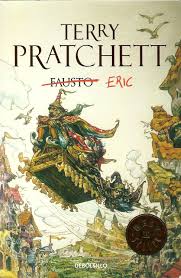
Eric, the ninth Discworld novel, was originally published as a Discworld story to distinguish it from its predecessors in the series. It came in a large format with illustrations throughout by Pratchett’s then cover illustrator, Josh Kirby.eric

This is going to make me hugely unpopular with Pratchett fans everywhere, but I have never been a big fan of Kirby’s work on the Discworld covers. For a start the emphasis seems always on under-dressed young women in various states of peril. If this was done tongue in cheek then he might have got away with it now and again, but the covers are essentially childish, and the books are not. I think this didn’t help Pratchett get the recognition his work deserved, and although a new illustrator took over when Kirby died in 2001, by then a lot of the damage had been done. Brandon Sanderson once famously wrote of STP (in an essay which described the Discworld novels as “the highest form of literature on the planet” which even I think it a bit of a stretch) that

“I’m embarrassed by how long it took me to discover Terry Pratchett. I avoided him during much of my early reading career”.

Could it be that Sanderson was put off by the covers perhaps?

(Incidentally, since writing this I have also found this quote from Sir Terry himself on LSpace.org, The Annotated Pratchett file:

The next UK paperback reprint of TCOM (they do a couple a year) will not have a Kirby cover. This is an experiment — there’s been feedback to me and to Transworld that suggests there are a large number of potential DW readers out there who think they don’t like fantasy and don’t get past the Kirby covers.”

Well there you have it.)

Anyway, Eric is now available widely without the art work, as are all the Discworld novels, so each to his own. Eric is a gently humorous retelling of the story of Faust, as the front cover of most editions with the word Faust struck through and replaced by the word Eric leaves little doubt about. It’s part of the continuing adventures of Rincewind, the original Discworld hero, who we left trapped in the Dungeon Dimensions at the end of Sourcery.

Rincewind is summoned out of these dimensions by a teenage demonologist, Eric, who like all teenagers wants to meet the most beautiful woman in the world, live forever, etc. Rincewind is compelled to play the part of the world’s least convincing demon, although strangely he does seem to have powers to fulfil Eric’s wishes. A very unfunny parrot provides a form of chorus as they travel to Klatch, followed shortly behind by the luggage, to Troy, or the Discworld equivalent Tsort, and finally Hell. There’s a ‘doing it by numbers’ feel to the plot, closely following as it does the source story, with only glimpses of the humour and thoughtfulness that characterises a typical Discworld novel. After they escape from Hell – of course – and go on their way, the story pretty much peters out rather than ending with any satisfying conclusion.

Normally I am falling over quotes to use in a post about a Discworld novel – with Eric that’s more of a challenge. For example:

“What’re quantum mechanics?”

“I don’t know. People who repair quantums, I suppose.”

just isn’t that funny, is it, let alone telling us something essential about life as the best STP quotes often do. Or take this below-par use of the word ‘horology’, I hesitate to call it a pun, which only Eric would be amused by:

“The Tezuman priests have a sophisticated calendar and an advanced horology,” quoted Rincewind.
“Ah,” said Eric, “Good.”
“No,” said Rincewind patiently. “It means time measurement.”

“Oh.”

I am not going to labour the point, this was a bit of a dud, and I am going to move swiftly on to the wonders of some of later novels.


Standard
Book review

Guards! Guards! (Discworld 8) by Terry Pratchett, 1989

“They may be called the Palace Guard, the City Guard, or the Patrol. Whatever the name, their purpose in any work of heroic fantasy is identical: it is, round about Chapter Three (or ten minutes into the film) to rush into the room, attack the hero one at a time, and be slaughtered. No one ever asks them if they want to. 
This book is dedicated to those fine men.” 

I was really looking forward to reaching Guards! Guards! in my Discworld reread. It is the novel in which Sam Vimes and the city’s night watch first appear, as well as featuring an extended role for the wonderful librarian.guards

A secret brotherhood, the Unique and Supreme Lodge of the Elucidated Brethren of the Ebon Night, plot to overthrow the Patrician Havelock Vetenari by using a dragon summoned from wherever it is that all the dragons went.  As plans go this has some weaknesses, not least the dragon’s reluctance to return to its own realm once the people have been gulled into accepting a new puppet king. The fine men of the Night Watch, who at full strength are Captain Vimes, Sergeant Colon, Corporal Nobbs, and Lance Constable Carrot Ironfoundersson, set out restore order, aided by their new deputy, the Librarian.

Vimes is a drunk, fit only for the Watch, a small group of incompetents suited for bell ringing and running away. Newly appointed Constable Carrot is the exception to this rule. Brought up by a dwarf family (a great visual joke that Elf obviously borrowed) he is a strapping young man full of enthusiasm and youthful idealism for the rule of law – his first act on being sworn in is to arrest the head of the Thieves’ Guild.

Vimes begins investigating the dragon attacks, and in doing so meets Lady Sybil Ramkin, a magnificent swamp dragon breeder (That is, she is magnificent, not the swamp dragons, which are to royal dragons what chihuahuas are to great danes). She gives him a pet dragon, Errol, and offers help in the investigation. While the Brethren’s plan initially works and the Patriarch is deposed, the dragon returns unexpectedly during the coronation, eats the prospective king, and takes up residence in the palace. He seems to be able to control Vetinari’s chief minister Wones, clearly the Supreme Master of the brethren all along, through telepathy. A new order is imposed in which tributes are paid to the dragon in the form of gold, jewels, and a monthly human sacrifice.  I won’t give away the finale because I am getting soft in my old age, but suffice to say fans of Shrek won’t be taken by surprise.

A commonly asked question about Discworld is where to start? At the beginning is always the best place, of course, but I would accept that it takes quite a bit of determination to face the prospect of the 40 or so novels in the series. If you are not convinced you have the stamina for the long haul, and want to sample Sir Terry when he had really hit his stride, then Guards! Guards! is a great starting place. You don’t need to have read any of the preceding novels as a precondition to enjoying Guards! – it works well as a stand alone narrative. It also introduces you to a range of characters who you will grow to love, if you have a heart. I’ve written before and often about my love for this series, and I would still argue that Granny Weatherwax is one of the greatest female characters in all literature (yes, I am well aware that sounds preposterously overstated – I stand by every word.) But Sam Vimes is the character with the most interesting story arc – he starts this novel as a broken wreck of a man, and by the end of the series he – well, things get a lot better for him. It’s a story of redemption through public service, and that may sounds pompous but it’s true nonetheless.

Rereading these novels is a joy, in part because you know what is to come and can spot all the small moments of foreshadowing. Vimes and Lady Ramkin’s relationship is that rare thing, a believable romance between two characters past their prime. The other source of pleasure in the novels is the “spot the pop culture reference” game STP loves to play – the text refers playfully to Sherlock Holmes, (“There was also the curious incident of the orangutan in the night-time”) Casablanca, Evelyn Waugh, Dirty Harry, and the Hobbit, to name just a few.

Guards! is written with an obvious love for books, bookshops, and libraries. This shines through in the many references to the importance of these in our lives and the special place in hell reserved for people who don’t respect them.

“The truth is that even big collections of ordinary books distort space, as can readily be proved by anyone who has been around a really old-fashioned secondhand bookshop, one that looks as though they were designed by M. Escher on a bad day and has more stairways than storeys and those rows of shelves which end in little doors that are surely too small for a full-sized human to enter. The relevant equation is: Knowledge = power = energy = matter = mass; a good bookshop is just a genteel Black Hole that knows how to read.” 

Creating the beloved librarian to protect the Unseen University’s library was a great gift.

Last but not least I can never read Pratchett without being reminded yet again of his awesome ability to turn a phrase, comedic, philosophical or otherwise. Here are just a few random examples:

They felt, in fact, tremendously bucked-up, which was how Lady Ramkin would almost certainly have put it and which was definitely several letters of the alphabet away from how they normally felt.”

“Someone out there was about to find that their worst nightmare was a maddened Librarian. With a badge.”

“A good bookshop is just a genteel Black Hole that knows how to read.”

“The three rules of the Librarians of Time and Space are: 1) Silence; 2) Books must be returned no later than the last date shown; and 3) Do not interfere with the nature of causality.”

“… a metaphor … is like lying but more decorative.”

“His sister had been sent down to the village to ask Mistress Garlick the witch how you stopped spelling recommendation.”

Glorious.


Standard