
Last Orders, by Graham Swift, 1996
Four men take the ashes of a friend, Jack Dodds, to Margate, to scatter them off the end of the pier. Last Orders is the story of their journey. Along the way all four are given time to tell their stories as internal monologues and through their conversations, as are some of the women in their lives. It’s a strikingly simple story where little happens, but where we warm to the frailty and vulnerability of these flawed, human characters as we learn more about them.
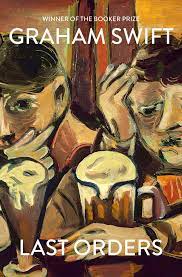
Ray, the character who is given the most space to develop his narrative, works in an insurance office, but always wanted to be a jockey. His friends know him as Lucky; he is a very successful gambler. However the nickname was originally given to him during his years in the African desert during the Second World War, when luck was needed to survive. Together with his friends Lenny, a greengrocer, Vince, Jack’s adopted son, and Vic, a funeral director, they stop at various points along the way from Bermondsey to Margate as a way of saying farewell to their late friend. We learn that all the men served in the army, missed out on careers they would have preferred to have pursued, and troubled relationships, especially with their daughters who they have all in one way or another lost. All have secrets that will remain unspoken. Their shared experiences bond them together. Their pilgrimage, underlined by a brief stop in Canterbury, ends with them casting their friend’s ashes to the turbulent April winds.
I enjoyed Last Orders. Its structure meant I had to invest time in working out who was who, the various family relationships etc, but once those were clear the short chapters and the alternating perspectives meant the narrative had a lot of pace, despite the relative lack of incident. I did have one quibble with the text, which will take some time to describe but shouldn’t be given too much emphasis despite that. My concern was with the use of the vernacular. Each character ‘speaks’ – including in internal monologue – in a form of South London Cockney. There’s thankfully no real attempt to transcribe the accent – no dropped h’s and glottal stops – but Swift tries to catch the cadences and slang of working class Bermondsey.
The reviews quoted in the edition I read were full of praise for the success of this attempt and the authenticity of the language:
“He has succeeded in elevating the demotic to an elegiac level of which Wordsworth could only dream; here is language such as men do use” (This quote is cited as coming from The Guardian, although it is not to be found in the paper’s original review of the novel).
“The novel’s hero is the English language as spoken by ordinary people. ” Sunday Times.
And several others along similar lines. It’s ironic that the Guardian reviewer apparently used the awkward phrase “such as men do use” to describe authentic everyday speech. I’ve ranted here before about authenticity in novels – if an author is aiming to represent something as authentic then they need to get it right. When the Guardian revisited the novel in 2012 the reviewer shared my concern:
“I did have a problem though, right from the very first sentence, which reads: “It aint like your regular sort of day.” It’s a striking enough opening and, viewed retrospectively, a witty summary of the rest of the book, which takes place over the course of one fraught day. Yet, for me, that sentence didn’t ring true. Graham Swift grew up in south London, and presumably knows the local habits and speech patterns better than – say – Martin Amis knows Lionel Asbo’s. But there’s something that doesn’t quite click. His colloquialisms and slang and deliberately simplistic language all seem a bit cor-blimey-guvnor. I’ll be amazed if I ever read a novel with more “aints” per page. (I just turned to page 63, for instance, and found: “June aint my sister. I aint got no sister … I aint going to be a butcher never, it aint what I’m trying to be.”)
As John Mullan delicately put it: “In Last Orders, there is sometimes the danger of hearing the TV demotic of Only Fools and Horses or EastEnders.” Or as AN Wilson noted more bluntly in the same letter to the Independent quoted above: “The ersatz Bermondsey ‘characters’ had as much plausibility as Kipling’s Cockney rhymes. One began to imagine the embarrassment of reading this stuff to a real Bermondsey butcher.” This time, Wilson has a point. The novel’s voice is flawed.”
“Graham Swift grew up in South London” – well yes and no. He was hardly a Bermondsey boy! He went to school at Dulwich College, a so-called ‘independent’ i.e. private school, and from there to Cambridge. Which of itself doesn’t mean he is unable to capture the way working class people speak, it just makes it harder. Generally speaking Swift carries this act of impersonation off quite well, but at times he tries too hard (“it aint never gone nowhere”) and at others Swift the author takes over the voice of the character in the course of their internal monologue, so they start speaking in elegant imagery – Ray at one point describes the aroma of the seaside at Margate as “It smells like memory itself, or the inside of a lobster pot”. To be fair, capturing the precise language and cadences of former soldiers from Bermondsey, with its very specific slang informed by the years in the desert, would have been incredibly difficult. I thought the flawed nature of the novel’s voice would be an issue for me, would possibly even spoil the novel, and I know I have made the point at some length, but once I tuned in to the language I came to terms with it and was able to pass over the moments when it all went a bit Eastenders.
The title of the novel is a play on the phrase “last orders”, called out by publicans just before closing, and the instructions given by Jack about the disposal of his ashes. In other words closing time in the pub comes to represent the end of life. This is not a new insight of course – Eliot used this image much earlier – ‘hurry up please it’s time’. But the theme of death pervades the novel, with the final journey to Margate to scatter Jack’s ashes allowing the characters time to reflect on their own mortality and lives. The narrative point of view shifts constantly although Ray’s is the dominant voice – when chapters are given place name headings his is the narrative voice.
“What might have been?” is a question we all ask ourselves as we get older. Jack dreamed of being a doctor; Ray a jockey. Amy, Jack’s wife, had an affair with Ray but never wavered in her devotion to June, her profoundly disabled daughter. (Incidentally I noticed that the 1996 Guardian review called June a ‘moron’. Such insensitive language would of course not be acceptable now. Things do change.) But they are bound by the expectations of their families and society. Vince, coming from the following generation, is able to break the bonds of family expectation – he refuses to follow his adoptive father into the butchery trade and sets up as an independent car salesman.
The second world war is another important theme in the novel. It is easy for us to forget in the twenty-first century that even in the 1990’s most old men would have served in the conflict in one way or another. The friendship between Jack and Ray started when they met in the North African desert, where Lenny served as well – he still half-jokingly refers to himself as “Gunner Tate.” Vic was in the navy, and while Vince is of the next generation he also spent five years in the army in Aden. The trip to Margate includes a stop for Vic to pay his respects at the Naval Monument at Chatham. The army shaped a whole generation of men, creating strong bonds between them, and this novel acknowledges the passing of that generation, another variation on the last orders theme
I try and avoid playing the ‘did the Booker jury get it right in (year)?’ game, because it’s fairly futile. Margaret Atwood (Alias Grace), Rohinton Mistry and the perennial Booker bridesmaid Beryl Bainbridge were all shortlisted the year Last Orders won, but I think it can hold its ground amongst that competition. It’s a finely crafted novel, slight on incident and plot development, as modern novels so often are, its structure is quite predictable, and I am not sure how long it will dwell in the memory (especially if I hadn’t written this post) but the characters were strong, believable and well-defined, and the mournful meditations on life, death and the road not taken weren’t overly depressing as they could have been. There was a five-minute kerfuffle about the novel’s debt to William Faulkner’s As I Lay Dying shortly after Last Orders was first published. While my instinct is to ignore such nonsense I mention it only because the much more powerful Faulkner novel works as an illustration of how a story about a final journey can have such an impact.
.
 The Reading Bug