
The Midnight Library by Matt Haig, 2020
The Midnight Library is a very explicit anti-suicide book. So if it saves a single life, then it is worthwhile. Any reviewer of the novel therefore needs to make a simple choice – should the novel be treated as a work of literary fiction, or should it be considered as a self-help book, intended as therapy and advice for those in need? Of course it can be both things at once, and in the main does so successfully, but these are two very different yardsticks by which to evaluate the book. (Note to self – yardstick = dead metaphor. Presumably there sticks a yard long were once in common use to measure things, but despite them no longer being widely used, the phrase persists).
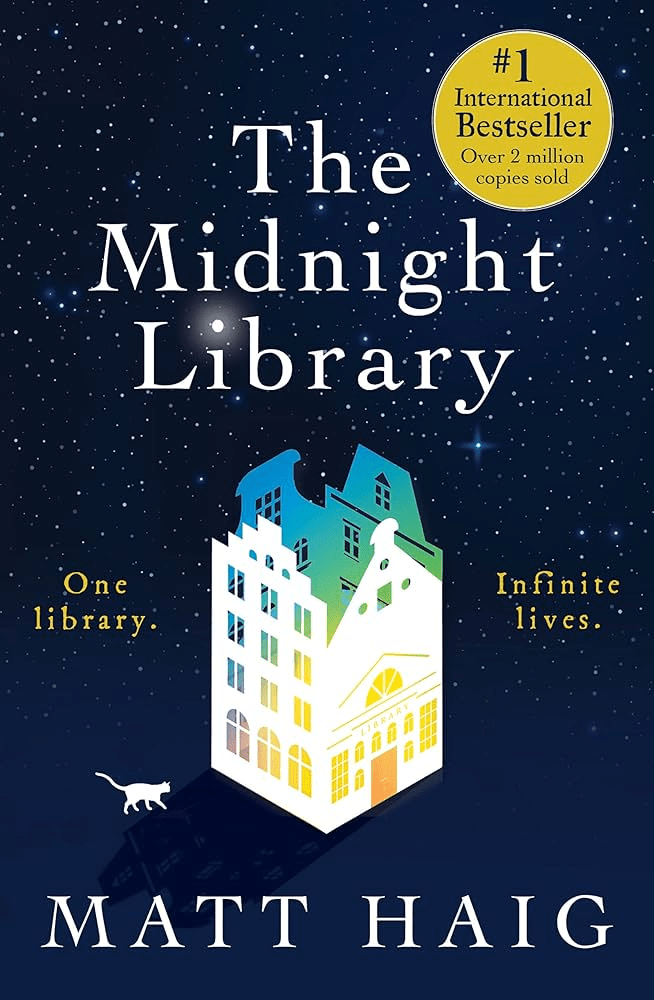
Anyone contemplating suicide must feel that life is not worth living. Haig’s mission in this novel is to persuade them otherwise. He attempts this through the story of his central character, Nora Seed (I assume the surname Seed was chosen because seeds are full of potential life). But when we first meet her, Nora feels anything but. Her cat is dead, she is alienated from her family, she has lost her job. She has recently separated from her fiancé, having changed her mind at the last minute about marriage. Her life, once full of promise and possibility, seems empty. Late one evening, she tries to kill herself.
Nora wakes up to finds herself in a library. Each book on the infinite shelves tells the story of an alternative version of her life. The core of the novel sees Nora briefly living these multiple lives. In each she is given the opportunity to change one decision she regrets making, and see how it would have affected her life. In one she becomes a rock star, having decided not to leave her brother’s band; in another she wins Olympic medals having kept up her promising swimming career; in yet another she on an Arctic research vessel studying global warming and has a close encounter with a hungry polar bear. Each version of her life is better – more interesting, more fulfilled – than what she refers to as her ‘root’ life, but every one is also in some way unsatisfactory, so she keeps doom-scrolling through endless ‘what-ifs’ searching for a version of her life in which she has not taken a wrong turn, and is happy.
If I were suicidal, being told that the choices I made in life had prevented me from becoming an Olympic athlete, a rock star, or an artic explorer might not convince me that I had nothing to regret, even if in each of these alternative lives there were also things that were not perfect. A common cause of dissatisfaction with Nora’s new lives is that in each a family member or close friend has died – her brother from an overdose, her mother from cancer, a friend in a road traffic collision, and so on. None of these deaths were a result of her choices, so seeking a life in which she took a different route and kept everyone alive seems a futile search.
The novel’s conclusion – that life is worth living, and regret at the choices we make is foolish – comes as hardly a surprise. Is this life affirming? it’s unquestionably intended as such, and literature as therapy is undoubtedly worthwhile. The popularity of this novel suggests that people find it helpful, so any dissent from me would probably be churlish. One yardstick (see what I did there?) of a novel’s success I often find useful is to ask whether you want to spend more time with the characters, to find out how their lives span out. Who would turn down the chance to read more about Elizabeth Bennet or Mr Pickwick? Sadly I can’t say the same of Nora Seed. I am glad her story ended on a positive note – but it could hardly have ended any other way in the circumstances!
 The Reading Bug